Table of contents
- Why AI Lead Generation Strategies for Nigerian Businesses Are No Longer Optional
- How AI Lead Generation Strategies for Nigerian Businesses Close the Gap Between Effort and Results
- The Real Cost of Ignoring AI Powered Lead Generation in Nigeria as Competition Scales Digitally
- 5 Strategic Ways to Use AI for Lead Generation in Nigeria
- Best AI Lead Generation Software in Nigeria for Small Teams With Limited Budgets
- How Automated Lead Generation Platforms in Nigeria Stack Up & What to Look For Before Subscribing
- Final Thought
- FAQs
The average Lagos SME chasing leads through cold DMs at midnight, or the Abuja startup sales team making 80 calls a day with maybe 3 meaningful conversations to show for it is the old way of doing things which is bleeding businesses dry.
The benefit of knowing how to use AI for lead generation in Nigeria has become less of a “nice to have” and more of a survival skill in 2026. The 5 strategic ways to use AI for lead generation and building your social media presence in Nigeria covered in this article are not theory. They are practical, proven, and most importantly, accessible knowledge, even for startups working with a lean budget.
Whether you are selling software in Victoria Island or running a real estate agency in Port Harcourt, this guide will show you how smart AI lead generation tactics can change your entire business.

Why AI Lead Generation Strategies for Nigerian Businesses Are No Longer Optional
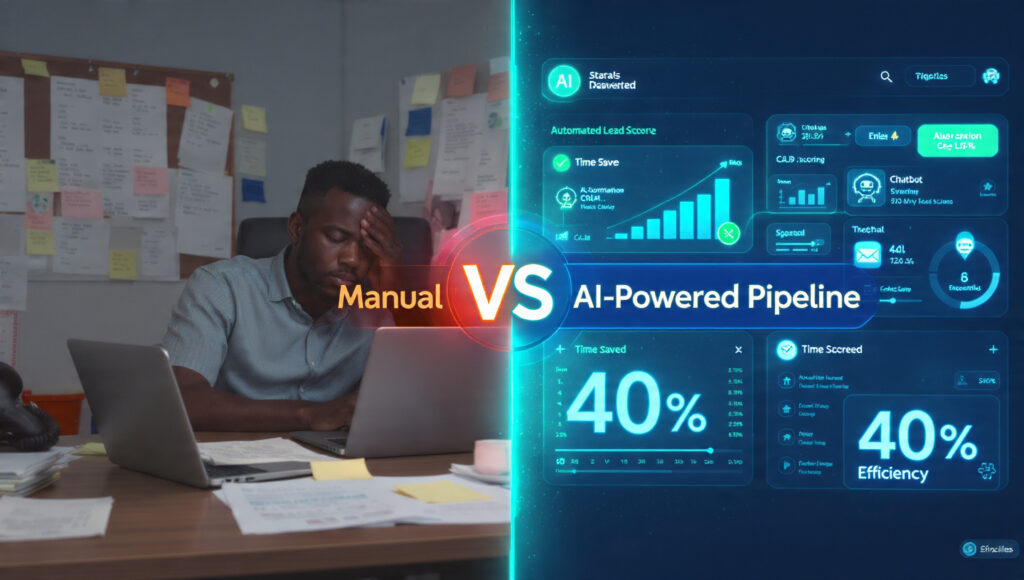
Let’s be honest about something nobody wants to say out loud, a lot of Nigerian businesses are still running their lead generation like it is 2015. Cold calling lists that cost a fortune and go nowhere. Email blasts with 8% open rates (on a good day), Sales reps spending hours manually researching contacts on LinkedIn, only to find the person changed roles six months ago which is exhausting and in 2026, it is inexcusable.
Cold calling fatigue is real. Research by Cognism found that 69% of buyers have accepted a cold call, but less than 2% of those calls ever convert to meetings. For Nigerian businesses where airtime and human hours cost actual money, that maths does not add up.
Email marketing is not much better in its traditional form and when campaigns are not personalized or timed properly, they become noise. Average B2B email open rates in Nigeria hover around 15–18%, and that is before you account for spam filters and cluttered inboxes.
What about Manual prospect research?
That’s the real time vampire. A sales rep spending 3 hours building a contact list from scratch, cross-referencing LinkedIn, creating lead engagement on Instagram, and company websites, is a sales rep not selling. Meanwhile, the competition has already automated that entire process.
As sales strategist Aaron Ross, author of Predictable Revenue, once said: “You can’t build a $100M company on cold calling alone.” And in today’s Nigerian digital economy, that statement rings truer than ever.
How AI Lead Generation Strategies for Nigerian Businesses Close the Gap Between Effort and Results
Here is what makes AI powered lead generation in Nigeria different: AI does not get tired, does not miss patterns, and does not waste time on leads that will never convert. What happens is, it learns, adapts and gets better with the more data it processes.
When AI handles the top of your sales funnel, prospecting, scoring, and initial outreach, then your human sales team can do what they actually do best: build relationships and close deals. Which is not replacing people but deploying them smarter.
Think of it this way: you don’t use a calculator to make you less smart. You use it so your brain handles what a calculator cannot and AI is the calculator for your pipeline.
AI powered customer acquisition tools in Nigeria are now helping teams qualify 3–5x more leads in the same timeframe, flag the warmest prospects automatically, and trigger personalized follow-ups without lifting a finger. The gap between effort and results starts closing from day one.
The Real Cost of Ignoring AI Powered Lead Generation in Nigeria as Competition Scales Digitally
While you are debating whether AI is worth it, your competitors are using it. Nigerian fintech brands, e-commerce shops, real estate platforms, and digital agencies have been quietly integrating AI lead tools since 2023. The ones who moved early are now running circles around teams still relying on spreadsheets.
The cost of staying manual isn’t just lost time but loss in revenue, market share, and loss in competitive positioning. A Nigerian e-commerce brand that automates its lead qualification process can engage 200 prospects in the time it takes a manual team to follow up with 20.
Still posting consistently and wondering why engagement, or leads aren’t coming? That problem goes deeper than content.
Check out our piece on why posting consistently but still getting low engagement might be a visibility and strategy issue, not based on effort only.
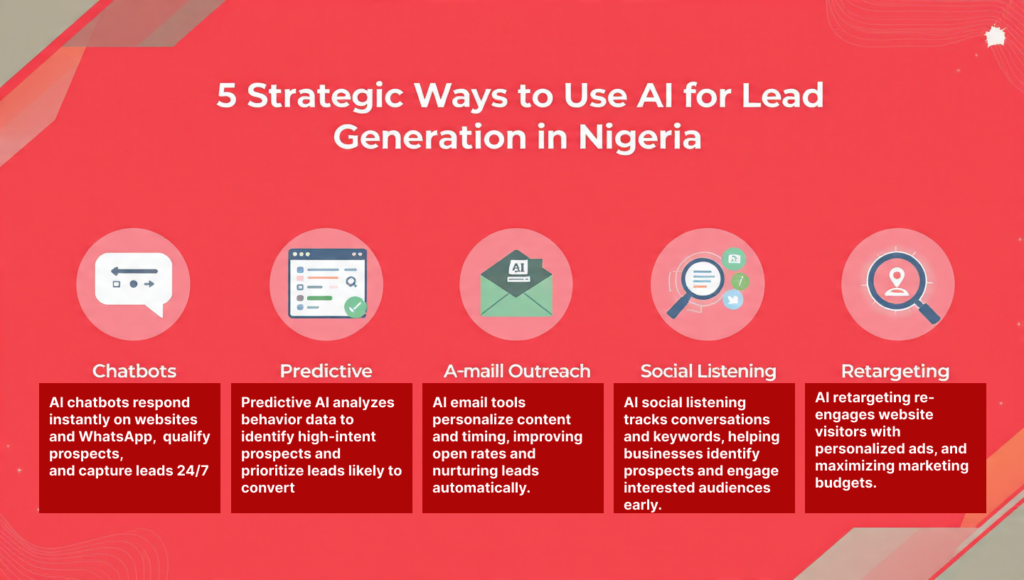
5 Strategic Ways to Use AI for Lead Generation in Nigeria
Alright, enough talk, let’s get into the actual strategies that matter. These are not generic tips you’ll find on some American marketing blog. These five methods are grounded in how Nigerian buyers behave, where they spend time online, and what actually moves them from being curious to saying YES.
Strategy 1: AI-Powered Chatbots That Capture and Qualify Leads 24/7
AI chatbots are the best sales reps most Nigerian businesses don’t know they have. They work at 2am on Sunday when your team is unavailable, they never forget to follow up, and they don’t have bad days.
A well-configured chatbot doesn’t just greet visitors, but qualifies them. It asks what they need, captures contact details, segments by interest, and routes hot leads directly to your sales team.
Tools like Tidio, ManyChat, and Intercom all have AI-powered conversation flows you can set up without a developer. But here’s what most people miss: for Nigerian businesses, WhatsApp is where the real action is. With over 93 million WhatsApp users in Nigeria as of 2024, deploying your chatbot there, not just on your website, puts you directly inside the app your prospects already live in daily. Your website gets traffic occasionally and whatsApp gets attention constantly.
Tactics: Create separate chatbot flows for cold traffic versus warm traffic. A visitor arriving from a paid ad needs a completely different conversation than someone who clicked a link from your email list. One is discovering you for the first time while the other already knows you. Treating both identically kills conversion before it even begins, and most brands never realize this is happening.
Use your chatbot’s conversation drop-off data religiously.
What I mean is:
Every point where users stop responding is telling you exactly where your qualification process is losing people. Most businesses collect this data and never open it. While the ones who analyze it consistently improve lead quality within weeks, not months. This is one of the fastest and most underused optimization loops in digital marketing.
Pro tip: Asking three qualifying questions before capturing contact info is the sweet spot. More than three and people disconnect and fewer than three, shows your leads aren’t warm enough to be useful to your sales team.
Strategy 2: Predictive Lead Scoring that Stop Treating Every Lead the Same
Not all leads are equal and predictive lead scoring is how AI stops your sales team from wasting hours on people who were never ready to buy in the first place.
Instead of calling every lead in the order they arrived, AI analyzes behavioral signals, pages visited, time on site, email opens, social engagement, content downloads, and assigns a score that reflects actual purchase intent. Your Lagos sales rep stops chasing the person who filled a contact form three weeks ago and forgot about it while they start calling the person who visited your pricing page four times this week and opened every email you sent.
At the end of it all that person converts and the other one wastes an afternoon and dents team morale.
Tools: HubSpot, Zoho CRM, and Pipedrive all have AI lead scoring built in at various price points. Zoho in particular offers competitive pricing that works for Nigerian SMEs operating without enterprise budgets.
Tactics: Layer your lead score with recency weighting. A lead who scored 80 points six weeks ago is significantly less valuable than one who scored 60 points yesterday. Most default scoring models don’t account for this time decay, but configure yours to reduce scores over time automatically so your hottest leads are always the most recent ones actively showing intent, not the highest historical scorers sitting cold and forgotten in your CRM pipeline.
Track scroll depth on your pricing and service pages specifically every day. A prospect who scrolls 80% down your pricing page but doesn’t convert is showing strong purchase intent with one specific blocker which is usually price, trust, or timing.
This single behavioral signal should trigger a targeted follow-up sequence addressing that objection directly, not a generic nurture email that treats them like someone still in the awareness stage. The data is already available in most analytics tools. Very few brands use it precisely.
Strategy 3: Personalized Cold Email Outreach at Scale
Cold email is not dead but bad cold email is dead.
There is a significant difference between the two, and understanding that difference is where the real money exists.
AI tools like Instantly.ai, Apollo.io, and Lemlist write personalized outreach emails at scale by pulling in the prospect’s name, company, recent LinkedIn activity, or relevant news about their business and inserting it naturally into each message. The result feels hand-crafted, because in a meaningful sense it was, just not by a human sitting at a desk.
For Nigerian startups and growing SMEs, this is where AI creates a genuinely outsized advantage. You don’t need a 10-person sales team to send 500 personalized outreach emails every week. All you need is a clean, well-segmented prospect list, a compelling and specific offer, and the right tool configured correctly.
Tactic: Segment your outreach list by buying stage signals before sending anything at all. A prospect who recently posted on LinkedIn about a problem your product solves deserves a fundamentally different email from one who simply fits your ideal customer profile but has shown zero active intent signals.
Apollo.io lets you filter prospects by recent activity and engagement. Sending the same message to both groups is one of the most common and costly cold email mistakes Nigerian brands make.
The highest-performing subject lines in Nigerian B2B outreach reference something specific and locally grounded which signifies a recent industry development, a Lagos or Abuja business context, or a pain point tied directly to the current economic climate. Generic subject lines get scrolled past while specific, contextually relevant ones get opened.
AI handles the body of your email brilliantly at scale. The subject line still rewards human judgment from someone who genuinely understands the local territory and what your audience is quietly worried about right now.
Pro tip: Always review a sample of AI-generated emails before sending the full sequence. AI doesn’t always catch local tone, cultural register, or the subtle nuances that make communication feel warm rather than transactional. Adding that Nigerian familiarity, the right level of directness, the appropriate warmth for your audience type, is often the difference between an email that feels like a cold pitch and one that feels like a message from someone who actually understands their world and respects their time.
Strategy 4: Target Leads in Nigeria Through Social Media Listening and Audience Targeting
This one is underused and wildly effective. AI-powered social listening tools scan platforms like LinkedIn, Instagram, Twitter/X, and even Facebook Groups for signals that someone is in a buying mindset.
Keywords like “looking for,” “recommend,” “anyone know a good…” are all buyer intent signals hiding in plain sight.
Someone posted in a Lagos entrepreneur Facebook group asking “does anyone know a reliable logistics company for e-commerce?” – that is a warm lead announcing themselves publicly.
Without social listening, you’d never know, but with AI, you can be in that conversation within minutes.
This ties directly into what we discussed about visibility and growth strategy. The platforms where Nigerian buyers are already talking are the same platforms where smart brands should be listening.
As covered in our post on the ways to grow on social media with ease, it is not about posting more, but about showing up in the right conversations.
Strategy 5: AI Powered Lead Generation in Nigeria Through Automated Content Recommendations and Retargeting
Not every website visitor is ready to buy, but that doesn’t mean they should disappear forever. AI-powered retargeting tracks visitor behavior on your site and serves them the most relevant content or ad based on what they showed interest in.
Let me show you how it works…
Imagine someone visited your real estate listing page but didn’t inquire? AI retargeting serves them a case study or virtual tour ad on Instagram within 24 hours, or Did someone read your fintech blog post? They get a targeted LinkedIn ad about your payment solution. All this isn’t magic but just machine learning and doing the heavy lifting by staying top-of-mind.
Tools like Google’s Performance Max campaigns and Meta’s Advantage+ use AI at the core of their targeting. For Nigerian businesses running digital ads, letting AI optimize audience targeting rather than manually picking demographics almost always outperforms manual configuration.
As e dey hot…
When combined these five strategies can create a lead generation system that works while you sleep, scale without hiring, and improve the more data it collects. That is the compounding power of using artificial intelligence for leads in Nigeria.
Now for the part you’ve been waiting for.
But before rattling off a list, here is something worth saying: the best tool is the one you’ll actually use consistently. A fancy platform you abandon in week three is worse than a simple one you master completely.
With that said, let’s break this down by category, because different strategies need different tools.
Best AI Lead Generation Software in Nigeria for Small Teams With Limited Budgets
Budget is always a real wahala and troublemaker for people in Nigeria, and dollar-denominated software costs in naira is not a small thing… biko, so let’s start with tools that won’t break the bank.
A Nigerian-built social growth and marketing automation platform designed for affordability and local relevance. It helps small teams generate leads through targeted engagement services, geolocation-based campaigns, and real-time analytics tracking.
2. Tidio (Free plan available, paid from ~$19/month)
An excellent AI chatbot for websites and WhatsApp integration. It’s a great starting point for capturing and qualifying leads automatically.
3. Zoho CRM (Free for up to 3 users)
One of the most accessible CRMs for Nigerian SMEs. It Includes basic AI lead scoring and email automation. Zoho also supports Paystack integration for Nigerian billing.
4. Mailchimp (Free up to 500 contacts)
Is an OG but still faithful email software that now includes AI-powered send-time optimization and basic segmentation. Great for email lead nurturing on a tight budget.
The honest reality is: most Nigerian startups can run an effective AI lead generation system for under $50/month using a combination of free tiers and entry-level plans. The goal is to start small, prove the model, then scale up tools as revenue grows.
How Automated Lead Generation Platforms in Nigeria Stack Up & What to Look For Before Subscribing
Before subscribing to any AI lead generation platform, Nigerian business owners should run through a quick checklist. Not all tools are built with African markets in mind, and some go make you see shege by force before you abandon them.
- Naira-friendly pricing or Paystack support: Does the tool accept Nigerian payment methods or at least accepts card payments that work on Nigerian Visa/Mastercard? Dollar billing failures are a known pain point, so try to pay attention to that.
- Data privacy compliance: Especially important for Nigerian fintech, health, and legal businesses. Confirm the platform is GDPR-aligned and, where applicable, ensure it aligns with Nigeria’s NDPR (Nigeria Data Protection Regulation).
- Integration with tools you already use: If you’re already on WhatsApp Business API or using a particular CRM, confirm the AI tool integrates before paying. Switching costs are real and brutal… so you don’t say dem no tell me na why!
- Ease of onboarding without a tech team: Most Nigerian SMEs don’t have a full-time developer. Any affordable AI lead tool for Nigerian startups worth considering should have solid documentation and ideally a no-code setup flow.
Red flags to watch for: tools with no Africa-region data, pricing that escalates steeply past 500 contacts, and platforms with zero live support options. It matters because, when something breaks on a campaign launch day, you need someone to talk to.
The visibility and consistency principles that drive social media growth apply just as much to lead generation. Just as great content needs distribution to reach people, as explored in our post on the myth that good content finds itself, great lead generation tools also need the right strategy behind them to deliver results.
Final Thought
The 5 strategic ways to use AI for lead generation in Nigeria are not futuristic concepts, but instead they are available, and affordable, systems working right now for Nigerian businesses that chose to move early.
AI powered chatbots capture leads at 2 AM while predictive scoring ensures your best reps call your best prospects. Personalized email outreach scales without scaling your team, social listening catches buyers mid-conversation and retargeting keeps your brand visible until the sale happens.
None of these strategies require a massive tech budget or a developer on speed dial. What they require is a willingness to stop doing things the hard way, and above all have little patience while the systems learn and improve.
As always, tools are only as good as the strategy behind them. Combine these AI lead generation strategies for Nigerian businesses with a clear offer, a strong content presence, and the kind of consistent visibility that platforms like Sizzle Social help you build, and your pipeline will never look the same.
The businesses winning in Nigeria’s digital economy are not necessarily the biggest ones, but the most efficient ones. And AI is the great equalizer.
FAQs
AI lead generation uses artificial intelligence tools to automate the process of identifying, attracting, and qualifying potential customers. For Nigerian businesses, this means tools that scrape prospect data, score leads by purchase intent, send personalized outreach, and trigger follow-ups automatically — all without manual effort for each step.
Not necessarily. Several AI lead generation tools offer free tiers or plans starting from $15–$49/month. Tools like Tidio, Zoho CRM, and ManyChat have free or low-cost entry points suitable for Nigerian startups. The key is starting with one or two tools and scaling as revenue grows.
ManyChat is currently the most capable tool for WhatsApp-based lead generation in Nigeria. It supports automated conversation flows, lead capture, and follow-up sequences through the WhatsApp Business API — which is ideal given Nigeria’s heavy WhatsApp usage.
No, and it shouldn’t. AI handles the repetitive, high-volume parts of lead generation: prospecting, scoring, initial outreach. Your sales team then focuses on relationship-building and closing. AI and human sales reps work best together, not as substitutes.
Predictive lead scoring assigns a numerical value to each lead based on behavioral signals — pages visited, email opens, content downloaded, LinkedIn activity. AI analyzes these signals and ranks prospects by purchase likelihood, so your team calls the warmest leads first instead of working blindly through a list.
Most international tools bill in USD, but many accept Naira-denominated cards (Mastercard or Visa issued by Nigerian banks). Zoho and some others have African billing support. Always test payment acceptance before committing to a platform.
Most businesses start seeing meaningful data within 30–60 days of consistent use. Lead scoring improvements and chatbot conversions can show results faster — sometimes within the first two weeks. AI tools improve over time as they gather more data about your specific audience.
Absolutely. Nigerian buyers are highly active on Twitter/X, LinkedIn, Facebook Groups, and Instagram, frequently posting about problems they need solved. AI social listening tools like Brand24 surface these conversations in real time, turning public posts into qualified leads for your sales team.
Fintech, real estate, logistics, digital marketing agencies, e-commerce, legal services, and SaaS businesses in Nigeria see the strongest results from AI lead generation. Any industry with a defined target buyer and a repeatable sales process is a strong candidate for AI automation.
They are two sides of the same coin. AI lead generation captures and qualifies buyers already aware of your brand — while social media growth tools like Sizzle Social expand the top of your funnel by increasing visibility and engagement. More people seeing your content means more people entering your AI-powered lead pipeline. Growth works best when both move together.