
Table of contents
- What Actually Determines Website Design Cost in Nigeria?
- The Type of Website You Need Shapes the Price of Website Design in Nigeria
- Who You Hire Changes Your Average Web Development Cost in Nigeria Dramatically
- What’s Included In Your Nigeria Web Design Quote ?
- How Much Does It Cost to Build a Business Website in Nigeria?
- E-commerce Website Development Cost in Nigeria
- Why Low-Cost Web Design in Nigeria Costs More in the Long Run?
- What Affordable Professional Website Design in Nigeria Should Actually Deliver
- How to Get the Best Website Design Value in Nigeria (Without Getting Burned)
- Questions to Ask a Web Designer or Agency Before Signing
- Make Your Digital Presence Count with the Right Design
- FAQs
There’s a story about the website design cost in Nigeria that makes designers cringe every single time they hear it… And here’s a quick backstory of it. A fashion boutique owner in Lekki handed over ₦40,000 to a “website guy” she found through a friend’s WhatsApp status. He promised her the world: a professional site, fast delivery, and everything in between.
Two weeks later, she got a link.
The homepage loaded halfway. The font looked like it was designed in 2009 and the contact form? Completely broken. And when she typed her business name into Google six months later, the site wasn’t found on Google.
Meanwhile, her competitor down the road with the same products and the same prices had invested properly knowing the website design cost in Nigeria, which made her budgeted correctly, hired a competent team, and was already ranking for the keywords their shared customers were searching every day.
This is not a rare story, it happened on Tuesday in Nigeria’s digital market.
The truth is:
The price of website design in Nigeria and the value of website design in Nigeria are two completely different conversations. And if you walk into one without understanding the other, you will almost certainly pay for a website twice.
So, if you’ve been asking yourself how much does it cost to build a business website in Nigeria and getting wildly different answers from every designer you contact. That confusion is a sign you’re taking the decision seriously.
And this guide is going to resolve it. We’re covering real price ranges, the variables that move those numbers up and down, the difference between cheap and affordable, and exactly how to hire someone without getting burned.
Let’s get into it.
What Actually Determines Website Design Cost in Nigeria?
Here’s why two designers can quote you ₦80,000 and ₦800,000 for what sounds like “the same website.”
The answer isn’t that one of them is lying, though that does happen too. The real answer is that Nigeria web design rates are shaped by a combination of factors that most business owners never think to ask about.
Understanding these factors before you request a single quote is the single best thing you can do to protect your budget.
And here is the list of them.
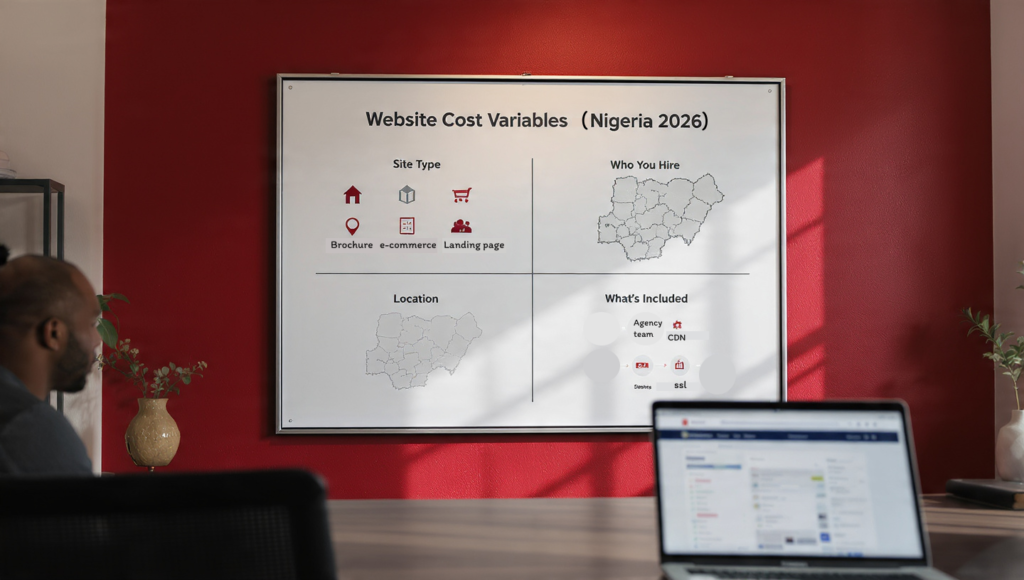
The Type of Website You Need Shapes the Price of Website Design in Nigeria
Not every website is built the same way, and they should not cost the same. The type of site you need is the first and most important variable that determines what you’ll pay.
1. Simple Brochure or Portfolio Websites
This is the entry-level category, and it is the right starting point for consultants, coaches, therapists, photographers, lawyers, and local service businesses who simply need a credible online home.
A brochure site typically runs five to seven pages, a homepage, an about page, a services page, a contact page, and maybe a blog or testimonials section.
It’s not complicated. But “not complicated” does not mean “should be built by whoever is cheapest.” Even a five-page site needs mobile responsiveness, SSL security, proper heading structure, a working contact form, and basic on-page SEO.
Without those foundations, you have a website that exists but does not perform. And a website that doesn’t perform is just an expensive business card nobody can find.
2. Small Business and Corporate Websites
When your business starts needing more than a brochure, think lead capture forms, multiple service categories, a blog with regular content, a team page, integration with a CRM or booking system, then you’ve moved into small business website territory.
This is also where most growing Nigerian businesses sit, and it’s where the average web development cost in Nigeria starts to reflect real work rather than template installations.
Corporate websites for established companies go further still: multi-department architecture, staff directories, investor pages, custom back-end functionality, and enterprise-grade performance. These are not weekend projects. They require strategy, development, and testing which reflects the pricing accordingly.
3. E-Commerce and Online Stores
If you are selling products online, you are building an entirely different kind of machine. An e-commerce site isn’t just a catalogue but a payment processor, an inventory manager, a customer account system, and a marketing engine all built into one.
The complexity is real, the integration work is significant, and the stakes are high because any downtime or broken checkout directly costs you money.
Paystack and Flutterwave integration, product variants, shipping zone configurations, SSL, customer accounts, and discount codes each adds development time and cost. This is the highest-cost website category, but for good reason.
Who You Hire Changes Your Average Web Development Cost in Nigeria Dramatically
The same website built by two different people can cost five times as much or five times as little.
What makes the difference is the person holding the keyboard that matters enormously.
And more importantly, the system behind that person.
When businesses want performance, structure, and measurable ROI and not just “a website”, they choose experienced teams with proven frameworks.
That’s where Sizzle Digital stands out by combining design, development, SEO structure, and conversion strategy into one coordinated process built for Nigerian brands in 2026.
1. Web Design Agencies vs. Freelancers
Agencies bring a full team such as the designer to handle visuals, a developer to handle code, a strategist to handle structure and SEO, and usually a project manager to keep everything on schedule.
That depth of skill comes with higher fees, more structured processes, and generally more accountability when things go wrong.
While freelancers offer flexibility and lower costs, many of Nigeria’s best web professionals operate independently, but the quality range is enormous.
A senior freelancer with eight years of experience and a solid portfolio is fundamentally a different product from someone who finished a Udemy course last month. Always evaluate the person, and not just the price.
2. Lagos vs. Abuja vs. Other States
This might surprise you, but geography genuinely affects Nigeria web design rates. Designers based in Lagos and Abuja typically charge more, and not because they’re more talented by default, but because their cost of living, client base, and market expectations are different.
A designer in Ibadan or Enugu might deliver equally excellent work at a lower rate and remote work has made location less limiting than ever, so don’t restrict your search to your own city.
3. Experience Level and Portfolio Depth
A web designer with five verified, live client websites that are loading fast, ranking on Google, and generating business for their owners is worth more than a designer with a beautiful Behance profile full of concepts that were never launched.
Experience is demonstrated by results, not by years or certifications alone. When evaluating freelance web designer rates in Nigeria, always anchor the conversation around live work, not promises.
What’s Included In Your Nigeria Web Design Quote?
This is where budgets get ambushed.
What I mean is:
You might receive a quote, agree to it, and then discover three months in, that several critical components were never included.
Let me explain what to watch out for.
1. Domain Name and Hosting Fees
Your domain name is your web address which is the thing people type to find you. Hosting is the server where your site actually lives. These are separate costs from web design, and they recur annually.
Depending on your provider and hosting plan, expect to budget between ₦15,000 and ₦80,000 per year for these, sometimes more for high-traffic or e-commerce sites that need more robust infrastructure.
Always ask your designer whether domain and hosting are included in their quote, and for how long.
2. SSL Certificate and Security Setup
SSL is the technology that puts the padlock icon in your browser bar and changes your web address from HTTP to HTTPS. Without it, browsers display a “Not Secure” warning to every visitor who lands on your site.
In 2026, that warning is a customer exit sign. Nigerian customers, especially for e-commerce will not enter their card details on a site flagged as insecure. SSL should be non-negotiable in any website quote, and any designer who treats it as optional is waving a yellow flag at you.
3. Post-Launch Maintenance and Support
Your website is not a static document and neither is it a plugin update. WordPress versions change, hosting servers require management, contact forms occasionally break and security vulnerabilities emerge.
Who handles all of this after your site goes live, and what does that cost? Most Nigerian businesses discover the answer to this question too late, after something breaks and they have no one to call.
4. Content, Copywriting, and Photography
A website is only as good as the content inside it. Words, images, and videos are what actually communicate your value to visitors, and they do not appear by magic. Many web design quotes cover structure and development only, with content assumed to be provided by the client.
If you need copywriting, product photography, or custom graphics, establish upfront whether those are included or billed separately. Surprises on this front are extremely common, and extremely frustrating.
Alright, this is the part you came for.
The part where the real numbers, and real expectations with no vague ranges are revealed accurately.
So, before we get into the figures, here’s a truth worth anchoring everything that follows: price and value are not the same thing.
A ₦60,000 website that generates zero traffic and converts zero customers is not cheap, but expensive while a ₦500,000 website that ranks on Google page one and generates ₦3 million in leads monthly is a sure bargain.
You can see it as an investment and not unnecessary expense
With that said, let’s look at…
How Much Does It Cost to Build a Business Website in Nigeria?
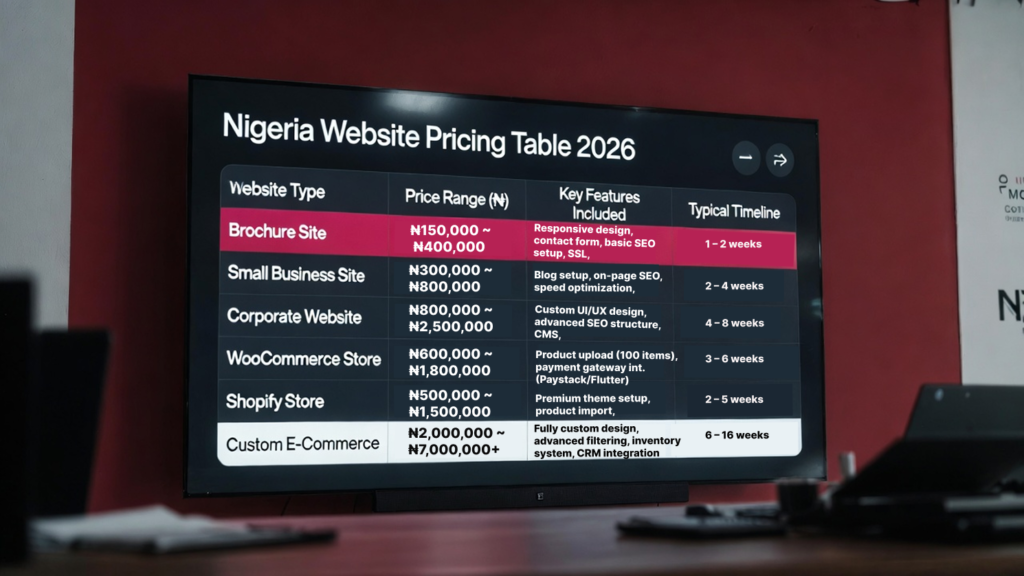
Brochure/Informational Website: ₦150,000 to ₦350,000
This price range is the right fit for service professionals, consultants, coaches, and local businesses that need a credible online presence without complex functionality.
At this investment level, you should expect mobile responsiveness, SSL security, basic on-page SEO setup, a functional contact form, and Google Maps integration.
What you should not expect at this price point is a site that will outrank established competitors on its own, complex animations, custom back-end features, or ongoing SEO management.
This is basically your professional foundation.
Small Business and Startup Website: ₦250,000 to ₦600,000
This is the range where most growing Nigerian businesses live, and where the small business website pricing in Nigeria starts to reflect strategic thinking rather than just aesthetics.
At this level, your site should include blog functionality for content marketing, a lead capture system connected to an email tool, multiple service or product pages with individual SEO targeting, and basic analytics integration through Google Analytics or Search Console.
With the range amount, you can reasonably expect a designer to have a conversation with you about your business goals and not just your page count.
If someone is quoting in this range but hasn’t asked what you actually want the website to accomplish, that’s worth pausing over.
Corporate Website Design in Nigeria: ₦800,000 to ₦2,500,000+
For large brands, institutions, government agencies, and companies with multi-department needs, corporate website development fees in Nigeria sit in this range and sometimes go well beyond it.
Multi-department page architecture, custom back-end systems, staff directories, investor portals, multilingual support, and enterprise-level SEO infrastructure are all features of this category.
This is not a price range for startups. But if your business genuinely operates at this scale, cutting corners here is a false move and a poorly built corporate site signals disorganization and undermines trust at exactly the level where trust matters most.
The ₦50,000 to ₦100,000 Website: What You’re Actually Paying For
Let’s be honest about this. Many Nigerian designers will take ₦50,000 to ₦100,000 for a “website” and what you’ll almost certainly receive in return is a pre-built WordPress theme with your logo dropped in, your phone number updated, and your services listed in the default template sections.
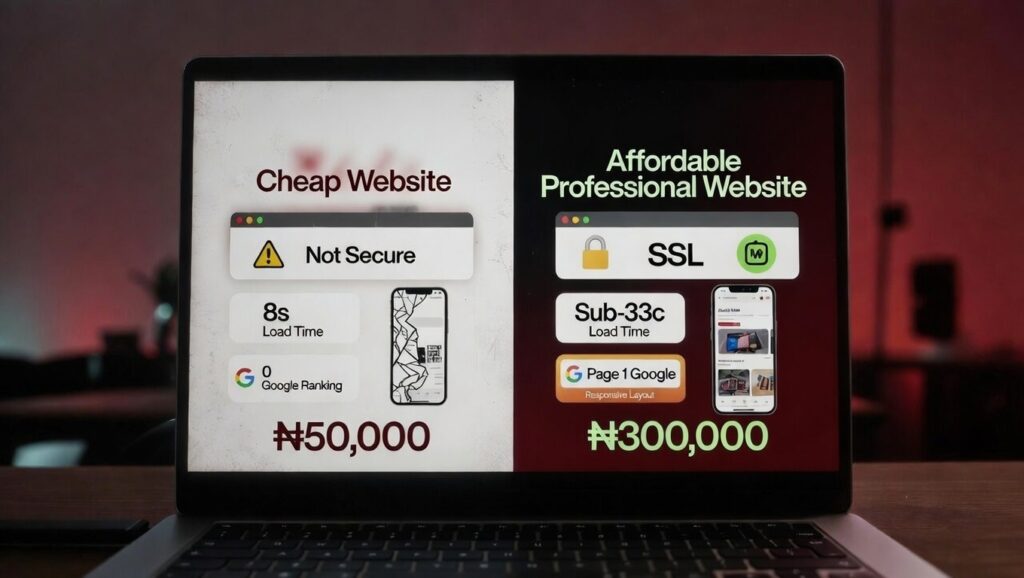
It will not be mobile-optimized for Nigerian network conditions, no proper SEO structure, and it will not load in under three seconds. And within six to twelve months, you will almost certainly be starting over, spending full price again to get what you should have built the first time.
The cost of a business website in Nigeria isn’t just what you pay upfront. It’s what you pay in lost customers, lost rankings, and rebuild costs over the following year. That ₦50,000 “bargain” has a habit of costing ₦700,000 by the time everything is accounted for.
Which is why building your website professionally from scratch is the best way and Sizzle Digital is the best platform to get your website designed for optimal conversion and search rankings on google.
E-commerce Website Development Cost in Nigeria
Building an online store is a different undertaking from building a brochure site, and the ecommerce website development cost in Nigeria reflects that.
You are not just creating pages, but you are building a system that processes payments, manages inventory, handles customer accounts, and stays secure through every transaction.
Let’s break down what the online store website price in Nigeria looks like by platform.
1. Basic WooCommerce Store: ₦350,000 to ₦700,000
WooCommerce, which runs on WordPress, is the most widely used e-commerce platform for Nigerian businesses, and for good reason, because it’s flexible, customizable, and works well with Paystack for local payment processing.
A basic WooCommerce build at this price range handles product catalogues of up to roughly 50 SKUs, includes Paystack integration, shipping zone configurations, inventory management, SSL, and a functional checkout process.
This is solid ground for a fashion brand, a food business, a beauty retailer, or any SME moving products online. The WooCommerce development fees in Nigeria at this level assume your product range is manageable and your customization needs are moderate.
2. Shopify Website Cost in Nigeria: ₦400,000 to ₦1,000,000+
Shopify has gained significant ground among Nigerian e-commerce businesses in recent years, particularly for brands that want a polished storefront without managing WordPress hosting complexity.
But the Shopify website cost in Nigeria comes with a dimension that WooCommerce doesn’t, which is an ongoing monthly subscription to Shopify itself, ranging from roughly $29 to $299 USD per month depending on your plan, in addition to transaction fees on every sale.
Your setup cost covers design customization, app integrations, product uploads, Paystack configuration (through a third-party gateway app), and launch testing. But the total cost of ownership over twelve months is significantly higher than the setup fee alone.
You have to calculate both before you decide on the right e-commerce platform for your Nigerian business.
3. Custom-Built E-Commerce Platform: ₦1,000,000 and Above
If your business is a high-volume marketplace, a multi-vendor platform, or needs custom product logic that off-the-shelf platforms simply cannot handle, a custom-built e-commerce system is the answer.
This is what you build when you are the next Jumia or when your product configuration requirements are so specific that no existing theme or plugin can accommodate them.
The investment here is substantial, but so is the competitive advantage of owning a system built precisely for how your business operates: one that no competitor using the same Shopify template can replicate.
Why Low-Cost Web Design in Nigeria Costs More in the Long Run?
I have to say this plainly, without sugarcoating it because too many Nigerian businesses have learned this lesson the hard way, and the price is expensive.
Cheap and affordable are not synonyms. They are opposites dressed in similar clothing.
Make I explain this wella, because the math matters more than most people realize.
1. Emergency Fix Costs After Launch
When a cheap website breaks, and it will, you need someone to fix it. That person is rarely the original developer, who has either disappeared or is unavailable. So you hire a second designer to diagnose and repair work they didn’t build.
Emergency fixes on poorly built Nigerian sites regularly cost between ₦30,000 and ₦150,000 depending on the severity and they happen.
Things like broken contact forms, hacked databases, SSL certificates that expire and take the site offline, and mobile layouts that collapse after a WordPress update are all billed from the “cheap” decision you make.
2. Revenue Lost While the Site Underperforms
This is the cost that doesn’t appear on any invoice, but it is the most expensive one.
A site loading in eight seconds on a Nigerian 3G connection is losing potential customers at a rate that would make any business owner weep if they saw the actual numbers. Every day that site is live while slowly loading, unranked, without a clear CTA, is a day it is costing you business.
Multiply that over twelve months, and the cost of your ₦50,000 website becomes something that cannot be justified by any measure.
3. The “Rebuild Everything” Problem
There will come a point when a cheap website fixing costs is more than starting over.
You begin to face problems like, the code is too tangled, template is too locked down, the hosting is too slow to be worth migrating. And the worst part is:
The SEO damage is too deep to recover from without a clean slate. At that point, you are paying full price again for a site you should have built properly the first time.
The cycle of build cheap, break, patch, rebuild, is a pattern that repeats across the Nigerian market with painful regularity. Knowing when to quit the patch-work and invest in a professional overhaul is how you fix website failures that are hurting your business. The budget for your company website in Nigeria should account for total cost of ownership, not just the day-one invoice.
What Affordable Professional Website Design in Nigeria Should Actually Deliver
Affordable is not the same as cheap. Affordable means you receive genuine, professional value at a price that makes sense for your business stage.
Here’s what that value should include, regardless of where you sit in the price range.
1. Mobile-First Design Built for Nigerian Network Conditions
Nigeria’s internet reality is specific and over 85% of users browse on mobile. Network speeds vary significantly between 4G in Abuja and patchy 3G in secondary cities. Any designer who builds your site desktop-first and then squeezes it into mobile as an afterthought is not building for your actual market.
An affordable professional web design in Nigeria should deliver optimized images, compressed assets, lazy-loading where appropriate, and a mobile experience that loads cleanly on a mid-range Android on a 3G connection.
2. SEO Foundation That Gives Google a Reason to Rank You
An SEO-friendly website design in Nigeria is not about installing a plugin and calling it done. It’s about how the site is built from the ground up: clean URL structures, proper H1/H2/H3 heading hierarchy, sitemap.xml and robots.txt configured correctly, image alt text on every image, schema markup for local business information, and page copy that is actually relevant to what your customers are searching for.
These are not extras to be requested later but they are the foundation. Any designer quoting you for “professional website design” without mentioning a single one of these elements during your conversation is either uninformed or hoping you won’t ask.
3. Local Payment Gateway Integration Done Cleanly
For Nigerian e-commerce businesses, Paystack and Flutterwave are not just payment options but trust signals. Nigerian customers recognise these logos and trust them. But how they are integrated matters as much as whether they’re included.
A sloppy integration with a discount plugin that breaks every few months is not the same as a clean, tested implementation that handles edge cases, failed payments, and refunds gracefully.
When evaluating any web design proposal that includes payment gateway integration, ask specifically how it will be implemented and whether you can test the checkout process before final payment.
4. Clear Ownership, Access, and Handover Terms
This one has burned enough Nigerian business owners that it deserves to be said without softening. When your website is complete, you should walk away with full admin access to your domain registrar, your hosting control panel, your WordPress dashboard or CMS, and your codebase if applicable.
No exceptions, conditions, or monthly “maintenance fee” should be held over your head as the price of access to your own site. Get this confirmed in writing before work begins. A designer who resists this conversation is telling you something important about how the relationship will proceed.
How to Get the Best Website Design Value in Nigeria (Without Getting Burned)
Right, so you now understand the price ranges, the variables, and the cost of getting it wrong.
The final piece is knowing how to choose correctly and how to separate the professionals from the pretenders in Nigeria’s web design market.
And here’s how to work it out yourself like a ninja.
Evaluate Any Web Design Quote Before You Pay a Kobo
1. Ask for Live Portfolio URLs Not Screenshots
Screenshots are dangerous. Anyone with a browser and a screenshot tool can claim any website as their work. Ask for live URLs and actual web addresses you can visit, test on your phone, run through Google PageSpeed Insights, and evaluate yourself.
If the sites they claim to have built are slow, broken on mobile, or riddled with dead links, that is your answer. You don’t need a longer conversation.
2. Request a Scope of Work Document in Writing
A verbal agreement is not a project plan and before you pay anything, ask for a written scope of work document that specifies: the pages to be built, the features to be included, the number of revision rounds, the project timeline with milestones, the deliverables at each stage, and what happens after launch.
Vague answers to any of these questions are yellow flags and a professional has these answers ready because they have delivered projects before.
3. Verify SEO Awareness During Your Discovery Call
Ask directly and listen carefully: “How will this website be optimized for Google?” A competent web designer in Nigeria will answer with specifics, having the knowledge of heading structure, URL optimization, sitemap, schema, and page speed targets.
An incompetent one will say “I’ll install Yoast” and move on. Yoast is a plugin. It is not an SEO strategy. If your designer can’t explain the difference, your site will not rank regardless of how beautiful it looks.
4. Confirm Ownership and Access Before Project Kickoff
Ask these four questions before the first payment is made. Who registers the domain, and in whose name? Who controls the hosting account and who has the login? Will you receive the full source code or admin credentials at project completion? Is there any ongoing fee required to maintain access to your own site?
Get the answers in writing. A designer who takes issue with any of these questions is not someone you want building your most important business asset.
Questions to Ask a Web Designer or Agency Before Signing
1. What CMS or Framework Will You Use?
This question matters more than it might seem. Whether your site is built on WordPress, Webflow, a custom framework, or something else determines your future flexibility. WordPress gives you the widest support ecosystem and the most options if you need to change developers later.
Meanwhile custom code can be excellent, or it can lock you into an ongoing relationship with one developer who holds the keys. Know what you’re buying before you buy it.
2. Will I Have Full Access After Launch?
Too many Nigerian business owners have discovered, after final payment, that their designer “manages” the hosting and will charge a monthly fee for continued access.
This is not standard practice. This is a hostage situation dressed up as a service agreement. Ask this question early, get the answer in writing, and if the answer is anything other than “yes, you will have full admin access to everything,” find a different designer.
3. What Does Post-Launch Support Look Like?
Every site needs maintenance. WordPress updates, plugin compatibility issues, hosting renewals, the occasional bug. What is included in your package after launch, and for how long? What is the cost of support beyond that period?
A designer who hasn’t thought about this question hasn’t built many sites professionally. A good agency or freelancer will have a clear, documented answer.
4. Can You Show Me a Site You Built That Ranks on Google?
This is the question that separates web designers from web development partners. Ask them to show you a site they built that currently ranks for a keyword that matters to that client’s business.
Then verify it, open an incognito browser, search the keyword, and see if the site appears. If they cannot produce a single example of a site they built that Google is currently serving to searchers, they are building pretty things that Google cannot find.
And a beautiful website that no one can find is, at this point, you already know the rest.
Make Your Digital Presence Count with the Right Design
In 2026, professional website design in Nigeria is not a luxury anymore. It’s the floor and the minimum requirement for any business that wants to be taken seriously online.
The businesses winning online right now did not get there by finding the cheapest option. They got there by investing in the right foundation, hiring people who understood both the technical requirements, the Nigerian market, and treating their website as a business asset rather than an expense line.
That’s the kind of website worth building.
And when you’re ready to build it properly, Sizzle Digital’s professional web design services is where you can get the best website designed solely for you, just as we have seamlessly designed for other Nigerian businesses who always come to Sizzle to make their digital presence count.
FAQs
Website design cost in Nigeria in 2026 varies significantly based on the type of site, who builds it, and what features are included. A simple brochure or informational website for a consultant or service business typically costs between ₦150,000 and ₦350,000. A small business or startup website with blog functionality and lead capture runs between ₦250,000 and ₦600,000. Corporate websites for established brands range from ₦800,000 to ₦2,500,000 or more. E-commerce sites built on WooCommerce start at ₦350,000, while Shopify builds begin around ₦400,000 and scale upward depending on functionality. Always factor in domain registration, hosting, SSL, and post-launch maintenance when budgeting, as these costs are often separate from the initial design quote.
For a small-to-medium business, the average cost of a business website in Nigeria sits between ₦250,000 and ₦600,000 for a well-built, mobile-responsive, SEO-ready site. This range covers a professional design, multiple service pages, a blog, a lead capture form, SSL security, basic on-page SEO, and Google Analytics integration. Businesses at the startup stage with simpler needs can build a credible online presence for between ₦150,000 and ₦350,000. Pricing below ₦100,000 almost always represents a pre-built template with minimal customization and no SEO foundation, which creates more problems than it solves in the medium term.
Ecommerce website development cost in Nigeria depends heavily on your chosen platform and the complexity of your product catalogue. A basic WooCommerce store with Paystack integration, up to 50 products, and standard shipping zones costs between ₦350,000 and ₦700,000. A Shopify setup runs between ₦400,000 and ₦1,000,000 for the initial build, but carries additional monthly platform subscription fees of $29 to $299 USD. Custom-built e-commerce platforms for high-volume or marketplace businesses start at ₦1,000,000 and scale significantly from there. Always budget for ongoing costs including transaction fees, plugin subscriptions, hosting upgrades, and payment gateway charges.
The cost to revamp a website in Nigeria ranges from ₦80,000 to ₦200,000 for a partial refresh, such as a homepage redesign, CTA restructure, and speed optimization which can lead up to ₦300,000 to ₦1,000,000 for a complete rebuild from scratch. The right choice depends on how severe the site’s problems are. If the issues are cosmetic, a refresh may suffice. If the foundation is technically unsound it might be due to poor code, non-responsive template, and missing SEO structure. A full rebuild is almost always the more cost-effective path over the following two to three years. A professional redesign should also include SEO migration, with 301 redirects from old URLs to new ones, to protect your existing Google rankings.
Freelance web designer rates in Nigeria vary based on experience, specialization, and the complexity of the project. Entry-level freelancers typically charge between ₦50,000 and ₦150,000 for basic websites, while mid-level freelancers with demonstrated portfolios charge between ₦200,000 and ₦500,000 for small business sites. Senior freelancers and specialists can charge ₦600,000 and above for complex builds. Hourly rates for freelance web designers in Nigeria typically range from ₦5,000 to ₦25,000 per hour depending on skill level. When evaluating any freelancer, prioritize their live portfolio over their quoted rate. A cheaper freelancer with no demonstrable results is not a bargain.
It depends on your project’s complexity and your budget. A web design agency in Nigeria brings a team, designer, developer, & strategist, which means more comprehensive delivery, better project management, and broader accountability. This comes at a higher cost, typically starting at ₦400,000 for business sites and scaling upward. A skilled freelancer can deliver excellent results at a lower price point, particularly for brochure sites and small business websites. The key distinction is not agency versus freelancer but competence versus incompetence. Review live portfolios, ask about SEO knowledge, confirm ownership terms, and evaluate communication quality. Those factors matter more than whether the person operates as a company or independently.
A professional website design package in Nigeria should include mobile-responsive design optimized for Nigerian network conditions, SSL security certificate, on-page SEO setup (proper URL structure, meta tags, heading hierarchy, sitemap), a working contact form, Google Analytics integration, and full admin access to your domain, hosting, and CMS upon project completion. For e-commerce sites, Paystack or Flutterwave integration should be included and properly tested before launch. Post-launch support terms. even if just a 30-day bug-fix window, should be documented. Any package that omits mobile optimization, SSL, or SEO foundation is not a professional package at any price point.
A simple brochure website in Nigeria typically takes two to four weeks from kickoff to launch, assuming content is provided promptly. A small business website with blog and lead capture functionality takes four to six weeks. E-commerce sites, depending on product volume and customization requirements, take six to twelve weeks. Corporate websites with custom back-end functionality can take three to six months. These timelines assume professional management and responsive communication from both parties. Delays most commonly occur when clients are slow to provide content such as text, images, and brand materials, so gathering these assets before the project begins will almost always accelerate delivery.
Your website almost certainly needs a redesign if it meets two or more of the following criteria: it does not function properly on mobile devices; it loads in more than three seconds on a standard mobile connection; it has not ranked for any meaningful keyword in the past twelve months; your bounce rate is above 70%; or there is no clear call-to-action on the homepage. Small fixes are appropriate when the site’s core structure is sound but specific elements like a broken form, an outdated page, a slow image, are affecting performance. If the issues are structural, patching them is temporary relief. A rebuild is the actual solution, and the website redesign cost in Nigeria for a proper rebuild is almost always recovered through improved leads and conversions within six to twelve months.
A functional, professional website that loads fast, looks credible on mobile, and has basic SEO in place starts at around ₦150,000 in Nigeria currently. Below that threshold, you are almost certainly purchasing a template installation rather than a professional build, and the hidden costs is: in fixes, lost customers, and eventual rebuilds which will exceed the initial savings. The sweet spot for small businesses in Nigeria that want genuine value without corporate-level investment is between ₦200,000 and ₦400,000. At this range, you should receive a mobile-first design, SSL, basic SEO, functional contact forms, Google Analytics, and a handover of full access credentials. Anything promising professional results for less than ₦100,000 should be evaluated with significant skepticism.
Not automatically, and this is one of the most important things to clarify before signing any web design agreement. Many Nigerian designers build websites without any SEO foundation, no proper URL structure, no meta descriptions, no heading hierarchy, no sitemap submission, and no schema markup. They deliver something that looks good, but that Google cannot meaningfully index or rank. A professional web design service in Nigeria should include on-page SEO setup as a standard deliverable, not an optional add-on. Ask specifically during your discovery call what SEO elements are included and get the answer in writing. Ongoing SEO management should contain, content creation, link building, monthly reporting which is a separate service that typically starts at ₦50,000 to ₦150,000 per month depending on scope.
Several practices protect you. First, always request live portfolio URLs, not screenshots and test those sites yourself. Second, get a written scope of work document before paying anything. Third, never pay 100% upfront; a professional will accept a deposit structure (commonly 50% upfront, 50% on completion). Fourth, confirm in writing that you will receive full ownership and admin access to your domain, hosting, and site upon completion. Fifth, ask how the site will be optimized for Google, and evaluate the answer critically. Sixth, check communication response times during the sales process, if they take three days to reply before you’re a client, imagine the response time when there’s a bug on your live site after payment. These six checks will eliminate worst-faith actors.
Sizzle Digtal is one of Nigeria’s leading digital marketing and growth platforms, built specifically for the Nigerian digital ecosystem. Whether you are a creator, a small business owner, or an established brand, Sizzle Digital provides tools and services designed to grow your online presence measurably and affordably ranging from social media growth and engagement analytics to targeted digital marketing campaigns. For businesses that want their website to actually generate leads and revenue, pairing a professionally built site with the right digital marketing strategy is the combination that produces compounding results.