
Table of contents
- The Conversion Blueprint: Five Things Nigerian Websites Get Wrong
- Step 1: Mobile Speed Optimization: The Foundation Nobody Talks About
- Step 2: Clear Value Headlines: Eight Seconds to Win or Lose
- Step 3: WhatsApp Lead Capture: Ditch the Form, Start the Conversation
- Step 4: Trust Signals and Social Proof: Credibility You Can See
- Step 5: Conversion Landing Pages: Where Ad Spend Becomes Revenue
- The Numbers Don’t Lie: Before and After a Nigerian Website Rebuild
- Sustaining the Machine: Long-Term Revenue Strategy for Nigerian Websites
- Final Thoughts
- Similar Blog Post You might be Interested In
- FAQs
Is your website working while you sleep or just sitting there looking fine? Sizzle Digital builds Nigerian business websites engineered to convert. What are you waiting for?
Nobody in your web designer’s DM is going to tell you that your beautiful website you paid ₦300,000 for is probably losing you money every single day.
And the Google we all know said:
On mobile UX, a one-second delay in mobile page load time can drop conversions by up to 20%. And most Nigerian business sites? Are still loading in five, six, sometimes eight seconds on mobile.
You see, the problem is not that your business isn’t good enough. The problem is your website was built to look impressive at the unveiling and not to sell. It was also built for your ego and not your customers’ patience.
And those customers? They left before they even read your headline.
But the exciting part is that: the fix is not magic, but architectural. Five specific changes, applied in the right order, can transform a static, decorative website into a genuine revenue engine that works at 2am on a Friday while you are fast asleep.
And this article walks you through exactly that: from mobile speed optimization to WhatsApp lead capture, clear value headlines, trust signals, social proof, and conversion landing pages.
Let’s get into it.
The Conversion Blueprint: Five Things Nigerian Websites Get Wrong
Most Nigerian business owners have been sold a lie. The lie is that a good website means a good-looking website with clean fonts, stock photos of confident professionals, and a colour scheme that matches the logo.
The real question is: is anyone actually clicking, calling, or buying?
That is the question Sizzle Digital asks first. Before discussing colors or animations, the conversation starts with conversion architecture: the structural decisions that determine whether a website visitor becomes a lead or a lost click.
So, here are the five pillars.
Step 1: Mobile Speed Optimization: The Foundation Nobody Talks About
Over 70% of Nigerian internet users browse on mobile devices (Statista, 2024). Most of them are on variable-speed 4G connections, buying data in ₦200 increments.
A website that takes four seconds to load on desktop may take eight on a Lagos street with moderate signal. Every extra second is a conversion killer.
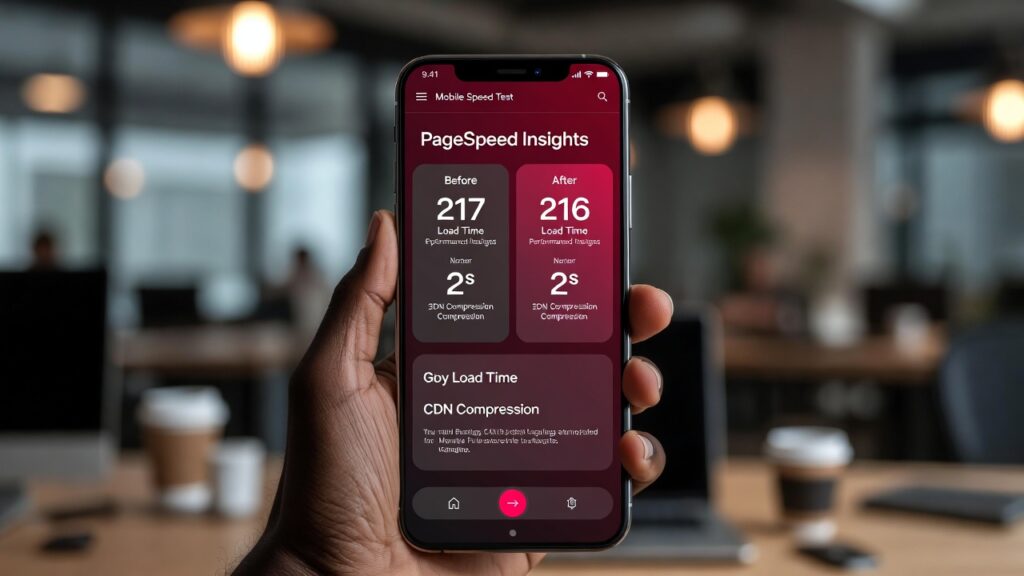
The technical solution is not glamorous and also non-negotiable. On the other hand, Image compression to WebP format reduces file sizes by up to 60% with no visible quality loss.
A Content Delivery Network (CDN) with African edge servers, like Cloudflare, serves your site files from locations geographically closer to Nigerian users, shaving precious seconds off load times.
Meanwhile Minifying CSS and JavaScript files removes unnecessary code bloat and enabling browser caching means returning visitors load your site faster each time.
The target is under two seconds on mobile whichis not aspirational, but the threshold at which bounce rates for Nigerian SMEs begin to drop meaningfully. Sizzle Digital runs a free website speed audit at the start of every engagement.
The results are usually eye-opening, and occasionally devastating.
Step 2: Clear Value Headlines: Eight Seconds to Win or Lose
If a visitor lands on your homepage. In eight seconds, they’ll decide: ‘Is this for me?’
Unfortunately most Nigerian business homepages fail this test because they open with the company name, a tagline like ‘Your trusted partner in excellence’, and a slider that takes three seconds to animate. By the time the visitor finds out what you actually do, they’re already back on Google.
The fix is the who-for-what-why headline structure. It answers three questions in one sentence:
- Who is this for?
- What do they get?
- Why should they care right now?
A legal firm in Lagos that changes its headline from ‘Chambers of Excellence’ to ‘Lagos Businesses: Protect Your Company From Legal Risk: Fast, Affordable, Trustworthy’ is no longer asking visitors to work before understanding what the offer is all about. The value is immediate.
Local pain-point headlines outperform generic benefit statements every time. Reference something real. It could be the difficulty of collecting payment from clients, the challenge of standing out in a saturated Abuja market, and the frustration of running ads that produce nothing.
When your headline speaks to a specific Nigerian business struggle, the visitor feels seen and visitors who feel seen, stay.
Above the fold, everything visible before the first scroll should contain: the benefit-focused headline, one supporting sub-headline sentence, one primary CTA button, and at minimum one trust badge. Client count, years in operation, a recognisable logo.
This combination does the most conversion work of any section on the entire site.
Step 3: WhatsApp Lead Capture: Ditch the Form, Start the Conversation
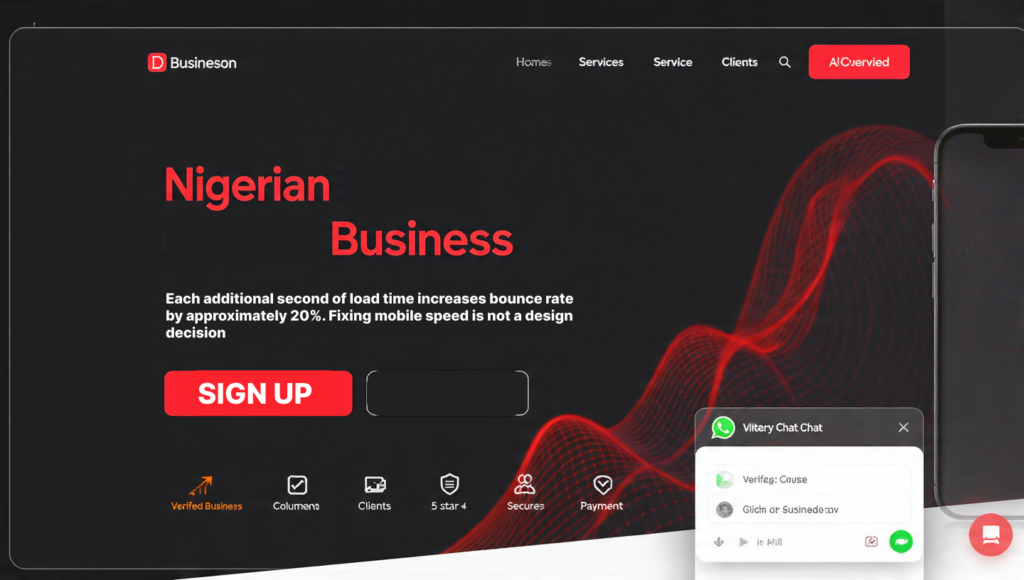
Contact forms are a relic. In a country where WhatsApp is not just a messaging app but a way of life, and where people buy groceries, negotiate contracts, and settle disputes all in one chat, asking a potential customer to fill out a form and wait 48 hours for a response is a commercial insult.
Just kindly replace the form and Install the WhatsApp button.
The bold WhatsApp button on the homepage should appear in at least three places: the hero section, a floating button that follows the user down every page, and the footer.
Each link should be pre-filled with a contextual message.
A visitor on your services page clicks WhatsApp and sees: ‘Hi, I’m interested in [service name], can we talk?’ That single detail removes the friction of composing an opening message, and the instant response sales funnel begins immediately.
For product-based businesses, WhatsApp checkout links take this further. A customer clicks, sees an order summary pre-loaded in the chat, confirms via bank transfer or mobile money, and the sale is done,no cart, no checkout page, and abandoned purchases.
This is the mobile money checkout link approach, and it is tailor-made for the Nigerian market.
Research from Hubspot says:
HubSpot’s 2024 Sales Report confirms that businesses with live chat or instant messaging CTAs convert leads at rates 2.8x higher than those relying solely on email forms. In Nigeria’s relationship-driven commercial culture, the principle holds even stronger.
Step 4: Trust Signals and Social Proof: Credibility You Can See
An unknown Nigerian business brand has about eight seconds and one scroll to answer the visitor’s most important unspoken question: ‘Can I trust these people?’ If the page does not answer that question fast and visibly, the visitor leaves.
Not because your service is bad but because your website didn’t do its job.
The architecture of trust on a high-converting Nigerian site follows a specific sequence.
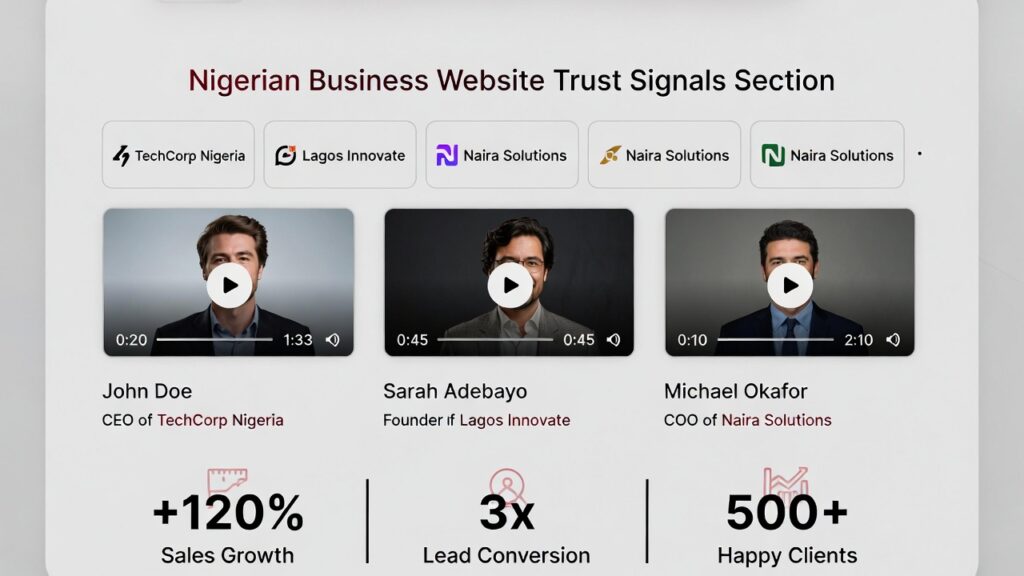
First, comes quantitative social proof, a number that is hard to dismiss (clients served, projects completed, years operating).
This should sit immediately below the headline.
Second, comes visual proof: Nigerian client logos and homepage testimonials from recognizable brands.
Third, and most powerful, comes video proof: real people, real names, describing a specific result. Not ‘they’re great,’ but ‘our leads went from 4 per month to 37 per month in 90 days.’
For Nigerian audiences specifically, local social proof beats international social proof every time. A testimonial from a business in Port Harcourt is more credible to a Lagos SME than a glowing review from a London client. Proximity creates trust, cultural familiarity creates trust and specificity creates trust.
Add secure payment icons for any transaction function and add a visible WhatsApp support indicator to show the business is staffed and responsive.
These are not decorative elements, they are, to borrow a phrase, conversion infrastructure.
Step 5: Conversion Landing Pages: Where Ad Spend Becomes Revenue
If you’re running Meta ads or Google campaigns and sending that traffic to your homepage, you are burning money. The homepage is built for cold discovery which introduces the breadth of your business.
A conversion landing page is built for one single purpose: to convert a visitor who arrived with specific intent from a specific ad. That specificity is everything.
Sizzle Digital engineers single-goal conversion landing pages around four principles.
Your headline should match the landing page and mirror the ad copy exactly. The landing page should have one single goal, convert. Which means no navigation menu, no links to other pages, and nothing to distract.
Above-fold proof, should have a result stat or testimonial within the first scroll, and not buried at the bottom to build social proof and trust.
The performance difference is not marginal. For Nigerian startups and SMEs running paid advertising, a properly built conversion landing page consistently outperforms homepage traffic by a factor of three to five on conversion rate.
Same ad spend, same traffic and dramatically more leads. The arithmetic is simple but the execution is where most businesses fall short.
Your website visitors are ready to buy. Are you ready to catch them?
Sizzle Digital installs WhatsApp lead capture, optimized landing pages, and full conversion architecture for Nigerian businesses. Get started, no forms required.
The Numbers Don’t Lie: Before and After a Nigerian Website Rebuild
Here’s what the transformation actually looks like when all five pillars are applied. Not in theory but in practice. This before vs after results case study comparison reflects the typical outcome Sizzle Digital clients experience within the first 60 to 90 days after a conversion-focused rebuild.
| Before (The Broken Website) | After (24/7 Sales Machine) |
| Slow 5s+ load, visitors gone before reading | Under 2s on mobile with CDN + image compression |
| ‘We deliver excellence’ homepage headline | ‘Lagos SMEs: Get More Clients Online, Starting Today’ |
| Contact form with 3-day response time | Bold WhatsApp button, pre-filled message, instant reply |
| No testimonials: visitors don’t trust you | Video reviews, client logos, before/after results |
| Homepage used for every ad campaign | Dedicated landing page per ad, message match guaranteed |
| Bounce rate: 70–90% (your money evaporating) | Bounce rate 30–45% with structured UX |
| Leads: 0–3/month (mostly wrong-fit enquiries) | Leads: 15–40+/month, qualified, ready-to-buy |
That bounce rate column should hurt a little. A 70–90% bounce rate means that for every ten people visiting a Nigerian business website, seven to nine leave without doing anything.
If those visitors came from paid ads, every one of them was money thrown into Lagos traffic. The conversion rebuild changes the arithmetic, and it changes the revenue.
Why Nigerian Businesses Keep Making the Same Website Mistakes?
The honest answer? Most Nigerian web designers are not conversion strategists. They’re aesthetic specialists, and there’s nothing wrong with that, except when the brief is ‘build me a website that generates leads.’
A beautiful site that doesn’t convert is like a well-dressed salesperson who can’t speak to a customer..
The second reason is measurement. Most Nigerian business owners don’t track their website’s conversion metrics at all. They know their page views. They don’t know their WhatsApp click-through rate, their landing page conversion rate, or which traffic source is producing the highest-quality leads.
Without those numbers, optimization is guesswork. With them, every monthly review cycle becomes a deliberate, incremental improvement.
A/B Testing CTAs: Small Tweaks, Big Naira Difference
Here’s a specific example of how much CTA copy matters. A WhatsApp button that reads ‘Contact Us’ performs measurably worse than one that reads ‘Chat With Us Now: Free Consultation.‘ Same button, same colour, and same placement.
Different words are used and, in some cases, it doubles the click-through rate. That’s the power of A/B testing CTAs for Nigerian business websites.
An A/B test shows two versions of one page element to different traffic segments and measures which converts better. Over four to six weeks of testing, a Nigerian SME can dial in their headline, their button text, their WhatsApp message, and their trust signal placement, each improvement compounding on the last.
Sustaining the Machine: Long-Term Revenue Strategy for Nigerian Websites
A conversion-optimised website is not a one-time project. It is an asset, and like any asset, it requires maintenance, measurement, and strategic evolution to retain its value.
The Nigerian businesses building durable digital revenue in 2026 are the ones who understand this distinction.
Content as a 24/7 Lead Engine, The Long Game
A well-written, SEO-optimised blog post answering a question that Nigerian buyers are actively searching for can generate qualified leads for two to three years after publication, at zero ongoing cost.
For service businesses in Lagos, Abuja, and Port Harcourt, educational content that demonstrates expertise such as, how-to guides, local case studies, common-mistake articles, builds the kind of trust that converts cold organic traffic into WhatsApp enquiries.
Sizzle Digital’s content strategy service builds these topic clusters systematically. Every article targets a specific search query that Nigerian buyers use when they are closest to a purchase decision.
This is the long game, and for businesses willing to play it, the compound returns are significant.
Scaling With Paid Traffic: The Landing Page First Rule
When a Nigerian business is ready to invest seriously in Meta ads or Google campaigns, the most important pre-launch question is not ‘which platform?’ It’s: ‘Does my landing page infrastructure exist and convert?‘
Sending paid traffic to an unoptimized homepage is a reliable way to produce disappointing ad results, and a fast way to burn a ₦500,000 ad budget with nothing to show.
The correct sequence: build and validate the conversion landing page first; confirm it converts at an acceptable rate with a small test budget; then scale.
That is the landing page first rule, and it is the difference between ads that generate pipeline and ads that generate regret.
Exit-Intent Recovery: The Last Chance Mechanism
On a well-optimised Nigerian business website, a visitor who is about to leave is not yet a lost lead.
Exit-intent technology detects the cursor movement toward the browser close button and triggers a last-chance prompt. For Nigerian businesses, the highest-converting exit-intent prompt is a WhatsApp opener: ‘Before you go, got a quick question? Message us now.’ Low friction.
No commitment. Just a conversation starting point. This single addition to a high-traffic site regularly recovers 5% to 15% of visitors who would otherwise leave without any engagement.
That might not sound dramatic but apply the arithmetic: if a Nigerian business site receives 3,000 visitors per month and exit-intent converts 10% of those who would otherwise bounce, that’s 150 additional conversations per month, from visitors who were already leaving.
Your website can close deals while you sleep.
Get free website audit + a clear plan to turn your business website into a genuine 24/7 sales machine Today.
Final Thoughts
The businesses that are winning digitally in Nigeria this year 2026 are not the ones with the biggest budgets or the flashiest designs.
They are the ones with the most intentional architecture and mobile speed optimization that keeps visitors on the page.
The WhatsApp lead capture that starts conversations instantly, clear value headlines that answer the visitor’s question before they ask it, trust signals and social proof that convert skepticism into confidence, and conversion landing pages that turn ad spend into measurable pipeline are what makes a site profitable.
None of these things are complicated. All of them require deliberate, strategic execution. That is exactly what Sizzle Digital was built to deliver. Not vanity, or aesthetics for aesthetics’ sake.
We only deliver results and revenue that compound returns on a digital asset that works for your business every hour of every day.
So, the question is simple: is your website a brochure or a business? If you’re ready for it to be the latter, the next step is a conversation.
Similar Blog Post You might be Interested In
How to Redesign Your Business Website in Nigeria for More Sales and Leads
Poor UI design isn’t just an aesthetic problem, but a revenue problem. When your site isn’t optimized for how Nigerians actually browse.. Read more
Why Your Business Needs a Conversion-Optimized Website in Nigeria
Look, if you’re still thinking a website is just “online presence,” we need to talk. That mindset is costing you real money, I mean… Read more
How to Choose the Right Web Design Agency in Nigeria
These first two steps I’ll reveal are your shield and sword. Step one forces you to look inward while step two turns that clarity outward… Read more
FAQs
Mobile speed optimization is the process of making your website load faster on smartphones and mobile networks, which matters enormously in Nigeria, where more than 70% of web traffic comes from mobile devices. The key actions include: compressing images to WebP format (reducing file sizes by up to 60%), implementing a Content Delivery Network (CDN) with African edge servers so your site loads from a location closer to Nigerian users, minifying CSS and JavaScript files to remove code bloat, and enabling browser caching so returning visitors load the site faster. The goal is a load time under two seconds on mobile. Every extra second of delay increases your bounce rate by approximately 20%, which means visitors leave before reading a single line of your content.
Nigerian buyers make decisions through conversation, not forms. A contact form creates friction, which requires effort, delayed response, and feels impersonal in a market where WhatsApp is the primary channel for business communication. A bold WhatsApp button removes all of that friction. The conversation starts immediately, the tone is personal and direct, and the buyer’s trust is higher because they’re in a familiar environment. Research from HubSpot confirms that businesses using live chat or instant messaging CTAs convert at 2.8x the rate of those relying on forms. In Nigeria, where WhatsApp handles everything from grocery orders to legal negotiations, that multiplier is likely even higher.
The most effective Nigerian business headlines answer three questions simultaneously: Who is this for? What do they get? Why should they care right now? Use the structure: [Target audience], [specific outcome], [differentiator or timeframe]. For a Lagos accounting firm, instead of ‘Excellence in Financial Services,’ write: ‘Lagos SMEs: Stop Overpaying Tax, Get a Free Financial Audit This Week.’ The more specific and locally resonant the headline, the better it performs. Reference a real Nigerian business pain point, difficulty collecting payment, standing out in a saturated market, running ads with no results, and your headline immediately creates a connection with the right visitor.
The trust signal architecture that works best for Nigerian business websites follows a specific sequence. First, quantitative proof: a number that is hard to dismiss, clients served, projects completed, years in operation. This should sit immediately below your headline. Second, visual proof: client logos from recognisable Nigerian brands, media mentions, or industry associations. Third, testimonial proof: real video testimonials from real Nigerian clients describing specific, measurable results. Text reviews alone are often dismissed as fabricated; video is far harder to fake. Additionally, secure payment icons for any transactional function and a visible WhatsApp support indicator both contribute meaningfully to conversion, as they signal that the business is staffed and responsive.
A conversion landing page is a standalone web page built for one specific goal: to convert a visitor who arrived from one specific campaign into a lead or customer. Unlike a homepage, which introduces the full breadth of a business, a landing page has no navigation menu, no links to other pages, and no distractions, just a single, focused message that mirrors the ad or link that brought the visitor there. For Nigerian businesses running Meta ads, Google campaigns, or influencer partnerships, sending traffic to the homepage is a proven way to waste ad spend. A well-built conversion landing page consistently produces a 3x to 5x improvement in conversion rate compared to a homepage, because it captures the visitor at peak intent with a perfectly matched message.
The target load time for a high-converting Nigerian business website is under two seconds on mobile. This is the threshold at which bounce rates begin to drop significantly. According to Google’s research on mobile user behavior, 53% of mobile users abandon a page that takes longer than three seconds to load. In Nigeria’s mobile-first internet environment, where users are often on variable-speed 4G networks and buying data in small increments, the stakes are even higher. A page that loads in 1.8 seconds will dramatically outperform one that loads in 4.5 seconds on every conversion metric, leads captured, WhatsApp clicks, and sales initiated.
At minimum, three WhatsApp access points should appear on every Nigerian business website: one in the hero section of the homepage (visible above the fold before any scrolling), one as a floating button that persists on every page as the user scrolls, and one in the footer. Each WhatsApp link should be pre-filled with a contextual opening message relevant to the page it appears on, for example, a services page link might open with ‘Hi, I’m interested in [service name], can we talk?’ This pre-fill detail removes the friction of the visitor composing an opening message themselves, which meaningfully increases click-to-conversation conversion rates.
A/B testing is the practice of showing two different versions of one page element, a headline, a CTA button colour, a WhatsApp button label, to different segments of your traffic simultaneously, and measuring which version produces more conversions. For Nigerian SMEs and startups, this is the highest-leverage improvement method available because it replaces guesswork with data. A WhatsApp button labeled ‘Contact Us’ might generate 40 clicks per 1,000 visitors. The same button labeled ‘Chat With Us Now, Free Consultation’ might generate 80. That’s double the leads from the same traffic, with no increase in ad spend. Over a four-to-six-week testing cycle, A/B testing systematically eliminates underperforming elements and replaces them with proven winners.
Exit-intent technology detects when a visitor’s mouse movement indicates they are about to close the tab or navigate away from your website, and triggers a last-engagement prompt at that precise moment. For Nigerian businesses, the most effective exit-intent prompt is a WhatsApp conversation opener, not a discount popup, which can cheapen brand positioning, but something low-friction: ‘Before you go, got a quick question? Message us on WhatsApp.’ On a high-traffic Nigerian business website, this single addition can recover between five and fifteen percent of visitors who would otherwise leave without any engagement. Applied to 3,000 monthly visitors, even a 10% recovery rate generates an additional 150 conversations per month from people who were already leaving.
The three metrics that most accurately predict revenue performance on a Nigerian business website are: WhatsApp click-through rate (what percentage of visitors who see the WhatsApp button actually click it), landing page conversion rate (of all visitors to a specific landing page, how many take the target action), and traffic source quality (which channels, organic search, paid ads, Instagram referral, produce the highest-converting visitors). Most Nigerian business owners track only page views and bounce rate, which give almost no actionable information about revenue performance. Setting up Google Analytics 4 with event tracking for WhatsApp clicks and form submissions provides the data needed to make deliberate, improvement-focused decisions every month.
An SEO-optimised blog post that answers a question Nigerian buyers are actively searching for can generate qualified organic traffic, and WhatsApp enquiries, for two to three years after it is published, at zero ongoing cost. For Nigerian service businesses, educational content that demonstrates expertise (how-to guides, local case studies, common-mistake articles) builds the kind of trust that cold paid advertising struggles to replicate. A blog post titled ‘How Nigerian SMEs Can Reduce Tax Liability Legally’ will attract exactly the right type of visitor for an Abuja accounting firm, at the precise moment they are most motivated to engage. Over 12 to 24 months, a strategic content cluster built around the search queries Nigerian buyers use closest to purchase decisions produces compounding lead generation returns
Message match is the principle that the headline and key promise on a conversion landing page should mirror exactly the language and promise of the ad or link that brought the visitor there. If a Meta ad says ‘Get a professional Lagos business website in 14 days,’ the landing page headline should say exactly that, not a generic ‘Welcome to our services.’ When the message matches, the visitor feels immediate confirmation that they are in the right place. When it doesn’t, there is a jarring discontinuity that raises doubt and increases bounce rate. Research consistently shows that landing pages with strong message match convert at rates 30–50% higher than those with generic or misaligned headlines. For Nigerian businesses spending real naira on paid ads, message match is not optional.
Conversion-optimised website projects in Nigeria vary significantly depending on scope, complexity, and the agency’s positioning. Entry-level projects from boutique agencies typically start around ₦250,000 to ₦500,000 for a basic five-page conversion build. Full strategic builds, including custom landing pages, WhatsApp lead capture architecture, trust signal design, mobile speed optimization, and basic SEO, range from ₦500,000 to ₦2,000,000 or more, depending on the number of landing pages and the depth of copywriting involved. The better framing for Nigerian business owners is not ‘how much does it cost’ but ‘what is the cost of my current website not converting?’ A site generating zero leads per month has a very high operational cost, the cost of wasted ad spend, missed enquiries, and lost competitive ground.
Most Nigerian businesses that undergo a properly executed conversion website rebuild, mobile speed optimization, WhatsApp CTAs, clear value headlines, trust signals, and dedicated landing pages, begin to see measurable improvement in lead volume within 30 to 60 days. Speed improvements are immediate: load times drop as soon as the CDN and image compression are applied. WhatsApp click-through rates improve within the first week as soon as the button placement and pre-fill messaging are optimised. Landing page conversion improvements typically become statistically meaningful within four to six weeks of live traffic. Content-driven lead generation takes longer, three to six months for SEO-optimized posts to build organic traffic, but the returns are durable and compound over time.
Sizzle Digital is a performance-driven digital marketing and web strategy agency built specifically for the Nigerian business ecosystem. Unlike generic web design agencies that optimize for aesthetics, Sizzle Digital’s model is built around one principle: results over vanity metrics. That means conversion-focused websites engineered with mobile speed optimization, WhatsApp lead capture systems, trust signal architecture, and dedicated landing pages built to match specific campaign goals. Every engagement begins with a free website audit that identifies current conversion bottlenecks across all five areas covered in this article. For Nigerian SMEs, startups, service businesses, and e-commerce brands that are ready to treat their website as a commercial asset, not a decorative expense, Sizzle Digital provides the strategic execution to make that transformation real.
Absolutely, and this is one of the most important points to make clearly. A conversion-optimized website is not defined by budget size; it is defined by strategic intention. A small Nigerian business with ₦150,000 can build a highly effective three-page site, homepage, services page, and a single landing page, that outperforms a ₦2,000,000 aesthetic build that was never designed to convert. The priorities are non-negotiable regardless of budget: fast mobile load time, a clear value headline above the fold, a bold WhatsApp CTA, at least two testimonials, and one focused landing page for any paid traffic. Free and low-cost tools like Cloudflare (CDN), Squoosh (image compression), and WhatsApp Business (pre-filled chat links) remove significant cost barriers. The investment that matters most is not money, it is the quality of strategic thinking applied to the build.
For Nigerian e-commerce businesses, the cost of a poorly designed website is immediate and financially measurable in a way that service businesses sometimes don’t feel as sharply. Cart abandonment rates on Nigerian e-commerce sites average between 70–85%, according to Baymard Institute research, and slow load times are one of the primary drivers. Every second of additional load time on a product page directly reduces the probability that the visitor completes a purchase. Beyond speed, unclear product descriptions, missing trust signals like secure payment icons, the absence of a WhatsApp support option, and a complicated checkout process all contribute to abandonment. For Nigerian e-commerce specifically, offering a WhatsApp checkout alternative, where a customer can confirm their order and pay via bank transfer through a chat conversation, frequently recovers a meaningful percentage of buyers who were not comfortable completing an online transaction.
This distinction matters enormously for Nigerian business owners evaluating what they actually need. A website redesign is primarily an aesthetic exercise, updating the visual design, refreshing the layout, updating photography, and modernising the user interface. A conversion optimization project is a strategic exercise, systematically identifying and removing every barrier between a website visitor and the desired action, whether that is a WhatsApp message, a purchase, or a booking. The two are not mutually exclusive, but they are funded and executed with different goals. A Nigerian business that has an existing website with reasonable traffic but poor lead volume almost certainly needs a conversion optimization project, not a full redesign. New colours and a new logo will not fix a weak headline, a missing WhatsApp CTA, or a five-second mobile load time. Diagnosing which problem you actually have before spending money is the single most important first step.
The footer is one of the most underused conversion assets on Nigerian business websites. Visitors who scroll all the way to the bottom of a page are demonstrating unusually high intent, they read everything and are still looking for information or a reason to act. That behaviour should be met with a strong conversion prompt, not just a copyright notice. A high-converting Nigerian business website footer should contain: a brief one-sentence value statement reminding the visitor who the business serves, a bold WhatsApp CTA button (this is the third placement in the recommended minimum of three), a contact phone number that is clickable on mobile, social proof in the form of a star rating or brief testimonial, links to the most important service pages, and a newsletter opt-in if the business runs email marketing. For Nigerian service businesses where trust is built over multiple visits, the footer is the last chance to start a conversation with a visitor who has not yet converted, and it should be built accordingly.
Google Business Profile, formerly Google My Business, plays a significant and often underestimated role in the conversion journey for Nigerian business websites, particularly for businesses serving specific cities like Lagos, Abuja, or Port Harcourt. When a potential customer searches for a service in their city, Google frequently surfaces Business Profile results above organic website results. A complete, well-optimized profile with real Nigerian customer reviews, accurate business hours, a WhatsApp link, and regular photo updates drives qualified local traffic directly to the website, traffic that arrives with higher intent than cold paid ad traffic. Reviews on Google Business Profile also function as powerful trust signals that support and reinforce the social proof architecture on the website itself. A Nigerian business that ignores its Google Business Profile while investing in website conversion work is leaving a significant traffic and credibility source unoptimized.