

Table of contents
- Why These Mistakes Are Costing Nigerian Businesses Real Revenue?
- The 7 Nigerian Business Website Design Mistakes
- The Cost of Getting Nigerian Website Design Wrong
- Non-Mobile Responsive Design: The Structural Root of Most Nigerian Website Failures
- Slow Page Load Speeds: Why Nigerian Networks Make This Worse
- Missing CTAs: The Psychology of the Nigerian Buyer
- 5 Core Mistakes vs Sizzle Digital Fixes
- Building and Sustaining a Nigerian Business Website That Keeps Working
- Are you treating your website as a project or a long-term asset?
- Similar Blog Post You Might be Interested In
- FAQs
Last week, I wanted to buy furniture for my new apartment in Lekki. I found a Lagos-based company through Instagram Reels and good reviews. Clicked their website link, and… wetin be this? Their site was a classic example of Nigerian website design mistakes; it loaded like it was fetching data from Mars.
The layout scattered completely on my Android, text wrapping everywhere, images overlapping, and this tiny “Contact” button was hiding somewhere near the footer like a fugitive. I just left and bought from someone else on WhatsApp instead.
We’re out here blaming bad networks when the real culprit is bad design.
Regardless, this article reveals the 7 website design mistakes Nigerian businesses must eliminate in 2026. Some of these errors are so common they’ve become normalized with broken mobile layouts, missing WhatsApp buttons and pages that load slower than a Lagos traffic jam.
But here’s the truth I’ve learned after years in this industry: your website shouldn’t just exist. It should work. And if it’s committing any of these sins, it’s actively costing you money every single day. Understanding these website failures and fixes for Nigerian businesses is the first step toward reclaiming that lost revenue.
Sizzle Digital has audited over 100 Nigerian business websites in the past two years alone. The patterns are so predictable it’s almost painful.
But here’s the good news, every single mistake is fixable. Let me show you exactly where most businesses go wrong, and more importantly, how to fix it before 2026 catches you sleeping.
Why These Mistakes Are Costing Nigerian Businesses Real Revenue?
Most Nigerian businesses have a website. Small businesses, medium-sized companies, even some big players and now everybody don join the “we need website” train.
But here’s the conversation nobody is having: most of those websites are quietly losing money every single day.
Not through dramatic failures, nothing gets to explode and the server doesn’t crash at all.
But what happens is worse. It’s like death by a thousand small cuts.
Here’s what I mean:
A site that breaks on an Android phone in Yaba, a page that takes six seconds to load on Glo data in Ibadan and a Google search that returns zero results because there’s no local SEO signal anywhere on the site is bad news and each of these moments is a lead that went somewhere else.
And that is why at Sizzle Digital, we look beyond the average eyes. We build websites that draw the attention of individuals and turn them into loyal customers.
We’re Nigeria’s performance-driven web design and digital marketing team with one standard that matters: does it generate revenue?
Not, does it look impressive at the handover meeting when the client is nodding and snapping photos?
Not, does the owner’s nephew who knows “something about computers” think it’s fine?
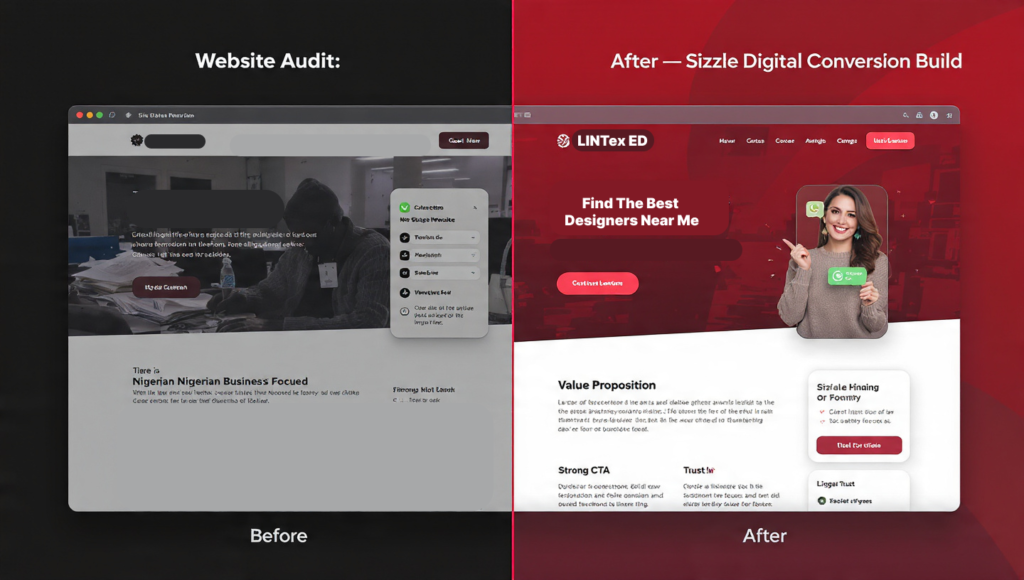
We audit, build, and optimize Nigerian business websites around three pillars that actually determine whether a website works as a business tool. These three pillars are conversion architecture, mobile performance, and local search visibility.
If any of these three is weak, the site is basically an expensive online brochure collecting digital dust.
And look, I’m not here to shame anybody. Running a business in Nigeria is hard enough without adding website stress. The fuel prices, the exchange rate, and the unpredictable policies… common we have enough wahala already.
Your website should be solving problems, not creating new ones. That’s why this article matters.
What follows are the 7 most common and costly website design mistakes Nigerian businesses are making in 2026. Each one is named clearly, explained with specific data where available, and paired with an actionable fix that Sizzle Digital uses daily.
The tone is direct because these mistakes have real financial consequences and you should feel that urgency without feeling lectured.
Let’s get into it.
The 7 Nigerian Business Website Design Mistakes
The list below of the 7-website design mistake is the common errors I see most businesses in Nigeria do. Also, this is not only the ones out there but just the least to begin with.
Keep an eye for what resonates most with your business and work on them quickly to fix the underlying issue that may have been eating away at your profit.
With that said, let’s dive into the most important part of this article.
1. Non-Mobile Responsive Design
Here’s a number that should stop every Nigerian business owner in their tracks:
over 85% of Nigerian internet traffic now comes from mobile devices.
Statista confirmed this, DataReportal 2024 knows this and even MTN’s own subscriber data confirms this.
Yet when I audit Nigerian business websites, I still find desktop-only layouts designed for 24-inch monitors as if we’re all sitting in air-conditioned offices with fibre optic connections.
A website that is not fully responsive, meaning it does not adapt its layout cleanly to every screen size, is structurally broken for the majority of its visitors before they read a single word.
It means the visitor hasn’t even seen your offer yet, and the website has already failed them.
The specific problems are painfully predictable. And when you see broken layouts on Android devices where text overlaps images and navigation menus disappear.
On the other hand, you get horizontal scrolling that forces users to zoom and pan like they’re reading a map which makes things difficult not just for you but also for your users.
And the unfortunate thing is…
These aren’t minor inconveniences, they’re conversion killers.
2. Slow Page Load Speeds
Google’s own research dropped a truth bomb few years ago that still holds today:
It says…
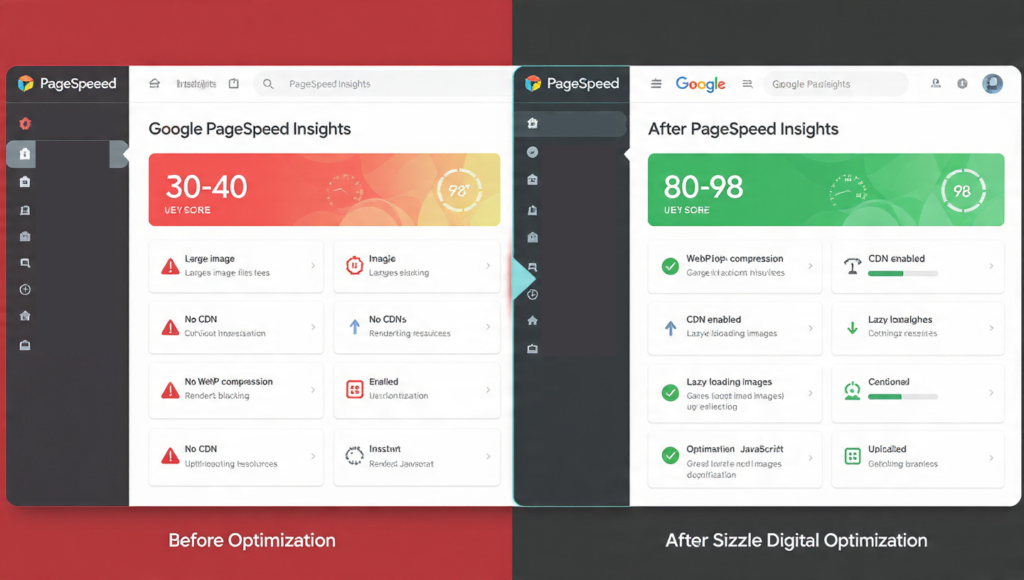
53% of mobile users abandon a page that takes more than three seconds to load. Three seconds! That’s less time than it takes to boil water for one cup of tea.
For Nigerian business websites serving users on variable 3G and 4G networks, where connection quality fluctuates based on location, time of day, and sometimes just cosmic alignment, the load speeds are often catastrophically slow.
And here’s the painful part: it’s rarely because of poor hosting alone. The real culprits are uncompressed images, heavy slider plugins, unminified code, and the complete absence of caching.
Heavy sliders on 3G networks in Naija are particularly offensive. You know those auto-rotating hero images with fade effects and text animations?
On a slow connection, they load one image, then another, then another and each one pushing the user’s patience further. By the time the third image appears, the visitor is gone.
3. Missing Clear CTAs
A Nigerian business website with no clearly visible, above-fold call-to-action is a website that expects visitors to do the work of becoming a customer without any direction.
And let me tell you something about Nigerian visitors: we will not do that work. We will simply leave and message the next business on WhatsApp.
The most common CTA mistake I see? A generic ‘Contact Us’ link buried in the navigation menu. Buried! As if the business is playing hide and seek with potential customers.
In a market where buyers expect immediacy and use WhatsApp as their primary commercial communication tool, this approach is commercial suicide.
Think about how Nigerians actually buy things now. You see a Reel on Instagram, you click the website link, you check quickly, and then you want to message the seller. Not fill a form, Nigerians hate forms and even to send an email seems too formal and too slow.
The absence of a bold WhatsApp button on the homepage of a Nigerian business website is one of the single most costly CTA mistakes in the local market.
It is a missed conversation with every visitor who would have messaged immediately if the option had been visible.
You don’t know how many leads you’re losing because they couldn’t find the button.
4. Poor Local SEO Setup
Imagine opening a shop in Alaba market but telling nobody where it is. No signboard, No directions and No mention of Alaba anywhere.
How many customers do you think will find you? Probably zero.
That’s exactly what Nigerian businesses do when they launch websites with no local SEO signals. They open a digital shop in the world’s largest marketplace and then make it impossible for local buyers to find them. Implementing local keywords and visibility strategies is a vital part of professional website design in Nigeria that ensures you aren’t hidden from your target audience.
Let me reveal to you some of the things about your website that causes missed opportunities every single time you overlook them
- Generic page titles like ‘Home | ABC Company’ are everywhere and missing meta descriptions that could have convinced someone to click is lost.
- No schema markup telling Google this is a Nigerian business serving specific locations.
- Zero Google My Business integration despite it being free and incredibly powerful.
- No location-specific keywords anywhere on the site. The result? The site ranks for nothing and not even the business’s own name in some cases.
Voice search is growing fast among Nigerian mobile users and people are asking their phones: “Where can I buy generators in Port Harcourt?” or “Best tailor around me in Lekki.” If your site isn’t optimized for these queries, with location keywords and proper schema, you’ll remain invisible to every voice search happening in your own neighborhood.
Missing schema on Nigerian business websites is particularly painful because schema markup is literally just code that tells search engines exactly what your business is, where it’s located, when you’re open, and what services you offer.
It takes maybe 20 minutes to implement and can easily improve how you appear in search results. Yet 80% of the sites I audit don’t have it.
5. Cluttered, Overloaded Pages
Before we proceed further, let me point out a few things most Nigerian businesses are doing wrong every single day that is hurting their business.
- Too many fonts.
- Three conflicting colour schemes competing for attention.
- A full-width animated banner that plays automatically with text flying in from four directions.
- A wall of unbroken text stretching endlessly.
- Generic stock photos of people shaking hands in suits and a demographic that looks nothing like the Nigerian business owner reading the page or their actual customers.
These are the hallmarks of a cluttered Nigerian business website, and they carry a specific conversion cost. Which means visitors cannot identify what matters, so they leave.
I call this the “market stall” approach to web design where everything is displayed at once because the business owner is afraid to leave anything out.
But here’s the problem: a market stall works because customers can physically touch and examine products. A website works differently. It needs visual breathing room. It needs hierarchy, guide attention and not scatter it.
No visual hierarchy means no guided attention. Without a clear visual pathway to the headline, sub-headline, supporting detail and CTA, the visitor’s eye has no instruction. It bounces around the page randomly, and the brain defaults to the simplest available action, which is to close the tab and find a site that respects their attention.
Too many fonts and colors on Nigeria sites is particularly common. I’ve seen pages using five different font families because “it looks rich.” It doesn’t. It looks confusing and confused visitors don’t buy.
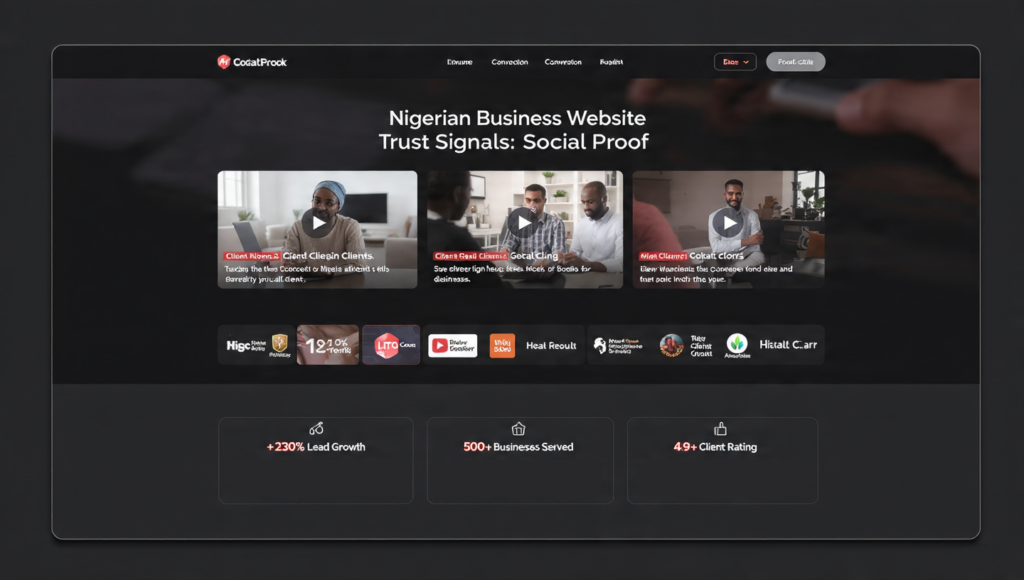
6. No Trust Signals on the Homepage: Credibility Gaps Cost Sales
A Nigerian business website visitor makes a trust judgement within eight seconds. Eight seconds! That’s barely enough time to read two sentences and glance at a photo.
If the homepage has no testimonials, no client logos, no results data, no secure payment icons (for e-commerce), and no visible evidence that real clients have engaged with this business and received value from it, the visitor’s default assumption is risk.
And when humans perceive risk, the overwhelming majority choose not to take it.
This is particularly consequential for Nigerian SMEs in service industries like legal, financial, construction and digital marketing where the buyer cannot see or touch the product before committing.
When asking someone to pay you for expertise or service they can’t evaluate beforehand. It requires trust.
Social proof is not a nice-to-have. It is the trust infrastructure that enables the sale. Yet I regularly audit Nigerian business websites with beautiful designs and zero social proof. Zero!
As if the business operates in a vacuum where nobody has ever hired them before.
7. Using a Generic Template With No Brand Differentiation
Nigeria’s digital market has matured significantly. Buyers in Lagos, Abuja, Benin and Port Harcourt encounter dozens of business websites every week.
They scroll through them on phones during traffic, on laptops at work and on tablets at home. And they have developed a refined instinct for the difference between a business that invested in genuine brand expression and one that bought a ₦5,000 WordPress template and changed the logo.
The latter communicates we are not serious enough about our brand to express it distinctly.
Now, I’m not saying every business needs a completely custom-coded website from scratch. That’s not always necessary or budget-appropriate. But there’s a massive difference between using a template as a starting point and using a template as the entire identity.
Brand differentiation on a Nigerian business website is not about being flashy, it’s about being specific. Specific language that speaks to the Nigerian buyer’s actual situation, not generic copy imported from a foreign template.
Also, specific imagery that reflects the local environment, the streets, the colours, the people, and the energy. A visual identity that is consistent across every page and immediately recognisable as yours, not “oh, this looks like that other company’s site.”
The Cost of Getting Nigerian Website Design Wrong
Let’s do some maths…
The kind that matters at the end of the month when you’re looking at your books.
Imagine your website receives 1,000 monthly visitors. This is conservative and many Nigerian businesses get more, especially with any paid advertising.
Now, if your site has an 80% bounce rate due to non-mobile responsiveness and slow load speed, which, frankly, is common and you’re retaining 200 visitors. Two hundred people actually stick around to see what you offer.
From those 200, if your conversion rate is 2%, because the CTA is weak, there’s no WhatsApp button, and the trust signals are missing, you generate 4 leads per month.
That’s four leads from 1,000 people.
Now flip the scenario. Same 1,000 visitors, but this time, the site is properly optimized, mobile-responsive, loads in under two seconds, clear WhatsApp CTA above the fold, trust signals visible, and navigation clear.
Bounce rate drops to 40%. You’re now retaining 600 visitors and the conversion rate improves to 8%. Which means you’re now generating 48 leads from the exact same traffic.
Same website budget, same traffic source and same business. But one version generates 12 times more leads than the other. The website didn’t change but the architecture did.
This is what we mean when we say bad design costs real money. It’s not abstract and neither is it “nice to have” versus “need to have.”
It’s 4 leads versus 48 leads. It’s ₦100,000 in revenue versus ₦1.2 million in revenue, from the same visitors.
Non-Mobile Responsive Design: The Structural Root of Most Nigerian Website Failures
The digital landscape in Nigeria presents unique challenges that global web design standards simply don’t account for. While businesses invest heavily in branding, advertising, and social media presence, the fundamental technical foundation of their websites often crumbles under the weight of local conditions.
This isn’t merely about aesthetics or keeping up with design trends, it’s about survival in a market where device fragmentation, network variability, and user behavior patterns diverge significantly from Western assumptions.
The structural integrity of a website determines whether a business captures or repels the traffic its marketing efforts generate. This is why learning how to build a high-converting business website in Nigeria is essential for any brand looking to scale effectively.
Let’s go deeper into mistakes because honestly, this is where most Nigerian business websites start losing before they’ve even begun.
The gap between a functional website and a conversion-generating asset isn’t measured in grand design flourishes but in foundational decisions made during development.
Every technical shortcut, every overlooked optimization, and every design choice made without considering the Nigerian context compounds into a visitor experience that frustrates rather than converts.
Understanding these structural failures means examining not just what goes wrong, but why Nigerian conditions magnify these problems beyond what developers in other markets experience.
1. The Technical Foundation Every Website Needs
Responsive design operates through specific technical implementations that many Nigerian developers implement partially or incorrectly. CSS media queries function as conditional statements that apply different styling rules based on device characteristics, screen width, orientation, resolution, and even capability.
A properly implemented media query stack doesn’t just shrink content; it rethinks the entire layout architecture for each device category. Desktop layouts with multiple columns become single-column presentations on mobile.
Horizontal navigation menus transform into hamburger icons. Font sizes adjust not by fixed percentages but by viewport units that scale proportionally. This level of technical precision is non-negotiable for mobile responsive design in Nigeria given the high volume of smartphone users.
The absence of comprehensive media query implementation means devices receive desktop code forced into mobile containers, creating the pinching, zooming, and horizontal scrolling nightmares Nigerian users encounter daily. This often leads to ballooning website redesign costs in Nigeria later when businesses finally decide to fix these fundamental errors.
Flexible Grid Systems That Prevent Layout Collapse: Grid-based design thinking separates professional implementations from amateur constructions. Fixed-width layouts, still common among Nigerian business websites, assume every visitor sees the same canvas size.
Flexible grids operate on proportional rather than absolute measurements, columns defined as percentages of parent containers rather than pixel values. This approach ensures that whether a Tecno Spark displays the site or an iPad Pro renders it, the proportional relationships between elements remain intact.
The grid becomes a living structure that breathes with available space rather than a rigid framework that breaks when stretched. Nigerian developers who skip this foundational architecture inadvertently create sites that function adequately only on the exact devices used during development, leaving every other visitor to navigate broken layouts.
2. The Network-Device Interaction Problem
Nigerian mobile data economics operate differently from unlimited-plan markets. Users purchase data in megabyte and gigabyte bundles with real monetary value attached. A website consuming 5-8MB per visit represents genuine cost to users, cost they incur before deciding whether your business merits their attention.
When responsive failures cause desktop-sized images to load fully before being scaled down, that wasted data consumption happens on the user’s dime.
The resentment this generates transfers directly to brand perception. Nigerian users remember which websites burn through their data and which respect their limited bundles.
Browser Caching Limitations on Budget Devices: Low-end Android devices feature constrained storage capacity and aggressive memory management. Browser caches clear frequently to free space, meaning returning visitors rarely benefit from cached assets.
Repeat visits trigger fresh downloads of CSS files, JavaScript libraries, and images that should persist between sessions. This reality demands even more aggressive optimization than standard web performance guidance suggests.
Asset sizes must shrink to absolute minimums, and cache headers must balance persistence with device storage realities. Nigerian websites ignoring this dynamic force repeat visitors through the same slow experience every time.
3. Mobile-First Indexing Consequences
Search engine algorithms now evaluate websites primarily through their mobile versions. Google’s crawlers simulate mobile devices when indexing content, meaning desktop-optimized sites present their compromised mobile experience to the algorithm.
Pages that hide content behind unclickable mobile menus, display text too small for crawling, or fail to load resources on mobile connections receive lower quality assessments. The ranking penalty isn’t separate from user experience, it’s Google measuring the same frustration users feel and concluding the site offers poor quality.
Ranking Factors Tied to Mobile Experience: Core Web Vitals measurements specifically evaluate mobile performance metrics: Largest Contentful Paint measures loading performance; First Input Delay measures interactivity; Cumulative Layout Shift measures visual stability.
Nigerian sites failing on these metrics receive direct ranking penalties regardless of content quality. Google’s algorithm doesn’t consider that you’re a legitimate business with excellent products, it sees a site where content loads slowly, buttons respond sluggishly, and page elements jump around during loading. The algorithm assumes these characteristics indicate poor quality and ranks accordingly. This is a technical hurdle that makes it crucial to choose web design agencies in Nigeria that prioritize performance over just “looking pretty.”
Competitive Disadvantage in Local Search Results: Nigerian businesses competing in local search face mobile-first indexing consequences daily. When a competitor’s mobile-friendly site ranks above yours despite inferior products or higher prices, responsive design explains the discrepancy.
Google prioritizes sites delivering good mobile experiences because most searches now originate from mobile devices. The competitive disadvantage compounds over time as the mobile-friendly competitor gains traffic, engagement, and conversion data that further improves their ranking position.
Slow Page Load Speeds: Why Nigerian Networks Make This Worse
Speed represents the single most critical technical factor determining Nigerian website success or failure. Unlike markets where high-bandwidth connections compensate for optimization laziness, Nigerian network conditions magnify every performance mistake into a conversion catastrophe.
The gap between how quickly a site could load and how quickly it actually loads determines whether visitors engage or abandon. Business owners pouring money into advertising watch their investment drain away through slow-loading pages they’ve never tested on the networks their customers actually use.
The speed problem deserves deeper exploration because Nigerian networks create unique challenges that international web designers simply don’t consider. Global performance benchmarks assume reasonable infrastructure, consistent bandwidth, and modern devices, none of which describe average Nigerian browsing conditions.
The gap between intention and outcome widens with every unoptimized image, every external script, every font loaded from distant servers. Closing this gap requires understanding exactly how Nigerian networks operate and what technical responses those operations demand.
1. Ookla Speedtest Data for Nigerian Connections
Global internet measurement firms consistently rank Nigerian speeds below developing market averages. The average 4G download speed of 15-20 Mbps represents the theoretical maximum under ideal conditions, not the consistent throughput users experience.
Real-world testing reveals significant variations: 30-40 Mbps in well-served Lagos neighborhoods, 5-10 Mbps in developing areas, and sub-5 Mbps connections in locations relying on 3G fallback.
Website performance must accommodate the lower end of this spectrum, not celebrate the upper limits. Nigerian businesses building for the speeds they wish existed rather than speeds that actually exist exclude users based on infrastructure limitations beyond user control.
Telecommunications infrastructure in Nigeria operates near capacity during peak periods. Evening hours from 6 PM to 10 PM see dramatic throughput reductions as millions of users simultaneously stream video, browse social media, and communicate via messaging apps.
A website loading in 3 seconds during morning testing may require 8-10 seconds during evening congestion. Nigerian developers testing exclusively during business hours never experience this degradation.
2. Design Elements That Create Bottlenecks
Slider plugins represent perhaps the single greatest performance mistake on Nigerian business websites. Each slide adds a full-resolution image file, typically 200-500KB even after basic compression.
Five slides create 1-2.5MB of mandatory image downloads before content appears. Autoplay functionality adds JavaScript processing requirements. Transition animations further burden limited processors.
The cumulative effect transforms a simple homepage into a heavyweight application requiring significant bandwidth and processing power. Nigerian visitors abandon before seeing any slide because the slider itself prevents content from loading.
Unoptimized Google Fonts Performance Impact
External font loading creates a critical rendering path bottleneck. When a website requests fonts from Google’s servers, the browser must:
- Establish DNS connection to Google’s domain
- Negotiate SSL/TLS encryption
- Send HTTP request for font files
- Download font data (typically 100-300KB per font family)
- Render text only after fonts arrive
Each step adds latency, particularly on connections with high round-trip times to international servers. Nigerian users stare at invisible text while this sequence completes, wondering if the site is broken. System font stacks using locally available typefaces eliminate this delay entirely, delivering readable text immediately while custom fonts load progressively.
3. The Three-Second Abandonment Threshold
Human attention research consistently demonstrates that web users expect pages to load within 2-3 seconds. Each additional second increases abandonment probability exponentially.
For Nigerian users with slower connections and limited data budgets, patience wears thinner. When a site exceeds 5-6 seconds loading time, abandonment approaches certainty.
Nigerian businesses paying for traffic through advertising effectively purchase visitors who leave before seeing any content. The advertising spend converts to nothing because technical performance undermines acquisition investment.
Mobile Data Costs as Abandonment Triggers: Beyond time, Nigerian users consider data consumption when deciding whether to engage with a site. A website consuming 5MB for a single page view represents significant data value, perhaps 2-3% of a daily data bundle.
Users weighing whether to continue engaging consider whether your content justifies additional data consumption. Sites delivering value quickly earn continued engagement; sites hiding value behind heavy assets lose visitors who conserve data for known quantities like WhatsApp and Instagram.
Even after downloads complete, budget devices must process and render page content. JavaScript parsing, CSS application, and layout calculation consume CPU cycles on processors already struggling with basic operations.
A site requiring complex DOM manipulations or frequent repaints creates visible lag during scrolling and interaction. Users perceive this lag as poor quality regardless of underlying causes. Nigerian developers testing on powerful development machines never experience this reality.
Missing CTAs: The Psychology of the Nigerian Buyer
Conversion optimization requires understanding not just what users do, but why they do it. Nigerian consumer behavior diverges from Western models in ways that render standard conversion advice ineffective.
The contact form that works for American service businesses fails in Nigeria because it violates expectations about how commerce operates. The email signup that captures European leads goes unused because Nigerian users prefer different communication channels.
Understanding these differences means examining the cultural, social, and practical factors shaping Nigerian buying decisions. The CTA mistake isn’t just about button placement but about understanding how Nigerians actually want to buy and communicate.
Businesses copying international website designs inherit conversion assumptions that don’t match local reality. The result: websites that look professional but generate no leads, pages that attract traffic but produce no sales.
Fixing this requires rebuilding conversion paths around Nigerian preferences rather than forcing Nigerian users into foreign interaction patterns. The businesses that understand this convert visitors into customers while competitors wonder why their beautiful websites don’t work.
1. Trust Building Through Human Connection
Nigerian commercial culture prioritizes relationship establishment before transaction completion. Buyers want to know who they’re dealing with, assess seller reliability, and establish rapport before committing money.
This preference stems from marketplace traditions where personal reputation guaranteed quality and disputes resolved through social mechanisms. Digital commerce removing this human element creates uncertainty that inhibits conversion.
Nigerian users hesitate to transact with anonymous websites because they lack mechanisms for establishing trust. The solution requires reintroducing human connection into digital interactions. Leveraging automated tools such as 5 ways to use AI for lead generation in Nigeria can help bridge this gap by initiating personalized conversations instantly.
Fixed pricing models common in Western e-commerce conflict with Nigerian expectations around negotiation. Buyers anticipate discussing prices, requesting adjustments, and reaching mutually agreeable terms through conversation.
A website presenting take-it-or-leave-it pricing eliminates this expected interaction, creating discomfort that prevents purchase completion. Nigerian users may abandon sites with fixed pricing to find sellers offering negotiation opportunities, even at higher final prices.
The negotiation process itself validates the transaction by demonstrating seller flexibility and buyer skill.
2. Product Verification Desires in Nigeria
Counterfeit goods prevalence in Nigerian markets creates legitimate buyer concern about product authenticity. Users want confirmation that items match descriptions, that specifications are accurate, and that sellers deliver genuine products.
Direct communication enables this verification through photo requests, specification discussions, and seller assessment. Websites without communication channels prevent this verification, leaving users uncertain about purchase decisions.
Nigerian buyers choose sellers offering verification opportunities over those requiring blind trust.
Nigerian consumers purchasing from businesses expect ongoing relationships rather than one-time transactions. Questions after purchase, support needs, and future interactions require accessible communication channels.
A website facilitating initial contact but providing no ongoing connection signals transactional disinterest. Nigerian users anticipate sellers remaining available after purchase completion. The communication channel serving pre-sale inquiry should also handle post-sale support within the same familiar interface.
5 Core Mistakes vs Sizzle Digital Fixes
| Design Mistake | Business Impact | Sizzle Digital Fix |
| Non-mobile-responsive site | High bounce, lost mobile leads | Responsive design + mobile-first build |
| 5s+ page load (uncompressed) | 53% visitor abandonment | CDN + WebP compression + caching |
| No WhatsApp / unclear CTA | Visitors leave without contacting | Bold above-fold WhatsApp CTA |
| No local SEO / schema | Zero local search visibility | GMB + Lagos keywords + schema markup |
| Cluttered, overloaded pages | Poor trust, low time-on-page | Visual hierarchy + whitespace + clear UX |
So now you know the 7 mistakes. You understand the financial cost of each one. You’ve seen how design failures translate directly into lost revenue.
But here’s the question that matters most: what happens after you fix them?
Because here’s the truth about Nigerian business websites: fixing mistakes isn’t the finish line. It’s the starting line.
The businesses that compound digital revenue over time, that keep growing year after year, are the ones that treat their website as a live, evolving commercial asset rather than a one-time project.
Building and Sustaining a Nigerian Business Website That Keeps Working
Here’s a practice I’ve observed in every Nigerian business that consistently generates revenue: they audit their website every three months like clockwork.
Think about it. You wouldn’t install a generator in your business and never service it, right? One day, e go just cough and die on you during critical moment.
Same thing with websites. Things change, browsers update, Google changes ranking factors, your phone number changes, prices increase, and new services launch.
Without regular checks, your site gradually drifts from “accurate” to “misleading” without you noticing.
The quarterly audit should cover five specific areas.
First, mobile responsiveness, test on actual Nigerian devices, not just Chrome’s simulator. What works on your iPhone may fail completely on an Infinix Hot 30.
Second, page speed scores using Google Page Speed Insights. If numbers are dropping, something’s wrong.
Third, CTA visibility and click performance from your analytics. Find out if the WhatsApp button is still prominent or did a recent update bury it?
Fourth, local SEO signal accuracy: Update your Google My Business with accurate and recent information, schema markup, and proper location keyword coverage.
Fifth, content accuracy across every page: The pricing, contact details, service descriptions, team information should be regularly checked.
The businesses that do this consistently catch small problems before they become big ones. The ones that don’t wonder why leads suddenly dropped.
Content as a Long-Term Local SEO Engine
A blog post optimized for a query like “best web design agency in Lagos” or “how to register business in Nigeria” can generate qualified leads for two to three years after publication at zero ongoing cost.
That’s the magic of content as an asset. You write it once, Google sends people forever.
The key is thinking locally. Most Nigerian businesses copy content strategies from European blogs, which serves generic advice that doesn’t connect with Nigerian readers.
Instead, create content around the specific questions Nigerian buyers ask before purchasing. “How much does it cost to build a website in Nigeria?” “Best POS machines for small businesses in Lagos.” “Where to buy wholesale fabrics in Abuja.”
These are real searches happening daily.
Each piece of content should target one specific question and answer it thoroughly, not 300 words of fluff, but genuine helpful information that demonstrates expertise.
Include local examples, mention specific neighbourhoods, reference Nigerian pricing in naira, address Nigerian regulations and realities.
This specificity signals to Google that your content is relevant to Nigerian searchers which improves your chances of ranking.
Over time, these pages accumulate. Twenty blog posts become two hundred. Two hundred pages answering real customer questions become a library of organic lead generation that works while you sleep, while you’re in traffic, while you’re on holiday.
Performance Tracking as a Business Discipline
The Nigerian business owners who extract the most value from their website investments over time share one habit: they track the right metrics consistently and make decisions based on what the data tells them.
Three metrics matter most for predicting website revenue contribution.
First, WhatsApp click-through rate: what percentage of visitors actually click to message you? This tells you if your CTAs are working and if visitors find your offer compelling enough to start a conversation.
Second, landing page conversion rate: for pages where traffic lands from ads or social media, how many convert? This tells you if your marketing matches your website experience.
Third, traffic source quality: which channels actually send visitors who convert? Instagram might send lots of traffic, but if none convert, you’re wasting money there.
Review these numbers monthly. Not annually. Spend 30 minutes looking at your analytics, noting trends, and identifying problems. Then make one deliberate optimization change based on what you see. Maybe the WhatsApp button isn’t getting clicks on mobile, test moving it higher. Maybe a particular service page has high traffic but low conversion that improves the content and CTA.
Small improvements compound. One change this month, another next month, another the month after. Over a year, that’s twelve improvements.
Over three years, that’s thirty-six. The site that started good becomes exceptional through consistent data-driven iteration. The businesses that skip this step wonder why competitors seem to be pulling ahead.
Are you treating your website as a project or a long-term asset?
Here’s where I want to leave you.
A Nigerian business website that has addressed all seven mistakes we discussed is not finished, it’s just getting started. The real magic happens in the months and years after launch, through consistent maintenance, content creation, performance tracking, and strategic scaling.
The businesses that win online in Nigeria aren’t necessarily the ones with the biggest budgets or the fanciest designs. They’re the ones that treat their website as a living business asset deserving of regular attention, data-driven decisions, and patient improvement over time.
Your website should work as hard as you do every single day. It should answer questions when you’re sleeping, convert visitors when you’re in traffic, build trust automatically without you lifting a finger.
That’s not magic, that’s proper design, proper optimization, and proper maintenance working together.
Sizzle Digital didn’t enter this market to build “nice websites.” We’re here to build business tools that actually generate results. If any of these mistakes sounded familiar while reading, you already know what to do next.
Don’t let another month pass losing leads you’ve already paid to attract. The traffic is there and buyers are searching. Make sure your website is ready to receive them.
Similar Blog Post You Might be Interested In
How to Choose the Right Web Design Agency in Nigeria
Before you spend a single naira, you need something more important than a budget. What you need is clarity of… Read more
Website Design Cost in Nigeria: The 2026 Pricing Breakdown
The price of website design in Nigeria and the value of website design in Nigeria are two completely different conversations. And if you walk into one without understanding… Read more
Custom Website Design vs Templates: What Nigerian Brands Should Choose
The Nigeria web design comparison between custom vs template theme isn’t really about aesthetics. Both can look polished, but what separates… Read more
FAQs
The numbers don’t lie, over 85% of Nigerian internet traffic now comes exclusively from mobile devices according to Statista and DataReportal 2024. This means if your website isn’t fully responsive, adapting seamlessly to every screen size, means you’re structurally broken for the majority of your visitors before they’ve read a single word. Think about the phones Nigerians actually use: Tecno, Infinix, Itel, Samsung A-series dominate the market, not iPhones. A desktop-only site forces these users into “pinch-zoom frustration” where text overlaps, buttons become unclickable, and navigation disappears. Google also uses mobile-first indexing exclusively since 2021, meaning they crawl and rank your mobile version first. If that version is broken, your search rankings suffer. Beyond rankings, consider the behavior: 53% of mobile users abandon sites taking over three seconds to load, and a non-responsive site almost always loads slower on mobile. For Nigerian businesses, mobile responsiveness isn’t a nice-to-have feature, it’s the absolute foundation of whether your website works as a business tool or simply exists as an expensive online brochure that frustrates real potential customers daily.
Anything above three seconds on mobile is actively costing you money, full stop. Google’s research consistently shows that 53% of mobile users abandon pages that take longer than three seconds to load. For Nigerian businesses, this threshold is even more critical because our networks present unique challenges. According to Ookla’s Speed test Global Index, average 4G speeds in Nigeria hover around 15–20 Mbps, compared to global averages of 50+ Mbps in developed markets. This means the technical standard for “acceptable load time” requires much more aggressive optimization here than international guidelines suggest. The common culprits? Uncompressed images that run 2-5MB each instead of WebP format at 200-300KB. Heavy slider plugins loading multiple high-resolution photos with fancy animations. No browser caching configured, so returning visitors download everything fresh every time. Unminified code with unnecessary characters and spaces. Third-party scripts pinging servers in Europe or America. When you combine these technical problems with network limitations, load times can easily hit 7-8 seconds. At that point, you’ve lost over 70% of visitors before they’ve even seen your offer. Target sub-two-second load times through WebP images, CDN with African edge servers, proper caching, and ruthless elimination of unnecessary scripts.
Above the fold on your homepage is non-negotiable, visitors should see a WhatsApp option immediately without scrolling. But don’t stop there. Add a persistent floating button that follows users as they navigate through your site, always within thumb reach. Include WhatsApp in your footer on every page as reinforcement. On service pages, add context-specific buttons with pre-filled messages like “I’m interested in [specific service], can we chat?” This removes typing friction completely. Button copy matters tremendously, “Chat Now, Free Quote” consistently outperforms generic “Contact Us” across Nigerian business sites we’ve tested. The psychology is simple: Nigerians want immediacy and relationship before transaction. A visible WhatsApp button signals “I’m available to talk now, not hiding behind a form you’ll ignore.” Test on actual mobile devices because what looks prominent on desktop may hide in mobile view. Multiple entry points mean more conversations started. Remember: every moment a visitor spends searching for how to contact you is a moment they could be messaging a competitor instead.
Three critical elements consistently missing from Nigerian business websites. First, location-specific title tags and meta descriptions, most sites use generic titles like “Home | Company Name” or “Services | ABC Limited” which contains zero geographical context. Compare that to “Plumber in Ikeja, Lagos, 24/7 Emergency Repairs” which immediately signals relevance to both Google and searchers. Second, schema markup, this is code that tells search engines exactly what your business is, where you’re located, your hours, services, and reviews. Implementation takes about 20 minutes but dramatically improves how you appear in search results with rich snippets showing stars and information. “Missing schema Nigerian business” is one of our most common audit findings. Third, proper Google My Business integration with verified information, photos, and regular posts. Many Nigerian businesses claim their listing but never optimize it. Voice search adds another layer, Nigerians increasingly ask “where can I buy generators near me” or “best tailor around me in Lekki.” Without location keywords and proper schema, you’re invisible to every voice search happening in your own neighborhood while competitors capture those leads.
Stick to one primary typeface with one accent font maximum for headings or special elements. For colors, limit yourself to three brand colors used consistently across every page and element. The reason is neurological, when everything fights for attention, nothing stands out. “Too many fonts’ colors Nigeria” sites create visual noise that prevents visitors from identifying what matters. I’ve audited sites using five different font families because “it looks rich.” It doesn’t. It looks confusing. Your brand should feel cohesive and intentional, not like five different websites stitched together. Each additional font or color dilutes your brand identity and increases cognitive load on visitors. They shouldn’t have to figure out your design; they should absorb your message effortlessly. If you’re using more than these limits, you’re creating visual chaos that distracts from your actual offer. Remember: hierarchy guides attention; chaos scatters it. Whitespace between elements matters too, it’s not empty space, it’s breathing room for the eye. Clean, consistent, intentional design builds trust. Cluttered, chaotic design triggers exit.
They’re not optional, they’re conversion infrastructure. Here’s why: visitors make trust judgements within eight seconds of landing on your site, according to multiple usability studies. Within that time, they’re subconsciously asking: “Is this business legitimate? Have others used them? Can I trust them with my money?” Without visible social proof, testimonials, client logos, results data, trust badges, their default assumption is risk. And when humans perceive risk in commercial transactions, the overwhelming majority choose not to proceed. For Nigerian service businesses where customers can’t physically evaluate quality beforehand (legal, financial, construction, digital services), this is even more critical. Video testimonials from real Nigerian clients perform best because authenticity cuts through skepticism. Quantitative proof like “50+ projects completed” or “8 years in business” adds credibility that’s hard to dispute. A logo strip of recognizable clients (with permission) shows you’re established enough to serve real organizations. For e-commerce, security badges matter tremendously. We worked with a Lagos architect whose site was visually stunning but had zero trust signals, conversion rate below 1%. Added a simple trust section with client logos and “15+ projects completed” badge, conversion rate tripled. Same traffic, same offer. Trust changed everything.
Using a template isn’t automatically bad, using it without meaningful customization is where the damage happens. Here’s the problem: Nigerian buyers encounter dozens of business websites weekly and have developed refined instincts for spotting template sites. When they see a design, they recognize from three other Nigerian businesses, their subconscious registers “this business didn’t invest enough in their brand to stand out.” In a competitive market where buyers have choices, that perception costs you sales. The fix isn’t necessarily a fully custom-coded site from scratch, that’s not always budget-appropriate. But you must make the template your own through: custom colors that reflect your actual brand identity (not just default template colors), real Nigerian photography showing your team and projects (not generic stock photos), specific copy that addresses local situations Nigerian buyers face, consistent brand application across every page, and possibly layout modifications that improve conversion flow. Think of templates as starting points, not finished products. If your site could reasonably belong to any of three competitors after changing the logo, you haven’t differentiated enough. And in business, undifferentiated means forgettable.
Maximum five to seven primary navigation items, anything beyond that overwhelms visitors and dilutes attention from what matters most. Your menu should reflect how customers think about your business, not your internal organisational structure. The proven structure that works across industries: About (who you are), Services (what you offer), Portfolio/Proof (evidence you deliver), Contact (how to reach you). Additional pages like blog, FAQs, or terms can live in the footer where they’re accessible but not primary. Every extra menu item is a distraction from guiding visitors toward conversion. For mobile users specifically, cluttered menus become impossible to navigate on small screens, hamburger menus with fifteen links require precise tapping and endless scrolling. Test your current site: can a visitor find pricing in two clicks from the homepage? Contact information in one click? Specific service details in two clicks? If not, your navigation structure is costing you leads through confusion and frustration. Simplify ruthlessly. If everything in your menu is important, nothing is important, visitors need guidance, not every possible option displayed at once.
Quarterly at minimum, but immediately whenever anything changes significantly. This isn’t a technical task, it’s a business discipline that directly impacts credibility. Create a quarterly review calendar and systematically check: phone numbers (call them to confirm), email addresses (send test), physical addresses (verify on maps), business hours (especially during holidays or seasons), service listings (still offered? any changes?), pricing references (still accurate?), team pages (staff changes?), and any promotional content. The reason this matters so much: a website showing outdated information doesn’t just fail to help, it actively damages trust. If a visitor finds a disconnected number or drives to a closed address, they don’t think “they forgot to update their site.” They think “this business is unreliable.” In a market where trust is the primary conversion variable, that’s devastating. Most content management systems make updates straightforward without developer involvement, just log in, edit, save. Set calendar reminders. Delegate responsibility to one team member. An accurate site builds trust gradually; an outdated one destroys it instantly. The effort required is minimal compared to the trust lost when information is wrong.
Absolutely, and it’s completely free. Here’s what you’re flying blind without: how many people visit your site monthly, which pages they view most, where they drop off, how long they stay, which traffic sources actually send visitors (social media, search, direct, referrals), what devices they use, where they’re located geographically, and most critically, whether your WhatsApp button or contact forms are actually getting clicked. Without this data, every decision about your website becomes guesswork. Should you update the homepage? No data. Should you run more Instagram ads? No data. Should you change your CTA copy? No data. You’re just hoping, and hope isn’t a strategy. Google Analytics 4 installation takes under an hour for a competent professional. Add event tracking for WhatsApp clicks and form submissions, and suddenly you have concrete intelligence: “Our WhatsApp button gets 200 clicks monthly, but only 30 from mobile, maybe it’s hiding on small screens.” Connect Google Search Console to see what search queries bring you traffic and your average position. The businesses that compound digital revenue over time are those that make decisions based on data, not feelings. Analytics provides that data. Operating without it in 2026 is like driving at night with headlights off.
Not because of hosting alone, though that contributes, but because of a combination of technical problems compounded by our network realities. The average 4G speed in Nigeria hovers around 15-20 Mbps according to Ookla, compared to global averages above 50 Mbps. This means the technical threshold for “acceptable” requires much more aggressive optimisation here. Yet most Nigerian business sites are built with: uncompressed images that run 2-5MB each instead of WebP format at 200-300KB, heavy slider plugins loading multiple high-resolution photos with auto-play animations, no browser caching configured so returning visitors download everything fresh, unminified code with unnecessary characters and spaces, third-party chat widgets and tracking scripts that ping servers in Europe or America before loading, and Google Fonts loading from US servers adding latency. Each of these individually adds milliseconds; cumulatively they add seconds. On a 50Mbps connection, those seconds are annoying. On a 15Mbps connection in Yaba during peak hours, they’re catastrophic. The solution isn’t necessarily better hosting, it’s fixing these technical issues first, then evaluating whether hosting upgrades are needed. A clean, optimised site on average hosting will outperform a bloated site on premium hosting every time.
Avoid generic stock photos whenever possible, especially those showing people who don’t look like your customers or environments that don’t reflect Nigeria. Here’s why: Nigerian buyers notice when imagery doesn’t match their reality, Western boardrooms with white handshake photos, foreign street scenes, models who look nothing like local demographics. It creates subconscious distance and signals that you might not truly understand the local market you serve. Original photography of your actual team, real projects, Nigerian customers, and local environments builds authenticity that stock photos can’t replicate. If budget constraints make original photography difficult for every image, at minimum ensure your hero images and key trust-building visuals are authentic. For supporting imagery where stock is necessary, choose African-focused stock libraries that show relatable scenarios and people. Some Nigerian-specific stock photography options now exist, use them. Remember: every element of your site either builds trust or undermines it. Generic imagery that could belong to any business anywhere subtly communicates that you haven’t invested in representing your specific brand. And in business, specific always beats generic.
Hiding the WhatsApp button. It’s astonishing how many Nigerian business websites bury their primary conversion tool in the footer, behind a “Contact” page link, or as a tiny icon that’s easy to miss. In a market where WhatsApp is the primary commercial communication channel, this is commercial sabotage. The fix is simple but requires commitment: place a bold, styled WhatsApp button above the fold on your homepage, visible immediately without scrolling. Add a persistent floating button that follows users as they navigate, always within thumb reach. Include WhatsApp in your footer on every page. On service pages and blog posts, add context-specific buttons with pre-filled messages relevant to that content. Button copy matters tremendously, “Chat Now, Free Quote” consistently outperforms generic “Contact Us” because it creates urgency and sets expectations. Pre-filled message links remove typing friction completely. Test on actual mobile devices because what looks prominent on desktop may shrink on mobile. Multiple entry points mean more conversations started. Every moment a visitor spends searching for how to contact you is a moment they could be messaging a competitor instead. Make it impossible to miss.
Run a simple test: ask five people who don’t work for you or know your business well to visit your site for 10 seconds, then close it and describe what you do. If they can’t answer accurately, your site is cluttered. The problem with visual noise, too many fonts, competing colours, autoplay elements, flashing banners, walls of unbroken text, is that it prevents visitors from identifying what matters. When everything fights for attention, nothing stands out. Visitors’ eyes bounce around randomly, and the brain defaults to the simplest available action, which is to close the tab. The fix requires ruthless editing: reduce to one primary typeface with one accent, limit to three brand colours used consistently, remove autoplay elements entirely, break text into scannable chunks with clear headings, add generous whitespace between sections, and create clear visual hierarchy on every page. Ask yourself: what’s the one thing visitors should do on this page? Then design everything to guide them toward that action. Every element either serves that goal or distracts from it. If it distracts, remove it. Whitespace isn’t wasted space, it’s breathing room for attention.
Yes, you really need it, and it’s not as complicated as it sounds. Schema markup is simply code added to your website that helps search engines understand exactly what your business is, where you’re located, when you’re open, what services you offer, and what customers say about you. Think of it as translating your website content into language search engines understand perfectly. When implemented correctly, it enables rich results in search, those listings with star ratings, business hours displayed, location maps, and price ranges that stand out visually and get more clicks. For Nigerian businesses, “missing schema” is one of our most common audit findings, and it’s also one of the easiest fixes. Implementation takes maybe 20 minutes for a developer and costs very little, yet the impact on local search visibility can be dramatic. If your competitors have schema markup and you don’t, they’re appearing in rich results while you’re stuck with plain text listings. In local searches where multiple businesses compete for attention, that visual distinction often determines who gets the click. It’s not optional technical jargon, it’s a competitive advantage.
Quality web design for small to medium Nigerian businesses typically ranges from ₦350,000 to ₦1.5 million, depending on complexity, customisation level, and the scope of features needed. This might seem steep compared to the ₦50,000-₦150,000 “quick website” options you see advertised, but here’s the critical context: cheap sites almost always commit every mistake in this article. They’re template-based with minimal customisation, non-responsive or poorly responsive, slow-loading due to bloat, have no SEO foundation, no analytics installed, and no conversion architecture. They’re not really websites — they’re digital placeholders. Consider what one lost customer costs your business. If your current site generates 10 monthly leads and proper design could generate 30 from the same traffic, the design investment pays for itself in weeks. View it as capital investment in your business infrastructure, not as an expense. The cheapest website is the most expensive when it fails to generate revenue. Quality design that actually converts visitors into customers is one of the best investments a Nigerian business can make.
Google PageSpeed Insights is your best friend here, it’s completely free, accurate, and trusted industry-wide. Simply enter your website URL, and within seconds you’ll receive performance scores for both mobile and desktop from 0-100, plus detailed recommendations for improvement. For Nigerian businesses, focus heavily on the mobile score because that’s where 85% of your traffic comes from. Pay attention to Core Web Vitals specifically, Largest Contentful Paint (loading), First Input Delay (interactivity), and Cumulative Layout Shift (visual stability), as these directly impact both user experience and Google rankings. Run the test multiple times on different days and at different times, because network variability in Nigeria affects results. If your score is below 50 on mobile, you’re losing significant traffic to slow load times. The tool doesn’t just give you a score, it tells you exactly what to fix: “compress these images,” “leverage browser caching,” “eliminate render-blocking resources.” You can take these specific recommendations to your developer and know exactly what needs attention. No guesswork required.
Not necessarily, but you should definitely reposition your priorities. Nigerians overwhelmingly prefer WhatsApp for initial business contact, it’s immediate, familiar, allows back-and-forth negotiation, and feels human in ways that forms don’t. Contact forms introduce friction: typing information, composing messages, waiting for responses with no confirmation, uncertainty about whether the message was received. Keep your form for the minority of visitors who prefer it or for specific use cases where structured information matters, but position it secondary to WhatsApp. If you do maintain forms, minimise fields ruthlessly, name, phone number, brief message is enough. Seven-field forms with address, company size, budget range, and how you heard about us kill conversions completely. Always confirm submission with an instant response: “Thanks for reaching out. We’ll WhatsApp you within 2 hours to discuss.” Set clear expectations about response time. Forms still work for some audiences, but they should complement WhatsApp, not compete with it. Test which generates more conversions and optimizes accordingly.
Google Analytics 4 allows event tracking for outbound link clicks, which is exactly what you need. Your developer can set up specific tracking that records every WhatsApp button click as an event in your analytics. This gives you concrete data: how many clicks monthly, which pages generate most clicks, whether desktop or mobile users click more, and how changes to button placement or design affect click rates. Without this tracking, you’re guessing. With it, you’re optimising based on real behaviour. Also track form submissions as separate events, and consider setting up scroll depth tracking to see how far people scroll before engaging. The combination of these data points tells you exactly how your site performs as a lead generation tool. You’ll know which pages convert best, which CTAs work, and where visitors drop off. This intelligence is the foundation of every improvement you’ll ever make. If you’re spending money on ads or content marketing and not tracking conversions, you can’t calculate return on investment. Tracking isn’t optional, it’s how you know if your website actually works.
This decision requires an honest audit of your current site’s age, technology foundation, and the scope of issues. If your site is over three years old, built on outdated technology (Flash, old jQuery versions, non-responsive framework, custom code that’s hard to maintain), or requires extensive fixes across multiple categories, rebuilding often costs less than patching. Think of it like a car with engine problems, transmission issues, electrical faults, and body damage. At some point, repairing each component individually costs more than replacing the vehicle. Get a professional audit first, Sizzle Digital offers free ones that documents all issues and estimates repair costs versus rebuild costs. If the site structure itself is fundamentally broken (navigation doesn’t make sense, content architecture, information hierarchy wrong), start fresh. If it’s mostly optimization issues (speed, image compression, CTA placement, SEO elements), fixing may be sufficient. If your brand positioning has changed significantly, rebuild. If the same brand message just needs better execution, optimize. Let data, not emotion, guide the decision. And remember: the cheapest option upfront isn’t always the most economical long-term.