
Table of contents
- Why Responsive Websites Matter in Nigeria More Than Ever?
- Mobile First Design in Nigeria Trends Reshaping Business Websites in 2026
- Mobile-First vs Desktop-First: What It Means for Nigerian Business Websites
- The Benefits of a Responsive Website for Nigerian Businesses
- How to Build a Responsive Website in Nigeria: What the Process Actually Looks Like
- Responsive Websites for Nigerian Businesses: What to Look for in an Agency
- Are you losing rankings and sales because of poor mobile design?
- Similar Blog Post You Might be Interested In
- FAQs
Mobile responsive design in Nigeria is no longer a feature you add if the budget allows. It is the foundation of being found online, being trusted by visitors, and converting those visitors into paying customers.
The businesses that understand why responsive websites matter in Nigeria are growing. The ones that don’t are watching their ad spend vanish into bounce rates they don’t understand.
This article breaks down everything, from mobile first design Nigeria trends reshaping how developers build sites, to the real benefits of responsive web design in Nigeria, to exactly how to build a responsive website in Nigeria that works for your customers in 2026.
The kind you’d get from someone who’s been in the trenches of Nigerian digital marketing and has the Google Analytics screenshots to prove it.
Want to know what a properly built Nigerian business website looks like? Start here: how to build a high-converting business website in Nigeria from scratch. Then come back and keep reading.
Why Responsive Websites Matter in Nigeria More Than Ever?
Let’s skip the gentle warm-up. If your website breaks on a phone in 2026, you are losing business actively, continuously, every single day.
Understanding why responsive websites matter in Nigeria is understanding one simple truth: your customer’s phone is the first place they will judge your business. Not your shopfront. Not your brochure. Their screen.
Nigeria Runs on Mobile Not Desktop
The data on this is unambiguous and here’s why.
Over86.2% of Nigerian internet traffic comes from smartphones, according to StatCounter’s regional web usage data.
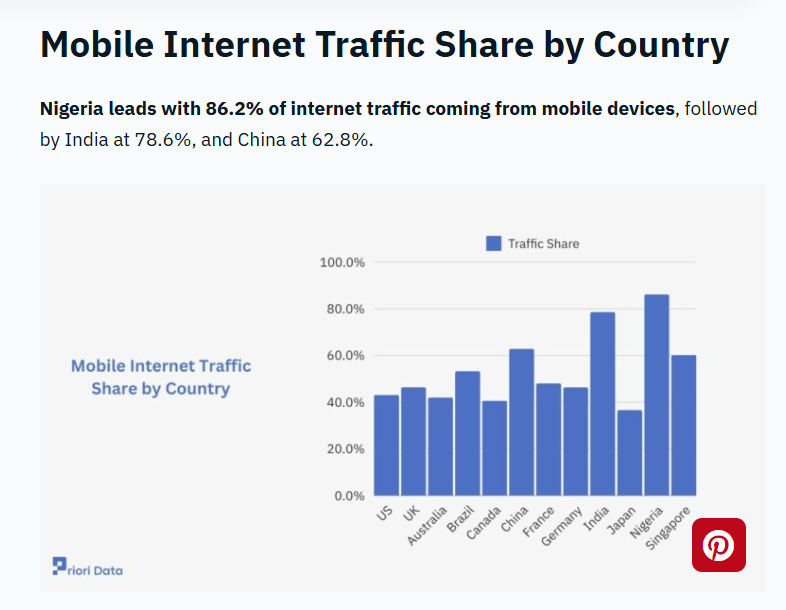
The mobile responsiveness impact on Nigerian users is immediate and direct: a customer in Surulere browsing for a fashion vendor, a trader in Onitsha comparing logistics companies, a startup founder in Abuja vetting a web agency, all of them are on their phones.
All of them will leave within seconds if your site doesn’t load cleanly. In cities like Lagos, Kano, and Port Harcourt, most small business customers browse, compare, and contact vendors on their phones before they ever visit a physical location.
The importance of mobile sites in Naija extends beyond Lagos. Tier-2 and tier-3 cities Owerri, Enugu, Kaduna, Benin City, are catching up fast on smartphone penetration, and their users have the same expectation of having a site that works on their device.
A website that breaks on mobile is, effectively, invisible to the majority of Nigerian internet users in 2026.
The need for adaptive sites in Nigeria isn’t a trend prediction. It’s today’s market reality, and yet walk through any Lagos business district, pull up the websites of small businesses, and you’ll find a disturbing number of them still serving desktop-first layouts that break hilariously on a phone. That’s not just a design problem; it’s a revenue problem.
Google Penalizes Non-Responsive Sites in Nigerian Search Results
Since adopting mobile-first indexing in 2019, Google evaluates the mobile version of your website, first, to determine your search rankings. If your mobile experience is slow, disorganized, or broken, Google marks your site down in its quality assessment.
For Nigerian SMEs relying on organic search to bring in new customers, this is not a technicality, but your visibility being cut.
The SEO gains from responsive design in Nigeria are equally real. A site that performs well on mobile, fast loading, clean layout, readable text, easy navigation, gets rewarded with better positions for both local (“best events company Lagos”) and broader (“web design Nigeria”) search terms.
As Google’s mobile-first indexing documentation confirms, sites with poor mobile usability are deprioritized in crawling and indexing. That’s straight from the source.
For Nigerian businesses spending on SEO or Google Ads, non-responsiveness is double damage: poor organic rankings and wasted ad budget sending expensive mobile traffic to pages that drive people away immediately.
The Google mobile-first indexing Nigeria reality cannot be negotiated around or delayed, it is the current standard, and it has been for years.
Nigerian Users Abandon Slow or Broken Mobile Sites Instantly
Speed and usability are not separate issues; they are the same issue. Google’s own research on mobile page speed established that 53% of mobile users globally leave a page that takes more than 3 seconds to load.
For Nigerian users on 3G connections, which remain common outside Lagos and Abuja, that threshold is crossed regularly on sites that were never optimised for performance.
The benefits of responsive design in the local market include directly reduced bounce rates. When a site loads cleanly and quickly on a Tecno or Infinix device, visitors stay. They read your services page. They watch your demo, click your WhatsApp button, and they convert.
A visitor who bounces from your broken mobile site, on the other hand, typically goes directly to a competitor’s site, and they do not come back. In a competitive Nigerian market, that churn compounds painfully.
Want a sharper picture of what poor responsiveness costs your conversions? Read why your business needs a conversion-optimized website in Nigeria for specific conversion data across Nigerian business categories.
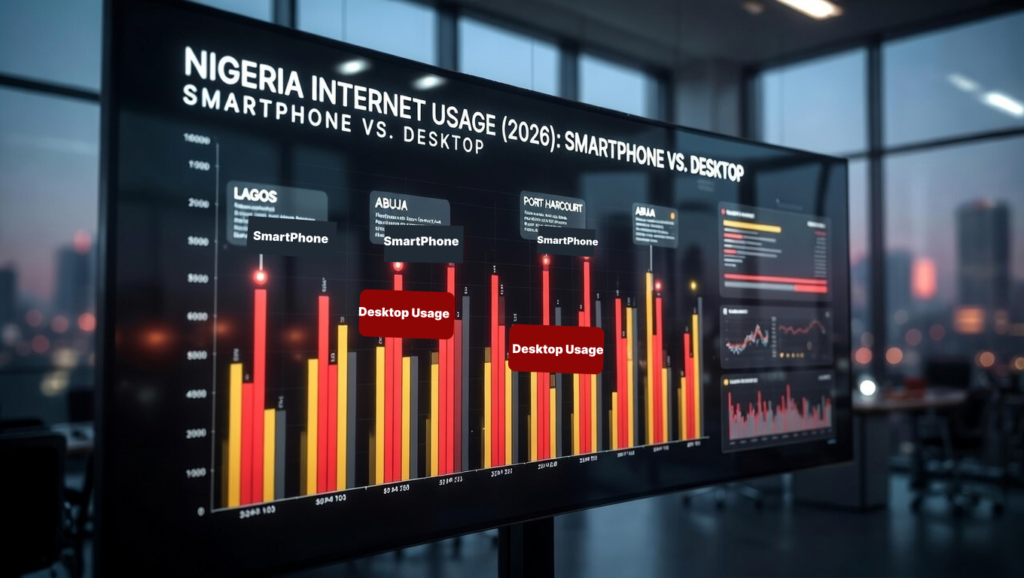
The chart below shows just how skewed Nigerian internet usage is toward mobile, and why designing for anything else first is designing for the minority.
Mobile First Design in Nigeria Trends Reshaping Business Websites in 2026
The conversation around mobile first design in Nigeria trends has shifted significantly. Three years ago, it was a recommendation. Today, it is the baseline standard, and the businesses that haven’t caught up are running behind on multiple fronts simultaneously.
Here are the three 2026 responsive design shifts in Naija that matter most.
Trend #1: Mobile-First Design Is Now the Starting Point, Not the Afterthought
The old process: design a gorgeous desktop site, then figure out how to squeeze it onto a phone.
The correct process: design the phone version completely first, then scale up to desktop.
Nigeria mobile first web trends show that the best agencies, the ones producing sites that actually rank and convert, build this way by default.
Why does the sequence matter so much? Because designing for mobile forces a discipline that benefits the entire site. When you only have 375 pixels of horizontal space, every element on the page must justify its existence.
Only the most important content survives the small-screen filter. Only the most critical CTA gets prime placement and only the most essential navigation makes the cut. When those same disciplined decisions are then expanded to a desktop layout, the result is cleaner, faster, and more purposeful than anything built the other way around.
Businesses still on old desktop-first sites are at a structural disadvantage in Nigerian search, not just aesthetically, but technically and algorithmically. Their mobile experience is a retrofit built on a foundation that was never designed for it.
The cracks show in load speed, in layout breaks on smaller phones, and in the user friction that turns visitors into bounce statistics. Future-proof mobile design in Nigeria means starting the right way.
Trend #2: Faster Loading Pages Are Becoming a Competitive Requirement
Nigeria’s internet infrastructure is evolving fast and the Nigerian Communications Commission (NCC) has confirmed 5G network licensing and expansion across major Nigerian cities, with Lagos and Abuja leading rollout.
As faster networks arrive, user expectations are rising proportionally, what was an acceptable 4-second load time in 2022 is frustrating in 2026.
The practical 2026 responsive design shifts in Naija around performance include: serving images in WebP format instead of raw JPEGs, implementing lazy loading so below-the-fold content doesn’t block initial page render, minifying CSS and JavaScript, and selecting hosting with strong West Africa CDN coverage. None of these are exotic, they are standard practice for any developer building for the Nigerian market seriously.
The top mobile web trends in Lagos and other commercial centers confirm that faster loading responsive websites on Nigerian networks are not just good for user experience, they are measurably driving more conversions. Portent’s website speed research puts the number at 7% more conversions per second of improvement.
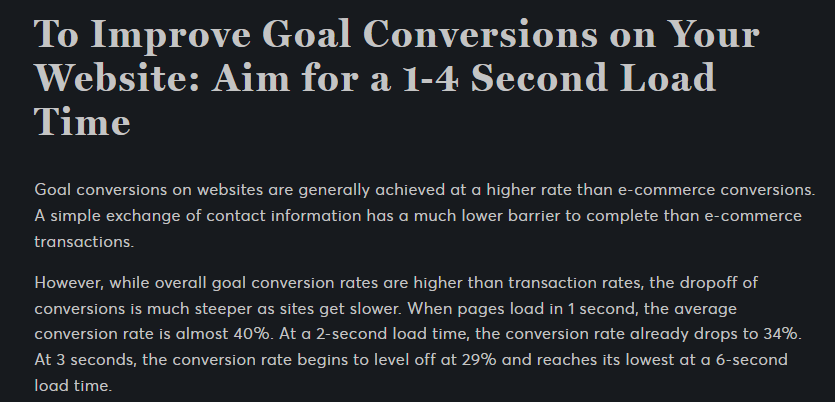
For a site receiving 400 Nigerian visitors monthly, one second faster means roughly 8–12 additional conversions per month. That’s not nothing, that’s compounding, monthly revenue impact from a one-time technical investment.
Trend #3: Voice Search and Conversational Queries Are Growing in Nigeria
This trend surprises most Nigerian business owners, and it shouldn’t. Voice search is no longer a curiosity, it’s growing in Nigeria, driven by the same smartphone adoption that’s driving everything else.
Nigerians are increasingly using voice commands in Pidgin, Yoruba, Hausa, and English to search for businesses, get directions, and find information. Mobile priority layouts for Nigerian sites now need to account for this shift.
The practical implication: voice search generates conversational queries, “how much does a website cost in Nigeria” rather than just “website cost Nigeria.” Sites that structure their content around natural questions, with clear headings, short answers, and FAQ sections, rank better for voice and AI search results.
Top mobile web trends in Lagos show that long-tail conversational queries are driving more targeted, intent-rich traffic than short keywords alone. This is directly the kind of traffic that converts. Structuring your content this way future-proofs your SEO against Nigeria’s evolving search landscape, including LLM-powered searches on ChatGPT, Perplexity, and Google AI Overviews.
Here’s a simplified look at the mobile-first design flow and how a properly built Nigerian business website moves from concept to launch the right way.
Mobile-First vs Desktop-First: What It Means for Nigerian Business Websites
| Factor | Desktop-First Site | Mobile-First Site | Impact for Nigeria |
| Google Ranking | Penalised | Favoured ✓ | Direct SEO loss |
| Load Speed | Slow on mobile | Optimised ✓ | Lower bounce rate |
| User Experience | Broken layouts | Fluid & clean ✓ | Higher conversions |
| Local Reach | Limited | Broad reach ✓ | More Nigerian leads |
| Long-term Cost | Constant fixes | Low maintenance ✓ | Better ROI |
The Benefits of a Responsive Website for Nigerian Businesses
The benefits of responsive web design in Nigeria aren’t theoretical blog talking points, they show up in your analytics, your WhatsApp inquiry count, and your monthly revenue.
Here is what actually changes when a Nigerian business switches from a broken desktop site to a properly built responsive one.
Higher Google Rankings and Organic Traffic in Nigeria
The SEO gains from responsive design in Nigeria begin the moment Google re-crawls your mobile-optimised site. Google directly rewards sites that deliver strong mobile experiences with better positions for both local (“electrician Abuja”) and broader (“marketing agency Nigeria”) search terms.
More positions mean more organic traffic, visitors who found you without you spending a naira on ads.
A responsive site built with clean code, structured headings, and fast load time gives Google’s crawler exactly what it wants to see: a site that will deliver a quality experience to users it sends there. Google rewards that.
Over time, as your pages accumulate organic authority, the compound effect of local SEO responsive design in Nigeria becomes one of your most powerful and cost-efficient marketing channels. And it all starts with a site that works correctly on a phone.
Pair your responsive website with a solid content strategy to maximize rankings. Professional website design in Nigeria: Sizzle Digital’s complete 2026 guide covers exactly how to build SEO authority alongside technical performance.
Faster Loading on Nigerian Mobile Networks Means More Sales
For a Nigerian business website receiving 500 visitors per month with a 2% conversion baseline, a two-second speed improvement yields roughly 14 additional conversions monthly. Over 12 months, that’s 168 additional sales opportunities, from a technical improvement, not from increased ad spend.
The advantages of mobile-friendly sites in Naija around speed are particularly pronounced for users outside Lagos and Abuja, where 3G connections remain common. A site loading in 2.5 seconds on 3G retains visitors; one loading in 6 seconds loses them, their attention, and their money.
The solution is faster loading responsive Nigeria networks performance, image compression, lazy loading, optimised hosting, all of which should be embedded in the website build, not bolted on after launch.
Better Engagement and Higher Conversions Across All Devices
Higher conversions on adaptive websites come from one elegant source which is, visitors who can actually read, navigate, and act on your content, without zooming, without horizontal scrolling, without hunting for a contact button that’s hiding behind an image.
When the mobile experience is smooth and fast, visitors stay. They scroll through your services. They read your testimonials and they click that WhatsApp button.
The numbers behind this are striking. Study found that mobile-friendly websites see up to 67% higher conversion rates compared to non-mobile-friendly equivalents.
For Nigerian e-commerce responsive website builds specifically, the impact on checkout completion is even sharper, the mobile payment flow (Paystack, Flutterwave) must be smooth or the transaction is abandoned at the final step. Knowing how to build a high-converting business website in Nigeria ensures these technical details are handled correctly to prevent lost sales.
Better engagement on mobile sites locally also feeds back into your SEO. Longer session times, lower bounce rates, and more pages visited per session all signal to Google that your site delivers value, which improves your rankings further.
Better UX → Better SEO → More traffic → More conversions. Each element reinforces the others. The mobile UX design Nigeria investment, done properly, is self-compounding.
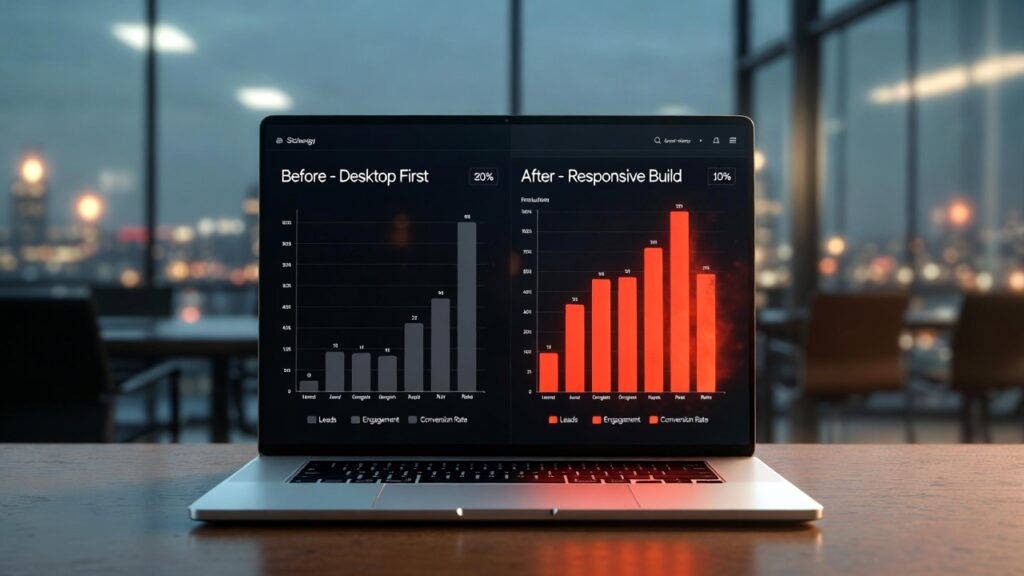
The conversion impact of switching to a responsive build is tangible and consistent. The chart below illustrates what Nigerian businesses typically see after a properly executed Sizzle Digital responsive redesign.
One Website That Works Everywhere: No Double Maintenance
One of the advantages of mobile-friendly sites that gets less attention than it deserves is operational simplicity. A fully responsive website is one website, one codebase, one URL, one set of content to manage, one analytics dashboard to review.
Your SEO authority is concentrated in a single domain. Every backlink, every social share, and every Google crawl goes to the same place.
Compared to businesses running separate desktop and mobile sites (the old m-dot setup), they’re managing twice the content, splitting their SEO authority, and paying double hosting costs for the privilege of a worse outcome. This efficiency is a major factor when calculating website redesign costs in Nigeria as it reduces long-term maintenance overhead.
Flexible web layouts Nigeria built on WordPress responsive architecture eliminate this entirely. One well-built foundation that scales to every screen, maintained by one team and growing one domain’s authority. That’s not just technically cleaner, it’s strategically smarter.
How to Build a Responsive Website in Nigeria: What the Process Actually Looks Like
A lot of Nigerian business owners have been burned by web designers who promised the world, took payment, and delivered something that broke on their own phone. The frustration is real, and it’s earned.
So let’s demystify the process of how to build a responsive website in Nigeria properly, what each stage involves, and what you should expect from a competent agency at every step.
Define Your Business Goals and Target Nigerian Audience
Before a single wireframe gets drawn, a skilled mobile responsive developer in Lagos or Abuja should ask you one essential question:
- What do you need this website to do?
- Generate leads?
- Sell products?
- Build brand credibility?
- Drive WhatsApp inquiries?
Each goal demands different design decisions, different CTA placements, different content hierarchies, different page structures.
Knowing your Nigerian audience shapes every technical decision. If most of your customers are in cities with strong 4G coverage, different image optimization standards apply than if a significant percentage are in areas still on 3G.
If your buyers are aged 25–35 and Lagos-based, their behavior patterns differ from customers aged 40–55 in Abuja’s business district. This audience intelligence is not optional background, but the foundation of adaptive site design in Lagos Nigeria that converts.
As digital marketing strategist Rand Fishkin, co-founder of SparkToro and Moz, has consistently argued: “Content and design that serves a specific audience’s specific needs will always outperform generic.”
This principle is even more acute for Nigerian businesses, where local context, payment preferences, communication habits, trust signals, is decisive in determining whether a visitor becomes a customer.
Design for Mobile First, Then Scale to Desktop
This is the step that separates a properly built site from one that will need a full rebuild in 18 months. Okay, here’s how to create a mobile site in Nigeria the right way: design the phone layout completely before touching the desktop version. Not the other way around, not simultaneously, but the Phone first always.
In practice, this means designing wireframes at 375px wide (standard small phone width) first, making every decision about navigation, content hierarchy, and CTA placement for that constraint.
Then, and only then, does the design scale outward to tablet (768px) and desktop (1280px+). The result is a site where the mobile experience is polished by design, and not patched after the fact.
Tools like Figma allow designers to show clients exactly what the mobile layout looks like before a line of code is written. This means no surprises at launch. You see the phone design, you approve of it, you see the desktop version and then you approve it.
Then development begins and any agency skipping this approval stage is working faster than it is working well.
Develop With Performance and SEO Built-In from Day One
To develop a responsive website with a Naija agency that actually delivers results, performance and SEO must be baked into the build, not treated as add-ons after the site is live.
The key elements of a performance-first responsive build include:
- Image optimisation: All images compressed and served in WebP format, not raw camera JPEGs that add seconds to load time
- Minimal plugin stack: Only essential WordPress plugins, the typical Nigerian business site has 20+ plugins it doesn’t need, all of them slowing the page
- Performance-optimised hosting: Server location with low-latency coverage for West Africa, or CDN configured for Nigerian traffic
- Technical SEO embedded: Structured H1/H2/H3 headings, meta titles and descriptions, schema markup, XML sitemap, all configured before launch, not after
- Clean WordPress architecture: A lightweight, well-coded theme without drag-and-drop builder bloat that doubles page weight
The cost of responsive design for Nigerian firms built this way is recovered quickly. A properly built site reduces wasted digital ad spend, improves organic rankings, and converts more visitors per month from day one.
Website design cost in Nigeria: the 2026 pricing breakdown gives a detailed look at what quality investment looks like across different project types.
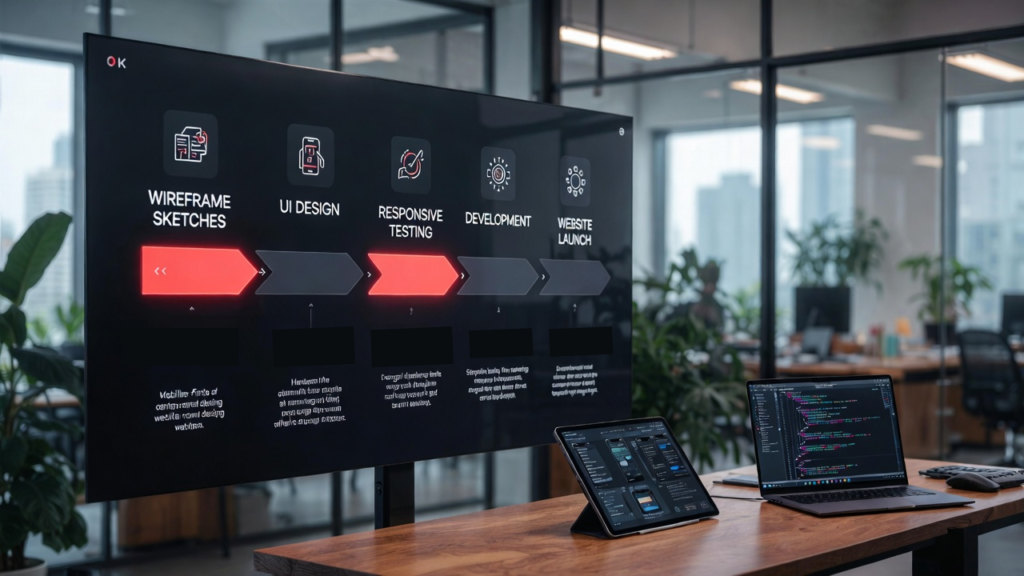
The development process for a professional responsive Nigerian business website follows a disciplined, sequential flow, each stage building on the last.
Here’s what it looks like from start to go-live.
Test Across Nigerian Devices and Network Conditions Before Launch
The steps to build an adaptive site in Abuja, Lagos, or anywhere in Nigeria must include real-device testing, not just resizing a Chrome browser window on a developer’s laptop.
Nigerian customers use specific phones: Tecno Camon and Spark series, Infinix Hot and Note series, Samsung Galaxy A03 through A54, and budget itel devices common in smaller cities. The site must work cleanly on all of them.
Network simulation is equally non-negotiable. Testing under 3G conditions reveals what your customers in Enugu, Kaduna, and Aba actually experience when your page loads, and it’s often very different from what the developer sees on fibre.
Any page taking more than 4 seconds on 3G simulation needs to be addressed before launch, not after. Browser testing must include Opera Mini, one of the most-used mobile browsers in Nigeria specifically because of its data compression features.
If your site renders poorly on Opera Mini, you are failing a significant chunk of your Nigerian audience. This level of detail is what distinguishes an agency that understands the Nigerian market from one that doesn’t.
For a list of the most expensive mistakes made in Nigerian web projects, website design mistakes Nigerian businesses must avoid in 2026 is an essential reading before you sign any contract.
Responsive Websites for Nigerian Businesses: What to Look for in an Agency
Not all web agencies in Nigeria are equal, and that’s a polite way of putting it. Choosing the wrong one can cost you more than the website itself, in wasted money, delayed launches, and broken sites you’ll spend months trying to fix.
Here is how to evaluate responsive websites for Nigerian businesses agencies properly, and the specific questions that separate genuine experts from smooth-talking generalists.
1. Look for an Agency That Builds Mobile-First, Not Mobile-Afterthought
Ask every agency you’re considering directly: “Do you design the mobile layout before the desktop layout?”
If the answer is anything other than an unambiguous yes, if they seem confused, or pivot to talking about how their templates are “automatically responsive” move on.
Automatically responsive templates are not the same as intentionally designed mobile-first experiences.
Ask to see their recent portfolio specifically on a phone. Open their previous client websites on your own Tecno or Samsung.
- Do they load within 3 seconds?
- Does the navigation work cleanly with a thumb?
- Is the text readable without zooming?
- Are the CTAs prominent and tappable?
This test takes two minutes and tells you more than any proposal document. Mobile friendly web design in Naija done right is visible immediately, and its absence is equally obvious.
For a thorough guide to the right selection criteria, how to choose the right web design agency in Nigeria walks through exactly what questions to ask and what answers to look for before signing anything.
2. Prioritize Agencies With Local Nigerian Market Understanding
A Fiverr freelancer building from a template in Bulgaria does not know that WhatsApp integration drives higher conversion for most Nigerian service businesses than any other contact method.
They don’t know that Nigerian testimonials need to be specific and local to build trust with a Lagos or Abuja audience. They don’t know that mentioning Paystack and Flutterwave on a pricing page increases purchase confidence for Nigerian buyers in a way that a generic “secure checkout” badge does not.
These are not design preferences, they are conversion-critical features that an agency fluent in the Nigerian market builds in by instinct.
Adaptive site design in Lagos done right requires knowing how Nigerian customers think, what makes them trust a business online, and what frictions cause them to abandon a purchase. International template builders operate in a different market entirely.
3. Demand Transparency on Performance, SEO, and Ongoing Support
Launching a website is not the end of the relationship, it should be the beginning of one. Adaptive site design in Lagos, Nigeria must come with post-launch accountability: speed monitoring, plugin security updates, content edits, SEO tracking, and performance reporting.
A site that gets no maintenance decays: plugins become security liabilities, page speed degrades, rankings slip.
Before any agency takes your money, ask these specific questions:
- What is your response time for post-launch support requests?
- Do you provide monthly performance reports?
- What does your maintenance retainer include?
- What happens if the site breaks after go-live?
An agency that gives clear, confident answers to all four has planned for a long-term partnership. One that deflects, generalizes, or promises to cross that bridge when they come to it is planning to vanish with your final payment.
Wondering whether a custom build or a template is right for your specific situation? Custom website design vs templates: what Nigerian brands should choose breaks down the honest trade-offs for different business types and budgets.
Here’s a practical reference checklist for evaluating any web agency you’re considering for a responsive Nigerian business website project.
Are you losing rankings and sales because of poor mobile design?
In 2026, a Nigerian business website that breaks on a phone is not a minor inconvenience, it is a structural failure.
It fails your customer the moment they arrive. It fails your Google ranking every time the crawler visits and it fails your ad ROI every time a paid click bounces immediately.
And it fails your brand by signalling, loudly and wordlessly, that you haven’t thought about the people you’re trying to serve. Mobile responsive design in Nigeria is the foundation of digital growth.
Why responsive websites matter in Nigeria is not a question for another year. Mobile first design in Nigeria trends are already here, they arrived years ago, and the gap between businesses acting on them and those ignoring them is already visible in their search rankings and conversion data.
The good news is: the path forward is clear. Define your audience, build mobile-first design, optimize for performance, test on Nigerian devices, then choose an agency that understands the Nigerian market and will be there after launch.
These are not secrets, they are the unsexy, unglamorous, genuinely effective fundamentals of building a business website that works.
Whether you’re building from scratch, redesigning what you have, or just trying to understand where your current site is failing, Sizzle Digital is the partner for that conversation.
Similar Blog Post You Might be Interested In
How to Build a High-Converting Business Website in Nigeria from Scratch
Most Nigerian business owners who’ve tried to build a website have one of two stories. Either they paid somebody ₦80,000, waited four months… Read more
How to Turn Your Nigerian Business Website Into a 24/7 Sales Machine
On mobile UX, a one-second delay in mobile page load time can drop conversions by up to 20%. And most … Read more
How to Choose the Right Web Design Agency in Nigeria
Last week, my auntie called me crying. Well, not crying-crying, but that Nigerian mother kind of crying where the voice shakes but she’s too proud … Read more
FAQs
Mobile responsive design is a method of building websites so that the layout, images, text sizes, and navigation automatically adjust to fit any screen, whether it’s a Tecno Camon, a Samsung Galaxy tablet, or a wide desktop monitor. The site doesn’t break, shrink awkwardly, or force users to zoom and scroll sideways. It simply works, beautifully, on every device.
For Nigerian businesses in 2026, this is no longer optional. Over 85% of Nigerian internet users browse exclusively on smartphones. That means your website’s first impression, and often its only impression, happens on a phone screen. A site that isn’t responsive turns paying customers into bounce statistics. Beyond user experience, Google now ranks websites based on how they perform on mobile first (mobile-first indexing). A non-responsive site doesn’t just frustrate users; it gets penalised in search rankings, cutting off your organic traffic. The bottom line: if your website isn’t responsive, it isn’t working.
Directly and significantly. Since 2019, Google has operated on a mobile-first indexing policy, meaning it crawls and evaluates the mobile version of your website to determine where you rank in search results. If your mobile site is slow, broken, or hard to navigate, Google treats your whole domain as lower quality and pushes you down the rankings.
For Nigerian SMEs competing for visibility in local searches, “best event planner Lagos,” “web design company Abuja,” “fashion store Nigeria”, losing those ranking positions is losing real customers. Your competitor with a properly responsive site will appear above you, absorb your traffic, and grow their business while yours stagnates. The SEO gains from responsive design in Nigeria are direct: better mobile experience → better Google scores → higher rankings → more organic traffic. It compounds over time, and it starts the moment you launch a properly built site
These two terms are related but not identical. Responsive design is an outcome, a website that flexibly adapts to any screen size. Mobile-first design is a process, a philosophy that says you design the smallest screen layout first, then scale upward to tablet and desktop. All mobile-first websites are responsive, but not all responsive websites are built mobile-first.
The distinction matters practically because mobile-first design forces better decisions. When you start with the constraints of a small phone screen, you are forced to prioritise the content and actions that matter most. The result is cleaner navigation, faster load times, and more focused CTAs that work beautifully on desktop too. Websites built desktop-first and then “made responsive” often have bloated code, awkward mobile layouts, and slower performance. For Nigerian businesses where most customers arrive via phone, the mobile-first approach is not just better, it is the correct starting point for every project.
There are several reliable ways to test this. The quickest is Google’s free Mobile-Friendly Test at search.google.com/test/mobile-friendly, paste your URL and Google tells you whether it passes its mobile usability standards, along with specific issues if it doesn’t.
You can also open your website on your own phone right now and look for warning signs: does the text fit the screen without zooming? Do buttons appear large enough to tap with a thumb? Does the menu open and close cleanly? Do images resize correctly? Does the page load in under 3 seconds on mobile data? For a deeper technical audit, Google PageSpeed Insights (pagespeed.web.dev) scores your site on mobile performance from 0-100, with specific recommendations. For Nigerian businesses, anything below 60 on mobile is a problem worth fixing urgently. A Sizzle Digital consultation includes a full technical audit of your current site before any redesign begins
Pricing varies by project scope, complexity, and agency. As a general guide for the Nigerian market in 2026: a basic responsive business website (5–8 pages, home, about, services, contact, blog) from a reputable local agency typically ranges from ₦150,000 to ₦450,000. E-commerce sites with payment integration (Paystack, Flutterwave) start around ₦400,000 and scale upward depending on product volume and custom features. High-end custom builds for larger businesses can exceed ₦1,000,000.
What many business owners miss is the cost of not having one. A non-responsive site running Google Ads wastes budget every time a mobile visitor bounces immediately. Poor SEO rankings mean you pay more for paid traffic because organic isn’t working. Lost conversion opportunities from broken mobile experiences cost more than the website itself over a 12-month period. The investment in a well-built responsive site typically pays for itself within the first few months of improved performance. See the full breakdown at Sizzle Digital’s website design cost guide.
Sometimes, yes, but it depends on how the original site was built. If you’re on a modern WordPress theme that supports responsive behaviour, a skilled developer may be able to update the theme, fix layout issues, and optimise images for mobile without rebuilding from scratch. This is usually faster and cheaper.
However, if your site was built on outdated code, a rigid custom layout, Flash-based elements, or a platform that no longer receives updates, trying to retrofit responsiveness is like patching a leaking roof instead of replacing it. You’ll spend money repeatedly on fixes while the core problems persist. The honest answer: always get a professional assessment first. Sizzle Digital evaluates existing sites before recommending a path, sometimes a targeted fix is right, sometimes a fresh build is the smarter investment. The decision should be based on what delivers the best ROI for your business, not just what’s cheapest in the short term
Testing on real devices that reflect the Nigerian market is essential, not just resizing a Chrome window on a developer’s laptop. The most important devices to test on include: Tecno Camon and Spark series (one of the highest-selling smartphone lines in Nigeria), Infinix Hot and Note series, Samsung Galaxy A03, A13, A23, and A54 (popular mid-range options), iPhone SE and iPhone 11/12 (used widely in Lagos among middle-income demographics), and budget itel devices (common in tier-2 and tier-3 cities).
Beyond device testing, network simulation matters. Testing under 3G conditions (still common in many Nigerian states outside Lagos and Abuja) reveals performance issues that 4G or WiFi testing would hide. Browser testing should include Chrome Android, Safari iOS, and Opera Mini, the latter is disproportionately popular in Nigeria for its data-compression features. Many Nigerian users on limited data bundles use Opera Mini as their primary browser, and sites that don’t render correctly on it lose a significant audience.
The impact is measurable and significant. Research from Google and Portent consistently shows that a one-second improvement in page load speed increases conversion rates by approximately 7%. For a Nigerian business website receiving 500 monthly visitors with a 2% baseline conversion rate, shaving one second off load time translates to roughly 7 additional inquiries or sales per month. Over a year, that’s 84 additional business opportunities, purely from speed improvement.
For Nigerian users specifically, the impact is amplified. Mobile data in Nigeria is expensive relative to income for many users. Slow pages consume precious data while delivering nothing. The user frustration is immediate, and they leave. Pages loading in under 2.5 seconds on a 3G connection retain significantly more Nigerian visitors than pages taking 5+ seconds. The factors that slow Nigerian business sites most frequently are oversized uncompressed images, too many third-party scripts and plugins, cheap hosting with servers far from West Africa, and no CDN (Content Delivery Network) configured for African traffic.
For the vast majority of Nigerian SMEs, startups, and entrepreneurs, a mobile-responsive website is the right first investment, not a mobile app. Here’s why: a responsive website works on every device without requiring a download. It can be found through Google search (apps cannot be discovered via organic search). It costs significantly less to build and maintain than a native app. It can be updated instantly without pushing app store updates. And it serves as the hub for all your digital marketing, your ads, your social media links, your WhatsApp business card all point back to it.
A mobile app makes sense once you have an established customer base with high repeat interaction needs, delivery platforms, loyalty programmes, subscription services. But building an app before you’ve proven product-market fit and established website traffic is putting the cart before the horse. The strategic sequence for Nigerian businesses is consistent: build a strong responsive website first, drive traffic, convert customers, grow revenue, then evaluate whether an app adds meaningful value to the next stage of growth.
Extremely important, arguably the single highest-impact conversion feature for most Nigerian business websites. Nigerian consumers are deeply WhatsApp-native. It’s the primary channel for business communication, price negotiation, order placement, and customer service across nearly every industry. A floating WhatsApp click-to-chat button on a responsive website reduces contact friction to a single tap, connecting the visitor directly to your business conversation in an app they’re already comfortable with.
For industries like fashion, real estate, food delivery, beauty services, professional consulting, and e-commerce, WhatsApp-generated inquiries from websites consistently outperform contact form submissions in both volume and conversion rate. The key is correct implementation on mobile: the button must be properly sized for thumb tapping, positioned to avoid obstructing content, and pre-filled with a greeting message that tells the customer’s message context. A mobile-first design approach ensures this is built correctly, not as a messy afterthought floating randomly over your homepage.
Your ad ROI suffers significantly and measurably. When you run Google or Meta Ads in Nigeria, the majority of your paid traffic arrives on mobile devices. If those visitors land on a non-responsive page, slow, broken layout, hard-to-tap buttons, they bounce immediately. You’ve paid for the click; you received zero value from it.
Worse, both Google Ads and Meta Ads use post-click quality signals to determine your Quality Score (Google) or Relevance Score (Meta). High bounce rates, low session durations, and poor engagement on your landing page all reduce your scores, which directly increases your cost per click and reduces your ad reach. This creates a compounding problem: you pay more, reach fewer people, and convert a smaller percentage. A responsive, fast landing page reverses this entirely, lower bounce rates improve scores, reduce CPCs, and extend reach. For Nigerian businesses spending ₦50,000–₦500,000 per month on digital advertising, fixing responsiveness often delivers better returns than increasing ad budget.
Google mobile-first indexing means that Google’s search crawler primarily evaluates the mobile version of your website to decide how to rank it in search results. Before 2018, Google ranked websites based on their desktop version. Now, it’s the opposite. If your mobile site is incomplete, slow, or poorly structured, you’re ranked lower, regardless of how polished your desktop site is.
For Nigerian websites specifically, this matters for several reasons. First, many Nigerian business sites were built 5–10 years ago with desktop-first design and have never been properly updated for mobile. These sites are actively penalized in Nigerian search results today. Second, Nigerian search competition is intensifying, more local businesses are investing in digital presence, and mobile performance is one of the clearest ranking differentiators. Third, Nigerian Google searches skew heavily local and intent-driven (“buy shoes Lagos,” “lawyer Abuja,” “web designer near me”), the businesses appearing in featured snippets and top results for these queries in 2026 are almost exclusively mobile-optimized.
The timeline varies by project complexity. A standard 5–8-page business website (homepage, about, services, contact, blog, testimonials) typically takes 4–6 weeks from project kickoff to launch, assuming the client delivers content (text, branding, images) within the first week. E-commerce websites with product listings, payment gateway integration, and inventory management typically run 6–10 weeks. Complex custom platforms with unique functionality can take 10–16 weeks.
The single biggest cause of delays in Nigerian web projects is content delivery from the client side, logo files, product descriptions, photography, testimonials. Having these ready before the project starts can cut two to three weeks off the timeline. Sizzle Digital provides clients with a content checklist at project kickoff that covers everything needed, so there are no surprises mid-project. Most importantly: a well-built site that takes six weeks is worth infinitely more than a rushed two-week build that needs constant repairs
Yes! This is one of the most valuable aspects of having your site built on WordPress, which Sizzle Digital uses as its primary development platform. WordPress has a user-friendly content management system (CMS) that lets non-technical business owners update text content, add blog posts, upload new images, modify product descriptions, and add testimonials, all without touching code.
You can log into your WordPress dashboard from your laptop, tablet, or even your phone and make live changes immediately. Sizzle Digital includes a basic WordPress training walkthrough as part of every project handover, covering the tasks you’ll need most: publishing blog posts, updating service pages, adding new team members, managing contact inquiries. For technical changes, new features, layout modifications, plugin installations, Sizzle Digital’s maintenance retainer handles these professionally. You’ll have independence for daily updates and expert support for anything more complex.
A responsive website uses a single domain and codebase that adapts to every screen size through CSS media queries and flexible layouts. An m-dot site (like m.yourwebsite.com) is a completely separate website, different URLs, different code, often different content, built specifically for mobile visitors.
The industry has almost entirely moved away from m-dot sites for good reasons. With a responsive site, all your SEO authority concentrates on one URL, every backlink, every Google crawl, every social share goes to the same domain. With an m-dot setup, your SEO power is split between two domains, weakening both. You also maintain two separate websites, doubling content management effort and hosting costs. Responsive sites automatically adapt to the ever-expanding range of screen sizes (foldable phones, ultra-wide tablets, smart TVs) without needing separate versions. For any Nigerian business considering or currently running an m-dot site: migrating to a single responsive domain will almost certainly improve your SEO and simplify your operations.
The impact on e-commerce is profound and directly measurable in revenue. The entire Nigerian online shopping journey, discovering a product on Instagram, clicking through to a website, browsing products, adding to cart, entering payment details, completing checkout, happens predominantly on a phone. If any stage of that journey is broken by a non-responsive layout, you lose the sale.
Specifically for Nigerian e-commerce: product image galleries that don’t swipe on mobile, checkout forms with text fields too small to tap accurately, payment buttons that fall off-screen, and cart pages that don’t resize correctly are all conversion killers. Each one is a moment where a customer simply gives up. Studies consistently show that mobile-optimized e-commerce sites see 2–3x higher conversion rates than non-responsive equivalents. For Nigerian online stores integrated with Paystack or Flutterwave, the payment page experience on mobile is especially critical, any friction at checkout means an abandoned transaction. Sizzle Digital builds e-commerce flows with the mobile checkout experience as the primary design priority.
Hosting choice significantly affects how fast your responsive website loads for Nigerian visitors, and load speed directly affects bounce rates, SEO rankings, and conversions. The key factor is server location: the physical distance between your server and your visitor adds latency. A server in London serving a user in Lagos adds more delay than a server in Johannesburg or Lagos itself.
For Nigerian businesses, strong options include: Whogohost and QServers (local Nigerian hosting providers with naira billing and decent infrastructure for standard sites), Cloudways on a DigitalOcean server in Johannesburg (significantly closer to Nigerian users than US/European servers, excellent performance and caching options), and SiteGround with CDN enabled (solid global infrastructure with Cloudflare CDN coverage of West Africa). Avoid ultra-cheap shared hosting from providers with no African infrastructure, the ₦5,000/year saving translates to 3–6 second load times that cost you customers daily. Sizzle Digital advises on the optimal hosting configuration for each project based on expected traffic volume and budget
A well-built responsive website, properly maintained, typically remains competitive for 3–5 years before needing a significant redesign. However, several triggers indicate it’s time for a refresh before that timeline: your site looks visually outdated compared to competitors; your mobile bounce rate has climbed above 70% and isn’t improving; your page speed scores are declining; your business model, target audience, or branding has significantly changed; or conversion rates are dropping despite stable traffic.
The more important question isn’t about redesigns; it’s about continuous maintenance and improvement. Blog content should be updated regularly. Service pages should reflect current offers. Testimonials should be fresh. Page speed should be monitored monthly. Technical issues should be resolved as they emerge. A website is not a one-time project; it’s a growing business asset. Sizzle Digital’s growth partnership model includes monthly monitoring and performance reporting, keeping your site competitive without waiting for a full rebuild to become necessary.
Several Google Analytics 4 (GA4) metrics directly tell you how your responsive website is performing for Nigerian visitors. Mobile bounce rate is your first warning signal, anything consistently above 65% on mobile indicates a poor user experience. Average session duration on mobile (how long visitors stay) below 45 seconds typically signals they’re not engaging with your content. Conversion rate on mobile (percentage completing your desired action, form fill, WhatsApp click, purchase) should be tracked monthly and compared to desktop.
Page load speed on mobile, measured via Google PageSpeed Insights, should be reviewed quarterly, aim for 70+ score and under 2.5 seconds on mobile. Organic traffic from Nigeria in GA4 shows whether your SEO is improving. Click-through rates on CTAs (WhatsApp buttons, contact forms, booking links) reveal whether your mobile UX is effectively guiding visitors to action. Sizzle Digital sets up complete GA4 analytics tracking as part of every website project and provides monthly performance reports to clients on maintenance retainers.
There are hundreds of web designers in Nigeria advertising their services on Twitter, Instagram, and WhatsApp. So why Sizzle Digital? Three specific reasons stand out. First, Sizzle Digital builds every website mobile-first by default, not retrofitted, not adapted, but designed from the phone screen upward, aligned with Google’s 2026 indexing requirements and Nigerian browsing reality. This is the correct process; many agencies still do it backwards.
Second, Sizzle Digital understands the Nigerian market specifically, not generically. The agency knows that WhatsApp integration drives more conversions than contact forms for most Nigerian businesses. It knows that Nigerian testimonials should feel local and specific. It knows how to build payment trust with Paystack and Flutterwave CTAs. Generic international template builders do not know this. Third, Sizzle Digital operates a growth partnership model, not a hand-over-and-disappear model. After launch, the agency provides ongoing SEO monitoring, performance reporting, and maintenance support. Your website investment continues to work for you, not slowly decay. Visit sizzledigital.ng to see the work and book a free consultation.