Table of contents
- The Foundation of SEO Website Design in Nigeria: Structure Before Style
- On-Page SEO Nigeria Sites: Every Element That Moves Your Google Ranking
- Technical SEO Design Nigeria: Speed, Mobile, and Security: What Google Checks First
- Local SEO Website in Nigeria: How to Dominate Google Search in Lagos, Abuja, and Beyond
- The Complete SEO Website Design Checklist for Nigerian Businesses in 2026
- How To Turn Your Website Into a Revenue-Driving Asset
- Similar Blog Post You Might Be Interested In
- FAQs
Nigeria’s internet economy is one of the fastest growing on the continent. The truth is an SEO website designed in Nigeria for conversion that nobody finds is essentially a very expensive business card nobody picks up.
But the good news? SEO website design in Nigeria is the practice of building your site to rank on Google from day one which is not some mysterious art reserved for tech giants.
It is a learnable, repeatable process and this guide breaks it all down, step by step, in the kind of plain language a secondary school student in Abuja could follow.
Whether you are a founder just launching your first site or a business owner tired of your ₦300,000 design investment delivering zero traffic, this is the beginner SEO design guide you have been looking for.
Let’s get into it because your competitors in Lagos and Abuja are not waiting.

The Foundation of SEO Website Design in Nigeria: Structure Before Style
A website that looks great but has no keyword architecture is like a beautifully painted shop on a street with no signboard. People walk past it every day and never know what you sell. The foundation of every search-friendly site in Nigeria starts long before a designer touches Figma.
In fact, according to Ahrefs, over 90% of web pages get zero organic traffic from Google. And the number one reason? They were never planned around how people actually search.
1. Define Your Keyword Map Before Building Any Page
Before your developer writes a single line of code, you need to know exactly what Google search terms each page of your website will target. This is your keyword map and it is the blueprint that drives everything else.
Use free tools like Google Search Console, Ubersuggest, or the Google Keyword Planner to research primary, secondary, and long-tail keywords for your niche. The goal is simple: every page on your Nigerian website gets exactly one primary keyphrase.
For Nigerian SMEs specifically, think in city-intent terms. Search queries like “web design company Lagos”, “SEO agency Abuja”, and “digital marketing Port Harcourt” have people behind them who are ready to spend money right now. Target those terms on city-specific pages and you immediately tap into high-intent local traffic.
One critical mistake to avoid: keyword cannibalization.
This is when two pages on your site compete for the same search term, splitting your ranking power and confusing Google about which page to show. One keyword per page and no exceptions.
2. Build a Site Architecture Google Can Actually Crawl
Google’s crawlers are essentially bots walking through your website, following links from page to page. If your site structure is messy buried pages, confusing navigation, broken internal links they get lost. And a page Google cannot find easily is a page Google will not rank.
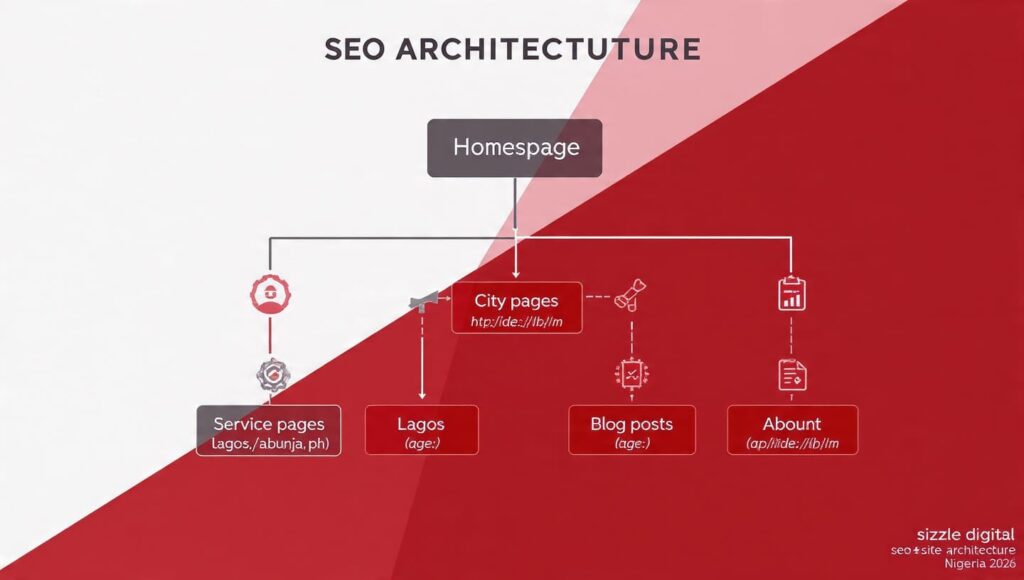
The rule of thumb for a Google ranking website in Nigeria is a flat structure: Homepage → Service Pages → Blog. No page should require more than three clicks to reach from your homepage. Create navigation menus that mirror your keyword map, with descriptive, keyword-rich labels “SEO Services”, not “What We Do.”
Once your site is live, submit an XML sitemap to Google Search Console. This is basically handing Google a map of every page on your site and saying here, index all of these. It sounds small, but it dramatically speeds up how quickly new pages get discovered and ranked.
3. Set Up SEO-Ready URL Structures from Day One
URLs are the addresses of your pages, and Google reads them as ranking signals. A URL like sizzledigital.ng/seo-services-nigeria tells Google and your visitors exactly what that page is about. A URL like sizzledigital.ng/page?id=47 tells nobody anything.
For location pages, put the city directly in the URL: /web-design-lagos, /seo-services-abuja. This is one of the simplest and most powerful local SEO web design signals you can send to Google. Keep URLs lowercase, use hyphens to separate words, and avoid random numbers, capitals, or underscores Google treats underscores as joined letters, not word separators.
| Page Type | Example URL Structure | Primary SEO Goal |
| Homepage | sizzledigital.ng/ | Brand + main service keyword |
| Service Page | sizzledigital.ng/seo-website-design-nigeria | Service keyword ranking |
| City/Local Page | sizzledigital.ng/web-design-lagos | Local search intent |
| Blog Post | sizzledigital.ng/blog/on-page-seo-nigeria | Long-tail keyword traffic |
| About Page | sizzledigital.ng/about | Brand trust + E-E-A-T signal |
If you are planning your very first website or thinking about a conversion-optimised redesign, getting this structural foundation right is the single most valuable thing you can do before a designer gets involved. Everything else builds on top of it.
On-Page SEO Nigeria Sites: Every Element That Moves Your Google Ranking
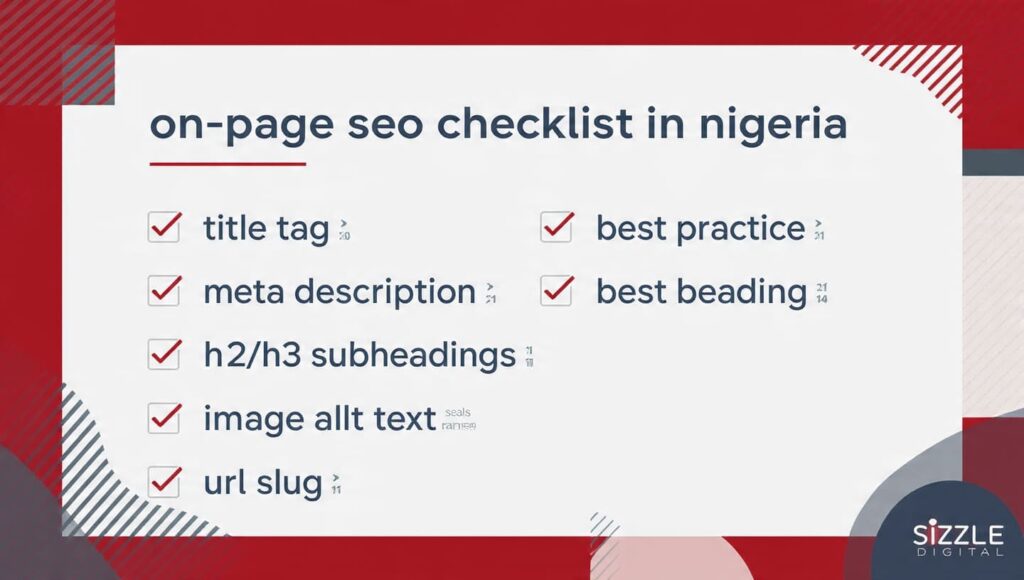
If site structure is the skeleton of your website, on-page SEO is the muscle, the nervous system, and the vocal cords all at once. It is every optimization you have direct control over: title tags, meta descriptions, headings, body content, image alt text, keyword placement, and internal links.
Get it right, and Google reads your page like a well-indexed textbook. Get it wrong, and even the most beautifully written content sits completely invisible while your competitor in Ikeja whose website looks worse than yours takes every click.
Most Nigerian websites fail this layer not because it is difficult, but because nobody told the designer it mattered.
Many freelancers build websites that are visually sharp but structurally invisible to search engines with no title tags, duplicate H1s, missing meta descriptions, images named “IMG_20231104_083241.jpg”. That is a real example, by the way. We have seen it more times than we care to count.
According to a 2023 study by Backlinko, the first organic result on Google gets an average click-through rate of 27.6%. The tenth result still on page one gets 2.4%. Everything below page one? Essentially zero. On-page SEO is the discipline that moves you from position 47 to position 4. Let us go element by element.
1. Write SEO Title Tags That Rank and Get Clicked
Your title tag is the single most visible on-page element in a Google search result; it is the blue clickable headline every searcher sees. And yet, an alarming number of Nigerian websites either leave it as the default “Home WordPress” or stuff it with keywords like a Christmas turkey. Neither works.
Every page, homepage, service page, blog post, location page needs a unique title tag that does three things simultaneously: includes the primary keyphrase, signals geographic relevance where appropriate, and stays under 60 characters so Google does not truncate it in the results. A truncated title tag is a missed impression. Think of it as a banner ad where half the text has been cut off.
The format that works consistently for Nigerian business websites: Primary Keyword + City | Brand Name.
For example: “SEO Website Design Nigeria | Sizzle Digital.” Or for a specific service: “Web Design Agency Lagos | Sizzle Digital.” Clean. Descriptive. Keyword-forward.
For blog posts, the formula shifts slightly. Numbers and emotional trigger words consistently outperform generic titles in click-through tests.
A title like “Website Design Mistakes Nigerian Businesses Must Avoid in 2026” will generate far more clicks than “Web Design Tips for Businesses.” Specificity signals credibility. Credibility earns clicks. Clicks are what Google’s algorithm interprets as user approval and user approval improves ranking.
2. Meta Descriptions That Sell the Click to Nigerian Searchers
Let us be precise about what a meta description is and is not. It is not a direct Google ranking signal Google confirmed years ago that it does not use meta descriptions to rank pages.
But it is one of the most important conversion elements on your entire website, because it determines whether someone who sees your result in search actually clicks through to your site.
Think of your search result as a tiny advertisement you did not pay for. The title tag is the headline. The meta description is the body copy.
You have 150 to 155 characters roughly two short sentences to convince a Lagos entrepreneur or an Abuja business owner to choose your link over the four other results sitting above and below yours.
The winning formula: lead with the problem, follow with the solution, end with a soft call to action. Example for a web design service page: “Most Nigerian websites look good but rank nowhere on Google. This step-by-step SEO web design strategy covers everything your site needs to get found.”
That meta description acknowledges a real pain point, promises a specific solution, and gives the reader a reason to click without being clickbait.
What kills meta descriptions for Nigerian business sites:
- Filler openers (“Welcome to our company”)
- Passive voice (“Services are offered for businesses in Lagos”)
- Vague value propositions (“We are the best digital agency in Nigeria”).
Nobody clicks generically. Write like you are speaking directly to one specific person with one specific problem.
One practical tip from the SEO trenches: write your meta description before you write the page content. This forces you to crystallise exactly what the page is about and who it is for, and that clarity flows into better content too. You train to win; you win because you train.
3. Heading Hierarchy (H1 to H4): The Outline Google Grades You On
Here is an analogy that will stick: your heading structure is to Google what a well-organised textbook is to a student. Chapters (H2s), sections (H3s), sub-points (H4s). A textbook where every chapter is titled “Chapter” and every section is titled “Section” teaches the student nothing.
A website where every heading is vague or missing teaches Google nothing and Google rewards what it understands.
The cardinal rule: one H1 per page. No exceptions. Your H1 is the page’s declaration of intent. It must contain your primary keyphrase and match the search intent of the query you want to rank for. If you want to rank for “how to build SEO website Lagos,” your H1 should say something like: “How to Build an SEO-Ready Website in Lagos: A Step-by-Step Strategy.” That exact match or near-match between the searcher’s query and your H1 is one of the strongest on-page ranking signals available.
From the H1 downward, use H2s as your main subtopics, each one targeting a secondary keyphrase or a synonym of your primary keyphrase. H3s break those subtopics into digestible chunks: steps, techniques, examples, or common mistakes. H4s are for finer granularity specific data points, sub-steps, or clarifying details.
The 2026 Google algorithm evaluates your heading hierarchy under the framework of E-E-A-T: Experience, Expertise, Authority, and Trust. A page with a clear, logical heading structure that covers a topic comprehensively signals all four. A page with a single H1 and wall-to-wall paragraphs signals none of them regardless of how good the actual writing is.
Practical tip: before writing a single paragraph, sketch your full heading structure first.
Title (H1) → three to five H2s → two to three H3s under each H2. This skeleton is your SEO blueprint. Every keyword placement, every internal link, every paragraph, it all slots into that pre-planned structure.
Nigerian businesses that treat heading architecture as an afterthought are essentially building a house and deciding where the load-bearing walls go after the roof is already on.
4. Keyword Placement in Body Content: The 3% Rule for Nigerian Pages
Keyword density is one of those SEO concepts that is simultaneously overrated and widely misunderstood in Nigeria. Here is the honest version: Google does not grade your content on a keyword percentage scale.
It uses natural language processing (NLP) to understand meaning, not just the presence of specific words. That said, keyword placement still matters, especially for communicating topical relevance clearly.
The practical target for keyword content optimisation on Nigerian sites: your primary keyphrase should appear in the first 100 words of your page (ideally the opening paragraph), in at least one H2 or H3 subheading, and naturally two to three more times throughout the body for a rough density of 1% to 2% on a 1,500-word page. Beyond that, lean on synonyms and semantically related terms.
What does semantic keyword use look like in practice? If your primary keyphrase is “SEO website design in Nigeria,” your content should naturally include related terms like “search engine optimised web build,” “Google-friendly site structure,” “on-page optimisation Naija,” and “keyword content site Nigeria.”
These semantic variations tell Google’s NLP engine that your page is genuinely and comprehensively about the topic, not just a page that repeats one keyword 47 times.
One specific mistake to flag: keyword stuffing in the opening paragraph. We regularly see Nigerian service pages that open with something like: “Our SEO website design in Nigeria offers SEO website design services for SEO website design clients in Nigeria.” That is not SEO. That is textual nonsense and Google’s spam filters recognise it immediately. Write for the human first. The algorithm will follow.
5. Image Alt Text: The SEO Win Most Nigerian Websites Leave on the Table
Every image on your Nigerian website has an invisible text field called an alt attribute, short for alternative text. Its original purpose was accessibility: screen readers use it to describe images to visually impaired users.
But from an SEO perspective, alt text is also how Google reads and indexes your images, because Google’s crawler cannot see pictures, only text.
A well-written alt text for a Nigerian business website does three things: describes what is literally in the image, includes a relevant keyword where natural, and stays under 125 characters.
For example, an image showing a web designer at work should not have the alt text “image1.jpg” (the default for most uploads) or “photo.” It should say: “Nigerian web designer reviewing SEO dashboard on laptop in Lagos office.” Descriptive. Contextual. Keyword-aware.
Why does this matter for rankings?
Two reasons. First, properly alt-tagged images make your page eligible to appear in Google Image Search, a source of organic traffic that most Nigerian businesses completely ignore.
Second, strong alt text across a page reinforces the page’s overall topical relevance to Google’s crawler, contributing (modestly but measurably) to your overall on-page SEO signal.
The quick audit: open any page on your Nigerian website, right-click any image, and select “Inspect.” Look for alt=”” in the image tag. If it is empty, that is a missed SEO opportunity. Go through every image on your top five highest-traffic pages and write descriptive, keyword-contextual alt text for each one. It takes an afternoon. The compounding SEO benefit lasts for years.
6. Internal Linking: The Hidden Ranking Multiplier Most Naija Sites Ignore
If on-page SEO were a Nigerian street market, internal linking would be the market leader who knows where every stall is and walks customers directly to what they need. It is the connective tissue of your website and when it is done strategically, it dramatically amplifies the ranking power of your most important pages.
Here is the mechanics behind it. Every page on your website has a certain amount of PageRank Google’s authority score for that page, built through the backlinks pointing to it from external websites. Internal links distribute that PageRank across your site.
A high-performing blog post that earns ten external backlinks does not just rank well itself, it also passes ranking authority to every page it links to internally. A single popular blog post, properly interlinked, can lift the ranking of three or four service pages simultaneously.
The rule: every new blog post links to at least two to three existing service or location pages. Every service page links to at least two relevant blog posts. Use descriptive, keyword-rich anchor text every time “our SEO services in Lagos” is infinitely better than “click here.” Generic anchor text tells Google nothing about the destination page.
Descriptive anchor text reinforces the keyword relevance of both the linking page and the page being linked to.
The highest-leverage internal linking strategy for Nigerian websites is the content cluster model: one comprehensive pillar page, say, professional website design in Nigeria supported by eight to ten satellite blog posts covering related subtopics. Every satellite post links back to the pillar. The pillar links out to the satellites.
Google sees a deeply interconnected web of topically related content and interprets it as genuine expertise. That interpretation shows up as higher rankings across the entire cluster.
A practical note on orphan pages with no internal links pointing to them. These are some of the most common and most damaging SEO problems we find in Nigerian website audits. Google discovers pages primarily through crawling links.
If a page has no internal links pointing to it, Google may simply never find it or may find it rarely enough that it never builds any ranking authority. Every page on your site should have at least two internal links pointing to it from other relevant pages.
For a complete walkthrough of how internal linking integrates with site architecture from day one, our guide on how to build a high-converting business website in Nigeria from scratch covers the full blueprint, from keyword mapping to content cluster strategy.
| On-Page Element | Best Practice | Key Metric / Limit |
| Title Tag | Primary keyword + city + brand. Unique per page. | 50–60 characters max |
| Meta Description | Problem → Solution → Soft CTA. Include keyphrase naturally. | 150–155 characters |
| H1 Heading | One per page only. Must match search intent + contain primary keyphrase. | Concise one clear idea |
| H2 Subheadings | One per major subtopic. Include secondary keyphrases and synonyms. | Descriptive, intent-led |
| H3 / H4 | Steps, techniques, examples. Use LSI keywords naturally. | Specific and scannable |
| Body Keywords | Primary keyphrase in first 100 words + 2–3x in body. Synonyms throughout. | 1–2% keyword density |
| Image Alt Text | Describe image + include keyword context. Never leave blank. | Under 125 characters |
| Internal Links | Minimum 2–3 per blog post to service/location pages. Descriptive anchor text always. | 3–7 links per page |
| URL Slug | Lowercase, hyphenated, keyword-rich. Set on creation — never change after indexing. | 3–6 words max |
Technical SEO Design Nigeria: Speed, Mobile, and Security: What Google Checks First
The content is good, design polished and the on-page elements are ticked off. But the site loads in nine seconds on a Nigerian 4G connection, crashes on a Tecno Spark, and runs on HTTP instead of HTTPS. Google checks all of this and penalises every single failure.
Technical SEO design in Nigeria is the unglamorous, behind-the-scenes work that makes everything else possible. Think of it as the plumbing of your website. Nobody admires plumbing at a dinner party, but the moment it fails, the whole house is a mess.
Site Speed Optimization: Built for Nigerian Data Realities
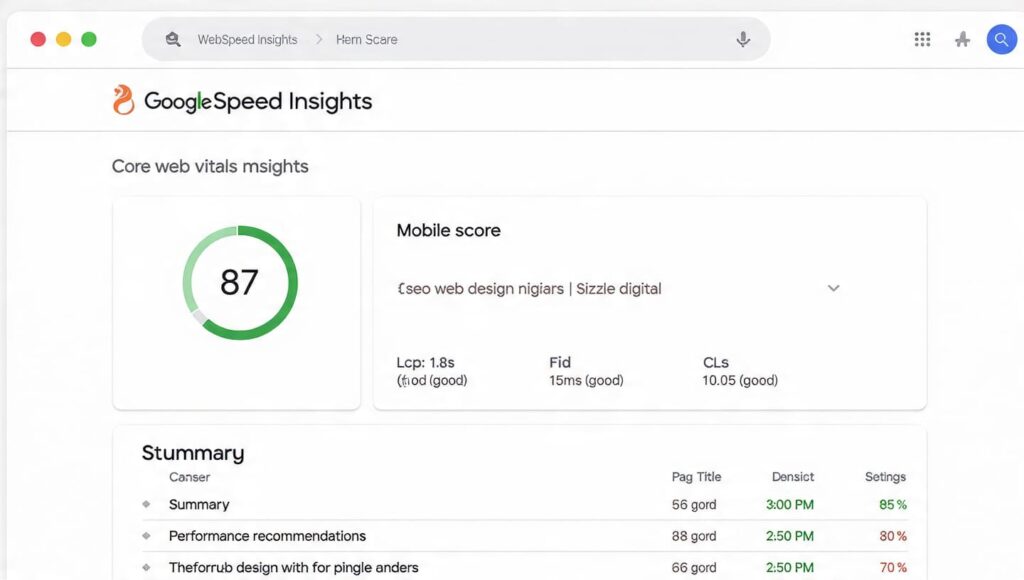
Google’s Core Web Vitals benchmark, specifically Largest Contentful Paint (LCP), targets a load time under 2.5 seconds. Meanwhile, many Nigerian websites routinely take 8 to 12 seconds to load on mobile.
That is not just a user experience problem; it is a ranking problem. Google’s algorithm directly factors page speed into search rankings, and a slow site will always lose to a fast competitor.
The fix is not complicated. Compress all images before upload, the WebP format at under 150KB per hero image is the gold standard for site speed SEO in Nigeria. Enable server-side caching so returning visitors load your site almost instantly.
And invest in a Content Delivery Network (CDN) like Cloudflare even though the free tier dramatically reduces load times for Nigerian users by serving your site from geographically closer servers.
Target a Google PageSpeed Insights score above 80 on mobile not desktop. Desktop scores are meaningless in a country where 84% of users are on their phones. If you have never run your site through Google PageSpeed Insights, do it right now. The results may be humbling but they are fixable.
Mobile SEO: 4 Out of 5 Nigerian Visitors Are on Smartphones
There is no such thing as a Nigerian website that can afford to be “desktop-first” in 2026. The numbers do not allow it. Over 80% of Nigerian internet users browse on mobile devices, predominantly Android phones running Chrome. A site that is not responsive is essentially invisible to most of your audience.
Responsive design is non-negotiable: your layout, typography, and interactive elements must adapt fluidly from a 1440px desktop monitor to a 360px phone screen. Tap targets, buttons, links, form fields, must be at least 48px tall.
Anything smaller, and Google flags it as a Core Web Vitals failure under Interaction to Next Paint (INP). And yes, Google’s mobile-first indexing means the mobile version of your site is what Google actually uses to rank you.
Test your site on both Chrome Android and iOS Safari those are the two dominant browsers among Nigerian users. Also test on a mid-range Android device, not just a high-end phone. Your customers are using Infinix and Tecno phones, not iPhone 15 Pros. Optimise for their experience, not yours.
SSL, Schema Markup, and Clean Code: The Trust Signals Google Rewards
If your website still runs on HTTP in 2026, Google marks it with a “Not Secure” label in the browser bar right where a visitor sees it the moment they land. That label kills trust instantly. Install an SSL certificate (HTTPS) the day your site goes live. Free options like Let’s Encrypt make this a ₦0 fix with no excuse for delay.
Schema markup is structured data that you add to your site’s HTML, giving Google machine-readable information about your business: your name, address, hours, services, review ratings.
The most valuable schema types for Nigerian businesses are LocalBusiness schema (boosts local search results) and FAQ schema (increases your chances of appearing in Google’s featured snippet boxes at the top of search results). Both can be implemented without writing a line of code using plugins like Yoast SEO or RankMath.
Finally, keep your code clean. Unused CSS, render-blocking JavaScript, and unvalidated HTML all slow Google’s crawlers and hurt your technical SEO design in Nigeria. Validate your HTML at validator.w3.org, and audit your JavaScript with Google’s Lighthouse tool built right into Chrome DevTools.
For a broader look at why these technical decisions matter before you even contact a developer, our guide on website design mistakes Nigerian businesses must avoid covers the most costly errors we see repeatedly in Nigerian web projects, many of them technical.
| Technical Factor | Why It Matters in Nigeria | Quick Fix |
| Page Speed | Nigerian 4G speeds vary slow sites lose users instantly | WebP images, caching, CDN |
| Mobile Responsive | 80%+ of Nigerian users browse on Android smartphones | Mobile-first WordPress theme |
| SSL (HTTPS) | Google flags HTTP as ‘Not Secure’, damages trust immediately | Install free Let’s Encrypt SSL |
| Core Web Vitals | Google’s UX score directly impacts your search ranking | Fix LCP and CLS in PageSpeed |
| Schema Markup | Unlocks rich results and featured snippets in Google | Add via Yoast SEO or RankMath |
| Clean URLs | Signals page relevance to Google crawlers | Set permalink to ‘Post Name’ |
Local SEO Website in Nigeria: How to Dominate Google Search in Lagos, Abuja, and Beyond
Let me paint a scenario. Two caterers in Abuja. Same food quality. Same prices. One has a website with a dedicated page optimised for “wedding caterers Abuja”, a fully completed Google Business Profile, and 47 five-star reviews.
The other has a generic homepage and a Google Business Profile that says “Established 2018” with no photos and zero reviews. When someone in Maitama searches for “catering services near me,” only one of these businesses appears. You already know which one.
That is local SEO web design in Nigeria in its simplest form. It is the difference between being found and being forgotten and it costs nothing to implement beyond time and intentionality.
Build Dedicated City Pages That Target Specific Nigerian Searches
The most powerful local SEO move you can make is creating a dedicated page for every city you serve. Not a page that says “We serve clients across Nigeria” an actual, unique, content-rich page optimised for that city’s search terms.
URL structure: /web-design-lagos, /seo-abuja, /digital-marketing-port-harcourt. Each page targets a hyper-local long-tail keyword “affordable web design company in Lekki” converts far better than the broad term “web design Nigeria” for a small agency trying to compete against established players.
Include local context on each page landmarks, business districts, specific neighbourhoods. Mentioning Victoria Island, Ikeja, and Lekki on your Lagos page is not fluff; it is a geo-targeted web design signal that tells Google your business genuinely serves that specific location.
This is also a strategy we break down in detail in our guide on how to choose the right web design agency in Nigeria because an agency that does not build local pages for your target cities is leaving serious search traffic on the table.
Optimize Your Google Business Profile to Power Local Rankings
Your Google Business Profile (formerly Google My Business) is the single most powerful free tool available to any Nigerian business trying to rank locally and an astonishing number of businesses either have not set one up or have left it half-finished.
A complete Google Business Profile directly boosts both your Google Maps listing and your organic search ranking. Fill in every single field: business name, category, address, phone number, website URL, hours, services, photos, and a keyword-rich description. This is your Google Business SEO site and treats it with the same care you give your main website.
Google reviews matter enormously for local rankings. Businesses with more reviews rank higher in the local map pack the three results that appear above organic listings for local searches.
Moz’s Local Search Ranking Factors study consistently identifies review quantity and quality as among the top signals for local map pack placement. Set up a system for requesting reviews from every satisfied client via WhatsApp, email, or a direct review link.
NAP Consistency: The Detail That Breaks or Builds Local Authority
NAP stands for Name, Address, Phone Number the three details that must appear identically everywhere your business exists online. Your website footer, Google Business Profile, Facebook page, Nigerian business directories all of them must show the exact same information.
This sounds trivial. It is not. Even minor inconsistencies “Sizzle Digital Ltd” on your website versus “Sizzle Digital” on Google Business Profile create conflicting signals that Google interprets as uncertainty about your business identity.
That uncertainty weakens your NAP consistent design and quietly drags down your local rankings.
Submit your business to Nigerian online directories VConnect, Gloo.ng, and BusinessList.ng. Each consistent listing is a local citation that reinforces your location authority in Google’s eyes. It is tedious work, but it compounds over time into serious Nigeria local search ranking power.
| Local SEO Action | Impact Level | Tool / Platform |
| Dedicated city-specific pages | Very High | WordPress CMS |
| Complete Google Business Profile | Very High | Google Business Profile |
| NAP consistent across all platforms | High | Website footer + all directories |
| Google Reviews campaign | High | Google Business Profile |
| Nigerian local directory submissions | Medium | VConnect, Gloo.ng, BusinessList.ng |
| LocalBusiness schema markup | Medium | Yoast SEO or RankMath plugin |
The Complete SEO Website Design Checklist for Nigerian Businesses in 2026
All five layers of optimized website design in Nigeria structure, on-page, technical, content, and local work together as an ecosystem, not a checklist you complete once and forget. A site with brilliant on-page SEO but a broken mobile experience will stall.
A technically perfect site with no keyword strategy will rank for nothing. Here is where the most common and costly mistakes happen and how Sizzle Digital approaches them differently.
1. Launching Without an SEO Audit or Keyword Plan
This is, without question, the most expensive mistake Nigerian businesses make with their websites. A ₦600,000 website launched without a keyword plan is a ₦600,000 guess and guesses rarely rank on page one.
Every Sizzle Digital web project begins with a full keyword research and competitor audit before any design work starts. We map every page to a unique keyword, define the URL structure, and plan the internal linking architecture. That groundwork takes a week. Redoing it after launch takes months.
If you already have a website that was built without this foundation, start with an SEO audit. Tools like Screaming Frog (free for up to 500 URLs) give you a complete picture of missing title tags, broken links, duplicate content, and indexing issues across your entire site. If you prefer a guided approach, our team offers a full professional website audit for Nigerian businesses before any redesign conversation begins.
2. Hosting Your Nigerian Website on Cheap Shared Servers
This is the silent killer. A cheap shared hosting plan in Nigeria we are talking ₦5,000 to ₦15,000 per year often puts your site on a server shared with hundreds of other sites. When those sites get traffic spikes, your site slows to a crawl.
Google’s threshold for ranking penalty on mobile is a Largest Contentful Paint above 2.5 seconds. Many Nigerian shared hosting environments produce load times of 8 to 12 seconds.
Managed WordPress hosting on providers like Kinsta or SiteGround costs more but it is not a luxury, it is an investment in rankings. Your hosting choice directly affects your Core Web Vitals score, which is a confirmed Google ranking factor in 2026.
A faster site is simply a better-ranking site, all else being equal. For a detailed cost breakdown of what Nigerian businesses should actually budget for quality web infrastructure, see our guide on website design costs in Nigeria.
3. Treating SEO as a One-Time Launch Task
SEO is not a switch you flip once and leave. It is a continuous system creating content, earning backlinks, monitoring performance, adapting to algorithm changes. Google updates its algorithm hundreds of times per year. What ranks today may quietly slide next month without active maintenance.
This is why Sizzle Digital offers ongoing SEO retainers alongside every website we build. Monthly audits, content publishing, competitor tracking, and performance reporting because a website is not a product you buy once. It is a 24/7 sales machine that needs regular fuel to keep running.
The businesses that dominate Google search in Lagos and Abuja in 2026 are not the ones who spent the most on their initial website. They are the ones who treated SEO as an ongoing investment consistently publishing helpful content, building local authority, and refining their technical performance month after month. Consistency wins. Always.
| SEO Layer | Key Actions | Priority |
| Site Structure | Keyword map, flat hierarchy, clean SEO URLs | Critical |
| On-Page SEO | Title tags, meta descriptions, H1–H4, internal links, alt text | Critical |
| Technical SEO | Speed, mobile, SSL, Core Web Vitals, schema markup | Critical |
| Local SEO | City pages, Google Business Profile, NAP, reviews | High |
| Content Strategy | Blog posts, keyword clusters, backlink-worthy content | High |
| Ongoing Audit | Monthly checks, content publishing, competitor tracking | Continuous |
How To Turn Your Website Into a Revenue-Driving Asset
Here is the bottom line. A website that looks good is a nice-to-have. A website that ranks on Google, loads fast on a Nigerian 4G connection, and converts local searchers into paying clients? That is a business asset.
The five pillars we have covered structural foundation, on-page optimisation, technical SEO, local search design, and ongoing auditing are not separate strategies. They are interconnected layers of the same system. Skip any one of them and the whole thing underperforms.
The Nigerian digital economy is growing at a pace that rewards businesses who invest in their online presence now. According to the Global Digital 2024 report by We Are Social, Nigeria’s internet user base grew by over 10 million in a single year. That is 10 million more people searching Google, clicking links, and making purchase decisions online every single day.
The question is not whether your business needs a properly designed, SEO-ready website. The question is how many more months you can afford to wait.
Start with your keyword map. Fix your URL structure. Compress your images. Complete your Google Business Profile. Publish one blog post per week. Then do it again next month. Build in consistency, and build it with quality. Success is built on effort, shaped by effort, and rewarded through effort and in the world of SEO, the algorithm always shows up to grade the homework.
If you want a team who has done this for Nigerian businesses from Lagos to Abuja and beyond, we are here. Our website design and SEO packages are built specifically for the Nigerian market, local insight, global standards, and measurable results from month one.
Similar Blog Post You Might Be Interested In
Custom Website Design vs Templates: What Nigerian Brands Should Choose
if you’re trying to figure out where your Nigerian business fits in the debate of custom website design vs website templates in Nigeria, this… Read more
How to Redesign Your Business Website in Nigeria for More Sales and Leads
Nigerian customers are now mobile-savvy. They judge your business within seconds, and if your site doesn’t… Read more
Affordable Website Design for Nigerian Startups (Without Sacrificing Quality)
When someone promises you a cheap professional site for your new business in Nigeria, your scam alert should… Read more
FAQs
SEO website design in Nigeria refers to the practice of building and structuring a website in a way that is optimised for search engines like Google from the very beginning before a single page goes live. Unlike standard web design, which focuses primarily on aesthetics, SEO web design combines visual quality with technical and content strategies that help a site rank on the first page of search results. In Nigeria, where over 109 million people use the internet and the vast majority search on Google, an invisible website is essentially a business that does not exist online. SEO-friendly design ensures that when your target customer in Lagos, Abuja, or Port Harcourt searches for what you offer, your website appears and that appearance translates directly into enquiries, leads, and revenue.
The cost of SEO-integrated website design in Nigeria varies significantly depending on the complexity of the project, the agency you choose, and the scope of work involved. Basic small business websites with fundamental on-page SEO optimisation typically range from ₦150,000 to ₦400,000. Mid-tier websites with technical SEO, local pages, schema markup, and conversion optimisation generally fall in the ₦400,000 to ₦1,200,000 range. Enterprise or e-commerce builds with full SEO infrastructure, custom development, and ongoing support can exceed ₦2,000,000. It is important to remember that the upfront cost of a properly built SEO website is far less than the ongoing cost of paid advertising required to compensate for a site that cannot rank organically.
The timeline for ranking a Nigerian website on Google depends on several factors: the competitiveness of your target keywords, the authority of your domain (how long it has existed and how many quality backlinks it has), the quality of your content, and how consistently you publish and optimise. For low-competition, hyper-local keywords like ‘accountant in Abeokuta’ or ‘cake shop in Asaba,’ some Nigerian sites begin seeing first-page results within four to eight weeks of launch. For competitive national terms like ‘web design Nigeria,’ expect a six-to-twelve-month sustained effort. The key insight is that SEO is compounding results grow over time as your site accumulates authority, content, and backlinks.
Among all on-page SEO elements, the title tag is consistently identified by SEO practitioners as the single most influential on-page ranking signal. Your title tag is the clickable headline that appears in Google search results; it directly tells both Google and the user what your page is about. For Nigerian websites, an effective title tag leads with the primary keyphrase, includes a geographic modifier where relevant (e.g., Lagos, Nigeria), and stays under 60 characters to avoid truncation in search results. However, title tags alone cannot sustain rankings without complementary elements meta descriptions, heading hierarchy, internal linking, and quality content all work together to signal relevance and expertise to Google’s algorithm.
Google confirmed that page speed is a ranking factor for both desktop and mobile search through its Core Web Vitals update, which became a ranking signal in 2021 and has been progressively weighted more heavily since. For Nigerian websites specifically, speed is even more critical because the majority of visitors arrive on mobile devices using data connections that vary significantly in speed across different parts of the country. A Nigerian business website that loads in eight seconds on mobile is competing at a severe disadvantage against one that loads in under two seconds. The practical impact: slow sites rank lower, have higher bounce rates, and convert fewer visitors creating a compounding disadvantage that only worsens over time.
Local SEO is the practice of optimising your online presence website, Google Business Profile, and directory listings so that your business appears in geographically targeted search results. For Nigerian businesses, local SEO is often more valuable than general national SEO because it targets buyers with immediate, high-intent searches. When someone in Ikeja searches ‘graphic designer near me’ or ‘printing services Ikeja,’ Google prioritises businesses whose online presence signals strong local relevance. Local SEO for Nigerian businesses involves creating city-specific web pages, completing and optimising a Google Business Profile, maintaining consistent NAP (Name, Address, Phone Number) across all platforms, and building local citations through Nigerian business directories. Together, these actions place your business directly in front of high-intent local buyers.
A keyword map is a strategic document that assigns one primary search keyphrase to each page of your website, ensuring that no two pages compete for the same search term a problem called keyword cannibalization. To create a keyword map for a Nigerian website, start by listing every page on your site (homepage, service pages, location pages, blog posts). Then use tools like Google Keyword Planner, Ubersuggest, or Semrush to research what search terms your potential customers in Nigeria use for each of those topics. Assign the most relevant and achievable keyword to each page, and note secondary keywords and synonyms that can naturally appear in the page content. This document becomes the blueprint your entire content and optimisation strategy is built on.
Schema markup (also called structured data) is a type of code you add to your website’s HTML that helps search engines understand the meaning and context of your content in a machine-readable format. For Nigerian business websites, the most valuable types of schema markup are LocalBusiness schema (which tells Google your business name, address, phone number, hours, and service area), FAQ schema (which can cause your questions and answers to appear directly in Google search results as an expanded snippet), and Product/Service schema (for e-commerce or service-based businesses that want pricing and rating information to appear in search results). Schema markup does not guarantee rich results, but it significantly increases your chances and it is one of the easier technical SEO wins to implement using plugins like Yoast SEO or RankMath on WordPress.
WordPress is widely regarded as the most SEO-friendly website platform available, and for good reason. It is the content management system of choice for approximately 43% of all websites globally, and its flexibility, plugin ecosystem, and developer community make it the practical default for businesses that take organic search seriously. Plugins like Yoast SEO and RankMath bring sophisticated on-page optimization tools directly into the content editing interface, making it easy for non-technical users to set title tags, meta descriptions, XML sitemaps, and schema markup. For Nigerian businesses specifically, WordPress is recommended because it works well with affordable managed hosting, supports all the technical SEO requirements Google looks for, and allows full control over content without requiring developer assistance for day-to-day updates.
Core Web Vitals are a set of specific metrics that Google uses to measure the real-world user experience of a web page, and they are a confirmed ranking factor since 2021. The three main Core Web Vitals are: Largest Contentful Paint (LCP) how long it takes for the largest visible element on the page to load (target: under 2.5 seconds); Interaction to Next Paint (INP) how quickly the page responds to user interactions like button clicks (target: under 200 milliseconds); and Cumulative Layout Shift (CLS) how much the page layout jumps around as it loads (target: under 0.1). For Nigerian websites, LCP is typically the most problematic metric because of large uncompressed images and shared hosting limitations. You can check your site’s Core Web Vitals scores using Google PageSpeed Insights, which provides both scores and specific recommendations for improvement.
There is no fixed number of internal links prescribed by Google, but the general best practice for most Nigerian business websites is to include between three and seven internal links per blog post, and two to four on service or location pages. The key is that every internal link must serve the reader’s navigation needs and use descriptive, keyword-rich anchor text not generic phrases like ‘click here’ or ‘read more.’ The most strategic internal linking practice for Nigerian websites is the content cluster model: one comprehensive pillar page on a broad topic like ‘digital marketing Nigeria’ surrounded by multiple blog posts on related subtopics, all linking back to the pillar. This cluster structure concentrates ranking authority on your most important pages and signals topical expertise to Google.
On-page SEO refers to all the optimization elements that exist within the visible content and metadata of individual web pages title tags, meta descriptions, headings (H1 to H4), body content, image alt text, internal links, and URL slugs. These are the elements you control through your content management system and are visible (or meta-visible) to both users and search engines. Technical SEO, by contrast, refers to the infrastructure-level optimisations that affect how search engines crawl, index, and render your website page speed, mobile responsiveness, SSL certification, XML sitemaps, robots.txt configuration, schema markup, canonical tags, and Core Web Vitals performance. Both layers are essential: on-page SEO tells Google what your page is about and for whom, while technical SEO ensures Google can actually access, read, and trust your site in the first place.
Always use a custom domain for a Nigerian business website, and ideally a .com or .com.ng domain. A custom domain (e.g., sizzledigital.ng) signals professionalism and business legitimacy, both to visitors and to Google. Free subdomain URLs like businessname.wixsite.com or businessname.wordpress.com carry none of the domain authority built by your own branded domain over time. From an SEO perspective, a custom domain allows you to build domain authority that accumulates over months and years backlinks, brand mentions, and consistent traffic all reinforce the reputation of that specific domain in Google’s eyes. Register your domain through a reputable registrar (Google Domains, Namecheap, or NIRA for .ng domains) and ensure you renew it annually to avoid expiry, which can cause significant ranking drops.
Google reviews are one of the most powerful local SEO ranking signals available to Nigerian businesses, according to Moz’s Local Search Ranking Factors report, which consistently places review quantity, recency, and quality among the top factors influencing local map pack rankings. For Nigerian businesses competing for city-specific search terms, a Google Business Profile with 50 genuine 5-star reviews will outrank an identical profile with five reviews almost every time, all else being equal. Beyond rankings, reviews build immediate trust with prospective clients who find your business through Google Search. 88% of consumers say they trust online reviews as much as personal recommendations, according to BrightLocal’s Local Consumer Review Survey. A simple WhatsApp message requesting a Google review from every satisfied client, sent within 24 hours of a positive project completion, is one of the highest-ROI marketing actions available to a Nigerian SME.
NAP stands for Name, Address, and Phone Number, the three core identifying details of your business that must appear consistently across every online platform where your business is listed. This includes your website footer, Google Business Profile, Facebook page, Instagram bio, LinkedIn company page, and any Nigerian business directories like VConnect or Gloo.ng. For local SEO purposes, Google cross-references your business information across multiple sources to verify legitimacy and accuracy. Inconsistencies, even small ones like ‘Lagos, Nigeria’ on your website but ‘Lagos’ on Google Business Profile, or a different phone number format create conflicting signals that weaken your local ranking authority. Audit every listing where your business appears at least once every six months and correct any discrepancies immediately.
Absolutely and this is actually one of the most exciting aspects of SEO for Nigerian startups and small businesses. While large brands dominate broad, highly competitive search terms like ‘bank in Nigeria’ or ‘insurance Nigeria,’ small businesses can consistently outrank them for specific, long-tail, and local search queries. A Lagos-based bakery cannot rank for ‘bakery Nigeria,’ but it absolutely can rank for ‘custom birthday cakes Victoria Island Lagos’ a search term with clear buyer intent and far less competition. This is the strategic advantage available to every Nigerian startup willing to invest in quality content and local SEO. Domain authority grows over time, meaning a startup that starts building SEO assets today will be significantly harder to displace in twelve to eighteen months than a competitor who starts next year.
Several clear signals indicate that a Nigerian website has SEO issues that need addressing. The most obvious: your website does not appear in Google search results for your business name, service type, or location even on pages two through five. Other indicators include zero or near-zero organic traffic (verifiable through Google Search Console, which is free), a Google PageSpeed Insights mobile score below 50, no title tags or duplicate title tags across pages (viewable by right-clicking any page and selecting ‘View Page Source’), missing meta descriptions, no XML sitemap submitted to Google Search Console, pages that are indexed but receive no impressions in Search Console, and a Google Business Profile that is unclaimed or incomplete. Any combination of these issues requires a structured SEO audit before further investment in content or advertising.
Google Search Console is, without question, the most valuable free SEO tool available to any Nigerian website owner, and it is often dramatically underused. It shows you exactly which search queries are bringing visitors to your site, which pages are indexed, which have errors, how your site performs on Core Web Vitals, and which keywords you rank for (and at what average position). Other excellent free tools include: Google Analytics 4 for traffic and user behaviour data; Google PageSpeed Insights for performance diagnostics; Ubersuggest (limited free version) for keyword research; Screaming Frog SEO Spider (free for up to 500 URLs) for technical site audits; and Google’s Rich Results Test for validating schema markup. For Nigerian businesses starting their SEO journey, mastering Google Search Console alone provides more actionable insight than most paid tools.
SEO in 2026 is arguably more valuable than at any previous point not less. The rise of AI-generated search answers (Google AI Overviews, Perplexity, ChatGPT search) has not replaced organic search; it has made quality, authoritative, well-structured content even more important, because AI tools pull answers from trusted web sources. In Nigeria specifically, where paid advertising costs on Google and Meta continue to rise, organic search traffic represents a fundamentally better long-term ROI. A piece of content that ranks on page one for a relevant keyword continues to deliver free traffic for months or years after the initial investment. Paid ads stop the moment you stop paying. For Nigerian businesses that want sustainable, compounding growth rather than an on-off traffic tap tied to advertising budgets, SEO remains the most efficient long-term digital marketing investment available.
Sizzle Digital’s approach to SEO website design starts with strategy, not design. Every project begins with a keyword research and competitive audit phase that maps the client’s target keywords, identifies competitor gaps, and defines the URL architecture before any visual design begins. From there, on-page optimization is built directly into the development process; title tags, meta descriptions, heading structures, and internal linking frameworks are implemented in the CMS before the site goes live. Technical SEO is handled through performance-optimised hosting, Core Web Vitals compliance, SSL setup, XML sitemap submission, and schema markup implementation. Local SEO assets, city pages, Google Business Profile optimization, and NAP consistency are addressed as part of the launch checklist. Post-launch, Sizzle Digital offers ongoing monthly SEO retainers to ensure rankings grow and adapt alongside Google’s algorithm updates, content strategy, and the client’s evolving business goals.